
Make Texture a preferred source on Google to support us
Add Texture to GoogleThe Boreal Aesthetic Put to the Test in the Field
In the contemporary watchmaking landscape, Norway is gradually establishing a distinctive signature, characterized by stark simplicity and an almost mystical connection to its environment. Until now, Straum had distinguished itself through its ability to capture the poetry of Scandinavian landscapes in dials with organic textures. With the Jan Mayen and Frozen Metal collections, the approach was one of aesthetic contemplation: wearing on the wrist the reflection of a glacier or the shifting hues of the Norwegian Sea. Today, the brand is taking a major strategic step forward. With the launch of the Straum Expedition, it is no longer content merely to draw inspiration from the wilderness; it is designing a timepiece capable of surviving in it.
This shift is embodied in a new internal motto: “Inspired by, built for, Norwegian nature.” While the first part of this promise has already been extensively explored by the brand, it is the second part that defines this new model. The Straum Expedition is the first true tool watch in the collection—a timepiece in which every line and every material choice meets the demands of ruggedness and practicality in hostile environments.
The Physics of Cold: The Choice of Grade 5 Titanium
The transition from a fashion watch to an exploration instrument begins with a fundamental consideration of the material. For the Expedition, Straum has abandoned steel in favor of grade 5 titanium. This choice is not driven solely by a quest for lightness, although wearing comfort is a compelling factor for a watch designed for adventure. The real reason lies in the metal’s thermal properties. In Norway, the cold is not an abstraction—it is a constant technical constraint.
Titanium has lower thermal conductivity and a lower coefficient of thermal expansion than steel. In practical terms, this means the watch reacts much less violently to extreme temperature fluctuations. For the explorer who puts on his watch early in the morning in a bivouac tent or after a dive, contact with the metal is less jarring, less “chilling.” The metal conducts heat more slowly, acting as a passive regulator between the skin and the outside air. It is this attention to physiological details that distinguishes a watch designed for the field from a mere urban fashion accessory.
A Design Built for Protection
The design of the Expedition’s case, though derived from the familiar silhouette of the Jan Mayen, has undergone a profound structural transformation. The diameter has been slightly reduced, from 38.7 mm to 38.2 mm. While this half-millimeter may seem insignificant on paper, it is accompanied by a complete redesign of the bezel. The bezel now features a stepped profile—a design choice that is by no means accidental.
This stepped architecture reduces the flat surface area exposed to scratches on the uppermost part of the watch. In the event of a side impact against a rock face or technical equipment, the angle of the bezel is designed to deflect the impact rather than absorb it head-on, thereby providing more effective protection for the sapphire crystal. The crown has also been redesigned. Larger and protected by sturdy shoulders, it allows for easy handling, even when hands are numb from the cold or covered with thick gloves. The case, with a controlled thickness of 11 mm, is water-resistant to 100 meters, confirming its status as an all-terrain watch.
Readability as the Top Priority
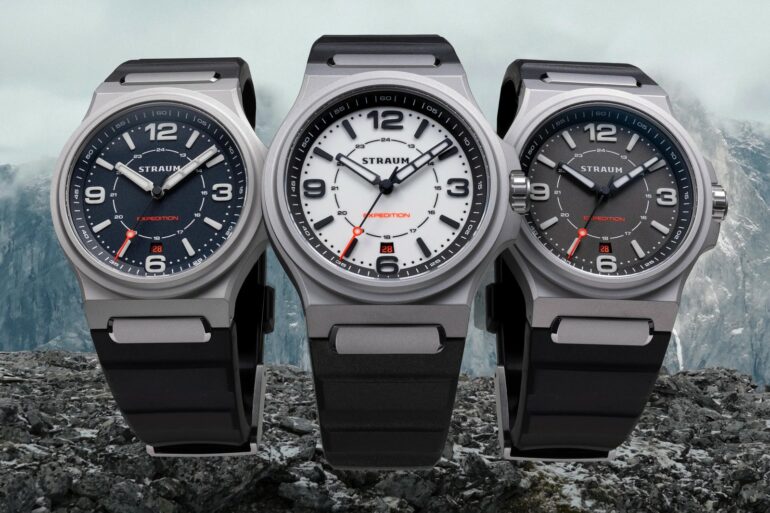
On the dial, Straum has abandoned artistic textural effects in favor of near-military clarity. The display is structured around an immediately apparent visual hierarchy. The outer flange features a 60-minute scale, while the center of the dial is highlighted by a 24-hour sub-scale. The generously sized hour markers are punctuated by Arabic numerals at the cardinal points (12, 3, 6, 9) for instant visual orientation.
One color detail immediately stands out: the use of “Fluor Orange.” This high-visibility shade adorns not only the tip of the “lollipop” seconds hand but also the numerals in the date window at 6 o’clock. This choice is not merely aesthetic; it is functional. In low-light conditions or heavy fog—common in the Far North—fluorescent orange is the color that remains visible to the human eye the longest.
The brand is offering three variations for this launch. The “White Lume” version is undoubtedly the most radical: it flips the usual conventions on their head with a fully luminescent dial against which black hour markers stand out. The standard models also include a brushed gray titanium version, while a limited edition of 200 pieces, dubbed the “Launch Edition,” features a deep midnight blue dial with nickel-plated hour markers and Super-LumiNova.

Mechanics Designed for Durability
Beneath the solid case back—a logical choice for a sports watch that prioritizes durability over showmanship—beats the G100 caliber from the Swiss manufacture La Joux-Perret. This automatic movement represents a significant step up from the usual standards of micro-brands. The date-equipped version of the G101 offers a generous power reserve of 68 hours. This power reserve is crucial: it allows the watch to be set aside for nearly three days without needing to be reset, a welcome reliability feature during rest periods on expeditions.
The case back itself tells a story. Where other brands settle for technical engravings, Straum has chosen to immortalize an evocative scene: a lone hiker gazing at a Norwegian landscape under a starry night sky. The brand’s “S” logo replaces the moon, a subtle reminder of the unbreakable bond between the watch and its homeland.
A New Value Proposition
In terms of pricing, the Straum Expedition is positioned with a certain confidence. Priced at £1,840 on an FKM rubber strap and £2,070 on a Grade 5 titanium bracelet (excluding taxes), it carries a premium of approximately £200 compared to the Jan Mayen. This price increase is justified by the increased complexity of the machining—notably the stepped bezel and the engraved case back—as well as by the extensive use of high-quality luminescent materials.
What’s appealing about this new iteration is the maturity of its approach. Straum didn’t simply “toughen up” an existing model. The brand has reimagined its own design language to prove that it’s possible to move from contemplation to action without compromising its identity. The Expedition is not just a rugged watch; it’s proof that a boreal aesthetic can be a technical asset when confronted with the realities of the field.
Ultimately, this watch is designed for those seeking a timepiece whose form is dictated by geography. It confirms that Straum has left the realm of promising startups behind to establish itself permanently as a serious player in the independent watchmaking scene, capable of producing timepieces designed for the great outdoors while being perfectly suited to the daily lives of those who dream of them.