
Make Texture a preferred source on Google to support us
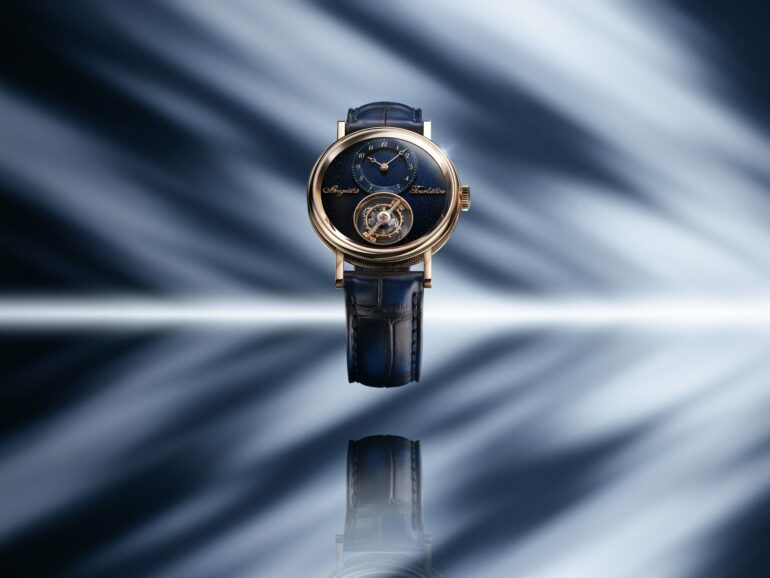
Add Texture to GoogleCapturing a fraction of a second in eternity. The endeavor borders on obsession, but it sums up quite well the ambition that drives the most exclusive circles of watchmaking today. Rather than resorting to the conventional practice of a historical reissue to mark the 225th anniversary of the tourbillon patent, the Breguet Manufacture has chosen to capture a fragment of space-time. Its new point of reference? The night sky as it appeared over Paris on June 26, 1801, at precisely midnight. This date, a founding milestone for the house, marks the day Abraham-Louis Breguet officially patented his invention. A miniature celestial vault, frozen in material, thus serves as the face of a reinterpretation of the Marine Tourbillon Équation Marchante 5887, hailed by the workshops as the most complex wristwatch in their current production.
Beyond the sheer array of mechanical features, this piece embodies a profound shift in the way the luxury industry approaches its own heritage. Archival accuracy and technical prowess are no longer enough to justify the existence of an object whose price defies the logic of the traditional market. It is now necessary to infuse it with a tangible emotional charge, transforming the machine into an intimate artifact.
Mapping a Memory in Enamel
The aesthetic of this dial moves away from the usual codes of marine chronometry and veers into the realm of miniature painting. The design features a sapphire center layered over a grand feu enamel background, whose gradient blue serves as a backdrop for a constellation applied by hand, point by point, using a luminescent material. The eye is first drawn to this 1801 panorama of Paris, but the manufacturer’s intention goes further by opening the door to an extreme level of customization.
Limited to a private run of 25 pieces, this edition offers its future owners the opportunity to redesign this sky. The astral map can be modified to reflect the configuration of the stars above a location and on a date chosen by the client. This approach radically transforms the object’s status. From an institutional tribute celebrating a milestone in micromechanics, the watch becomes a private reliquary, the guardian of an individual memory encoded in degrees of longitude and latitude.
The Visual Reward of Mechanical Virtuosity
Beneath this sapphire and enamel dome beats the 581DPE caliber, a self-winding movement whose technical specifications are dizzying. No fewer than 563 components interact within a confined space to power a trinity of major complications: a perpetual calendar, a one-minute tourbillon positioned at 5 o’clock, and a running equation of time. This last complication, particularly poetic, embodies the constant discrepancy between civil time—regular and standardized—and true solar time, dictated by the Earth’s elliptical orbit. A special hand, tipped with a faceted sun, overlaps the traditional hands to display these two temporal dimensions simultaneously.
The movement beats at a frequency of 4 Hz and guarantees a power reserve of 80 hours. But this accumulation of functions inevitably raises the question of readability. Faced with the profusion of displayed data, the eye hesitates, searching for its way. The manufacturer chose to move the perpetual calendar indicators to the sides of the dial to clear the center, but the reality remains: deciphering this Marine 5887 requires mental gymnastics and visual familiarization. This is the price often demanded by grand complications, where readability is sacrificed on the altar of technical prowess.

A platinum architecture anchored on the banks of the Seine
The casing for this state-of-the-art movement is a platinum case whose dimensions—43.9 mm in diameter and 11.8 mm thick—give it an undeniable physical presence on the wrist. This bold design serves as a reminder that marine watchmaking, before becoming an aesthetic expression of contemporary luxury, was first and foremost a science of survival. The marine chronometers of yesteryear were heavy, massive instruments, designed to withstand the rolling motion of the sea and ensure precise navigation.
Here, the roughness of the ocean gives way to sophisticated craftsmanship, visible through the sapphire crystal case back. The movement reveals meticulously hand-engraved bridges, flanked by a peripheral rotor—also crafted from platinum—which offers a clear view of the ballet of the gear train. For the strap, the choice is between a heavy platinum bracelet fully integrated into the case or a rubber version. This latter material, with its deceptively casual appearance, features a textured pattern inspired by the cobblestones of the Quai de l’Horloge—the historic location where Abraham-Louis Breguet established his workshops in Paris.
Through this interplay of contrasts between the coolness of platinum, the warmth of enamel, and the precision of a 563-component movement, this anniversary edition refuses to choose between a precision instrument and a piece of fine jewelry. Rather, it stands as a mechanical spectacle in which the measurement of time takes a back seat, supplanted by the desire to wear a fragment of history—whether celestial or personal—directly against the skin.