
Make Texture a preferred source on Google to support us
Add Texture to GoogleThe landscape has changed dramatically in the Asian precious metals market. During the first quarter, a staggering divide emerged in Chinese purchasing habits: demand for gold jewelry plummeted by 32%, even as demand for bullion and coins skyrocketed, climbing 67% to surpass the historic milestone of 207 metric tons. This statistical shift illustrates a harsh reality for the industry. The affluent customer now distinguishes between the cold, utilitarian safe-haven asset and the status symbol. Selling metal by weight is no longer enough to ensure the long-term survival of a major jewelry house. Faced with this shift, the Hong Kong giant Chow Tai Fook has taken a decisive step. The brand is embarking on a profound restructuring of its business model, moving away from pure volume to embrace the refined codes of international high jewelry.
Emancipation Through Design and Fixed Pricing
For decades, the sector has suffered from a chronic dependence on fluctuations in the price of gold on the commodities market. The solution devised by Chow Tai Fook’s management lies in decoupling the cost of raw materials from the retail price. The company is gradually implementing a fixed-price policy—a classic mechanism of the Western luxury sector that values creativity, labor, and the finesse of the finishes far beyond mere carat weight. In mainland China, this sales model now accounts for 35.4% of the group’s revenue, a significant increase from the 30.6% recorded in the previous fiscal year.
The financial results for the fiscal year ended in March 2026 validate this risk-taking. Total revenue rose by 5.3% to HK$94.4 billion. Most importantly, profitability soared: net income attributable to shareholders jumped 52.2%, reaching an all-time high of 9 billion Hong Kong dollars. This cash flow gives the brand considerable leeway to finance its move upmarket.
The Narrative Power of the Collections
The success of this repositioning rests on a remarkably effective product lineup, where each line tells a specific story. The Huá collection, a true pillar of the brand, generated HK$43 billion in retail sales on its own during fiscal year 2026. Other lines—including Rouge, Joie, and Palace Museum—have collectively generated nearly 10 billion dollars by skillfully tapping into the imagination surrounding Chinese heritage.
The public’s responsiveness to new aesthetic offerings is challenging traditional market expectations. Launched in April 2026, the Dawn line surpassed 500 million Hong Kong dollars in sales in just one month. Notably, this line attracted more than 20% new customers—a figure that confirms the jeweler’s intuition. Younger generations of buyers are moving away from the mere accumulation of material possessions. They demand that a piece of jewelry carry symbolic meaning, reflect a cultural identity, or be part of a community of connoisseurs.
Local Roots to Conquer the Global Market
Expansion beyond China’s borders is Chow Tai Fook’s other major growth driver; the company aims to double the value of its international operations by 2030 and surpass the 100-store mark overseas. Sales outside the domestic market surged by 52.6% during the last fiscal year. Under the leadership of Gabriela Ferreira, Managing Director of International Development, the expansion strategy targets specific regions. The goal is to establish a presence where the resurgence of tourism coincides with the emergence of a middle class that has a strong attachment to Asian culture.
After methodically expanding its presence across Southeast Asia, the brand opened locations in Sydney and Vancouver. But instead of imposing a standardized concept across the globe, the company has opted for hyper-personalization of its offerings. In Thailand, the store windows showcase designs centered on the golden elephant and the four-faced Buddha. In Australia, the pieces take the form of charms featuring koalas and kangaroos. In Canada, the maple leaf takes center stage. This local theme helps attract local customers while reassuring tourists and buyers from the Chinese diaspora—a three-pronged approach that proves particularly effective in shopping complexes like Bangkok’s Siam Paragon.
The Ultimate Showpiece on Canton Road
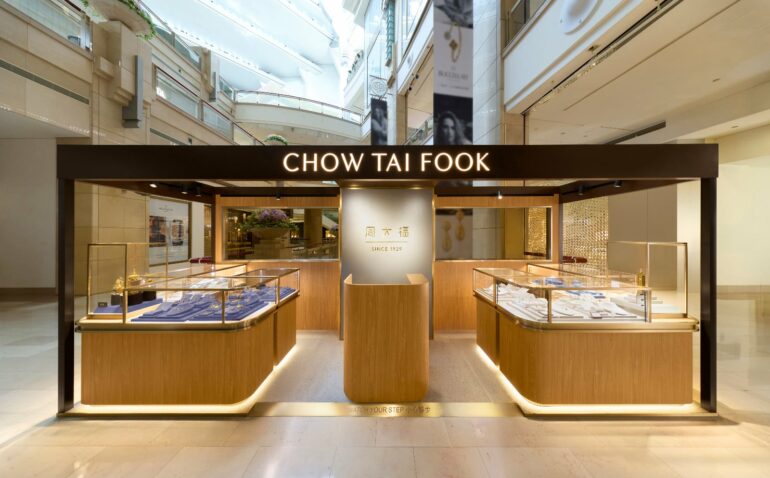
The spatial expression of this transformation comes to life in the heart of Hong Kong. Opened in February 2026, the Canton Road flagship store serves as a laboratory for the Chow Tai Fook of tomorrow. The layout breaks with the conventions of traditional jewelry stores to embrace the architecture of a luxury department store. The space is divided into several intimate areas: a zone dedicated to the house’s heritage, a private fitting room for VIPs, a section reserved for the world of weddings, and a fine jewelry department. The brand has even partnered with the French porcelain manufacturer Bernardaud to offer a selection of home goods, thereby blurring the lines between jewelry and lifestyle.

The viability of this immersive model is evident in the foot traffic and conversion figures. This flagship store generates monthly sales of nearly 60 million Hong Kong dollars. The group’s real estate strategy now focuses on streamlining and concentrating resources. Over the last fiscal year, management closed 969 retail locations deemed obsolete or underperforming to focus on opening 104 high-value-added boutiques. The results speak for themselves: on the mainland, the new luxury stores are posting productivity levels eight to ten times higher than the brand’s historical average. Stores that have undergone recent renovations, meanwhile, are seeing their profitability increase by approximately 15%.
Embracing Pop Culture Trends
To complete its rejuvenation, the jeweler is rolling out a particularly bold partnership strategy, a far cry from the conservatism often prevalent in the industry. By linking its image to contemporary cultural phenomena, the brand has succeeded in creating a buzz. The launch of a collection based on the hit video game *Black Myth: Wukong* generated explosive growth of over 130% during its second restock. Other forays into popular culture—through collaborations with the Chiikawa universe and Disney licenses—have led to lines forming outside store doors.
These one-off campaigns serve a major strategic purpose: data collection and customer loyalty. Between 35% and 55% of shoppers drawn to these exclusive launches immediately signed up for the brand’s loyalty program. This is an exceptional retention rate in an industry where impulse purchases rarely translate into long-term relationships. To embody this new era, the group has also revamped its roster of global brand ambassadors, entrusting the representation of its collections to actor Yang Yang and actress Zhao Lusi—two figures capable of engaging massive audiences on social media.
On the eve of its centennial, which will be celebrated in 2029, Chow Tai Fook demonstrates that a house founded in China now possesses the resources, discernment, and clout necessary to set its own rules. By refusing to let its value be dictated solely by the price of a raw material, the brand is charting a course for an autonomous, complex, and remarkably contemporary Asian luxury.