
Make Texture a preferred source on Google to support us
Add Texture to GoogleIn Praise of Intuition: When Pop Vertigo Collides with Museum Archives
Walls painted a deep blue frame a visual juxtaposition of disconcerting freedom. Along a section of the picture rail, the energetic lines and coded language of the American artist Cy Twombly catch the eye. Just a few centimeters away, original celluloid figures of Pikachu and the familiar silhouette of Doraemon respond to this abstraction. The space also features raw mineral elements and a model of a traditional dwelling. The assemblage borders on the absurd, yet a sense of balance prevails. We are not in the secret collection of a wealthy teenager, but at the heart of the San Francisco Museum of Modern Art. This specific room, named with unabashed candor *I Don’t Know, But I Like It*, encapsulates the philosophy of a curatorial experiment that challenges the norms of the California institution.
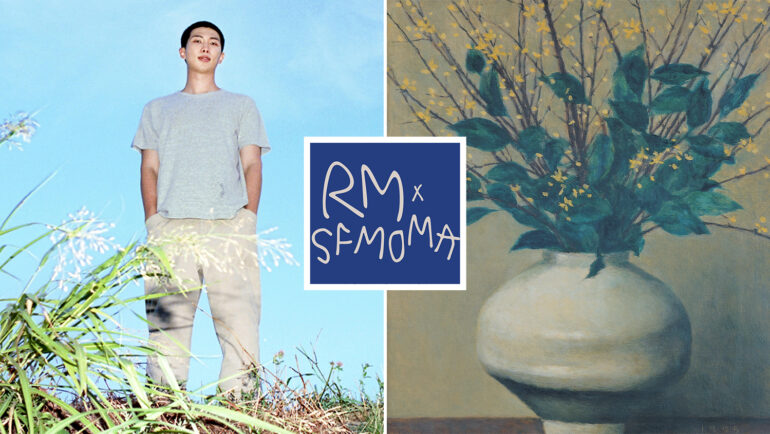
The vision behind this artfully orchestrated chaos belongs to Kim Namjoon, a central figure in the South Korean phenomenon BTS, known by the pseudonym RM. From October 3, 2026, through February 7, 2027, SFMOMA is presenting “RM x SFMOMA: Between You and Me.” The project marks a first for the institution: entrusting the keys to its galleries to an artist-collector of this media stature. Drawing on a vast collection ranging from 150 to 200 pieces, the exhibition fosters a dialogue between the musician’s personal acquisitions and the museum’s historical holdings.
Dismantling the Hierarchies of Art History
The immediate challenge of such a project was to neutralize the overwhelming impact of celebrity so that the artistic material could breathe. The curatorial teams avoided the pitfalls of a didactic retrospective or a eulogy. The exhibition design turns its back on chronological progression—a format that would inevitably have frozen the Korean selection into a rigid academic perspective. The chosen approach emphasizes the clash of correspondences, the friction between materials, and the collision of eras.
It is precisely in these frictions that the essence of the collector’s taste is revealed. The accumulation of masterpieces is not used here as a tool for social validation. On the contrary, the exhibition weaves a dense network where Mark Rothko’s vibrant blocks of color, Henri Matisse’s cutouts, and Georgia O’Keeffe’s organic sensuality intersect with the trajectories of major figures from the Korean Peninsula. Visitors discover the meditative depth of Yun Hyong-keun, the rigor of To Sangbong, the experiments of Nam June Paik, and the unique poetry of Chang Ucchin. The museum’s curatorial approach goes far beyond pure aesthetics to achieve an unprecedented documentary depth: many works by these Korean masters had never crossed the Pacific to be shown to American audiences.
The Trajectory of a Moving Eye
RM’s standing in contemporary art circles was not built on opportunism. His visual education was forged through the physical experience of the artworks. Everything changed in 2018 during an extended visit to the Art Institute of Chicago—a formative experience that sparked in him a veritable voracity for contemplation. This personal revelation quickly evolved into a methodical institutional commitment.

Over the years, the musician has refined his approach to philanthropy. In 2020, a major endowment supported the founding of the National Museum of Modern and Contemporary Art in Korea. Two years later, visitors to LACMA in Los Angeles discovered the works through an audio tour narrated by his voice. This patient dedication has just culminated in his recent appointment as the first global communications ambassador for the National Museum of Korea. These successive milestones shed light on the theme of the California exhibition. By admitting that he constantly feels torn “between” multiple geographies and states of mind, RM provides the key to understanding this project: a mental map rather than a mere display of possessions.
Breaking Through to the Public
The shockwave of this curatorial concept is also felt in the museum’s aisles. The massive influx of fan communities temporarily alters the institution’s social dynamics. Far from being intimidated by this, SFMOMA takes a highly strategic gamble: using this fervor as a Trojan horse. The exhibition design offers no easy access to the uninitiated public, but instead leverages the absolute trust the audience places in the musician to confront them with demanding visual languages.
Those who walk through the institution’s doors hoping to get a glimpse of a pop idol’s aura thus find themselves captivated by the austerity of a 1970s Korean abstract painting or unsettled by textile art. Here, celebrity acts merely as a conduit, quickly fading into the background to make way for the silence required by observation.
In an era consumed by the frenzied consumption of ephemeral images, the exhibition offers a counter-current proposal. It champions the idea that aesthetic appeal does not always need to be rationalized or justified by heavy theoretical discourse. By asserting the right to love without explanation, to bring together Japanese mass culture with the pinnacles of American abstract expressionism, this exhibition does more than simply connect San Francisco to Seoul. It revives the wandering gaze and celebrates the persistence of silent forms.