
Make Texture a preferred source on Google to support us
Add Texture to GoogleOn the streets of Singapore, the silence that follows the closure of an establishment is no longer an anomaly, but a sobering statistic. Between January and April of this year, 1,267 food and beverage businesses closed their doors for good, leaving behind empty spaces and a culinary scene gripped by uncertainty. One might think that the buzz that once characterized the city-state has evaporated, a victim of market saturation or relentless economic conditions. Yet, amid this turbulent landscape, one figure remains unflappable, almost serene: Indra Kantono. This hospitality strategist, co-founder of the influential Jigger & Pony Group, is not content merely to hold his ground. In the space of six months, he has launched two major new concepts, proving that while the traditional model is running out of steam, the thirst for authentic experiences has never been stronger. For this entrepreneur of Indonesian origin, the crisis isn’t a hindrance but a catalyst that forces us to rethink the social bonds forged within the walls of a bar.
Clarity as a Prerequisite for Creation
The meteoric success of his two latest venues, Pop City and BOP, owes nothing to chance or opportunistic haste. Indra Kantono cultivates an approach that could be described as surgical. Where others dive headfirst into fleeting trends, he imposes a pause—an honest, almost clinical observation of the urban ecosystem. The question he asks himself before every project is simple, yet formidable: What is this city truly missing? In a market that has become ultra-competitive, the answer no longer lies in amassing prestigious credentials or ostentatious decor. It lies in the ability to occupy gray areas—those spaces of freedom that defy conventional classifications.
Singapore enjoys a paradoxical advantage: the absence of rigid traditions in mixology. Unlike London or New York, the city is not bound by age-old conventions. This flexibility allows the Kantono Group to draw on a global repertoire to invent hybrid concepts. Here, one encounters Japan’s meticulous hospitality, the precision of European techniques, and the exuberant aromatic palette of Southeast Asia. The result is an ever-evolving concept, where the bar is no longer just a place to drink, but a cultural laboratory where boundaries dissolve in favor of what Indra Kantono calls “unclassifiable” formats.
From Tokyo to Seoul: The Quest for a Strong Identity
The first phase of this creative initiative, Pop City, turned its attention to the Japanese archipelago. Far from the clichés of stuffy luxury hotel bars, the venue draws inspiration from the spirit of Japan’s contemporary “snack bars”—those neighborhood spots where intimacy takes precedence over spectacle. It’s a tribute to a certain form of discreet, almost secret conviviality that resonates particularly well in a fast-paced metropolis like Singapore. No sooner had the ink on this first success dried than BOP was born, with a radically different yet equally deeply rooted ambition: to become the city’s first true Korean “cocktail-dining” bar.
For BOP, the notion of roots is not a marketing ploy, but the very foundation of the project. The concept was entrusted to Uno Jang, the group’s South Korean creative director, who drew on his own memories of childhood and youth to shape the soul of the venue. It’s not about replicating the set of a trendy Korean TV series, but about capturing the very essence of the culture of sharing and celebration as it’s lived in Seoul. This lived authenticity—this intimate touch infused into the design and the menu—undoubtedly explains why the lines outside BOP’s entrance never seem to end. Patrons don’t just come for a perfectly crafted drink; they come to immerse themselves in a collective memory elegantly brought to life.
The Architecture of Dialogue: The Bar as a “Third Place”
Indra Kantono advocates an almost sociological vision of his establishments. For him, a bar must function as a “third place”—that transitional space between home and work, essential to the balance of society. In a global context marked by divisions and uncertainties, these venues become necessary refuges. The entrepreneur is convinced that the role of a bar is to facilitate conversation, to allow strangers to interact for a few hours, and to bridge differences through the simple magic of warm hospitality. The staff is trained not only in technical skills but, above all, in this human-centered approach, transforming every visit into a warm respite, much like an evening spent in a close friend’s living room.
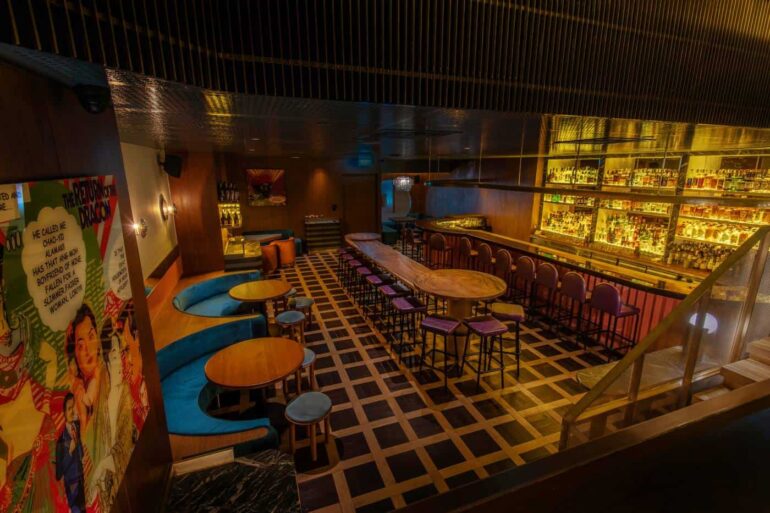
This philosophy is reflected in the layout of the space. Nothing is left to chance when it comes to social ergonomics. Kantono places great importance on the height of the counters, the width of the footrests, and even the shape of the tables. Everything is designed to encourage visual and physical interaction, both among guests and with the service staff. The goal is to break down the invisible barriers that often isolate people in public spaces. A successful bar, in his view, is a place where the architecture itself whispers to guests that they are free to strike up a conversation.
The Science of Atmosphere: Lighting and Infrastructure
Beyond the social aspect, Indra Kantono has mastered the more subtle codes of atmosphere—those that influence visitors’ subconscious. His recipe for creating the ideal space rests on specific sensory pillars. The first is light. He shuns cold or uniform lighting, preferring to recreate humanity’s instinctive attraction to flame. For him, the lighting in a bar should evoke the warmth of a campfire or the glow of a candle, generating an immediate sense of safety and comfort. It is this distinctive “glow” that lends faces a special softness and invites intimacy once night falls.
Finally, operational excellence remains the silent driving force behind his success. Kantono emphasizes a point often overlooked by designers who are too focused on aesthetics: service infrastructure. A beautiful venue loses all its meaning if the service is slow or sloppy. To avoid this pitfall, he equips his establishments with an abundance of service counters, designed for absolute efficiency. This allows the staff to remain available to guests, ensuring that glasses are never left empty and that attentive service never wavers—all without ever giving the impression of being rushed. It is this combination of a deeply humanistic vision and uncompromising technical rigor that makes the Jigger & Pony Group a notable exception in the Singaporean landscape. As the city ponders the future of its nightlife, Indra Kantono offers a concrete answer: the luxury of tomorrow will not lie in flashiness, but in the authenticity of human connection.