
Make Texture a preferred source on Google to support us
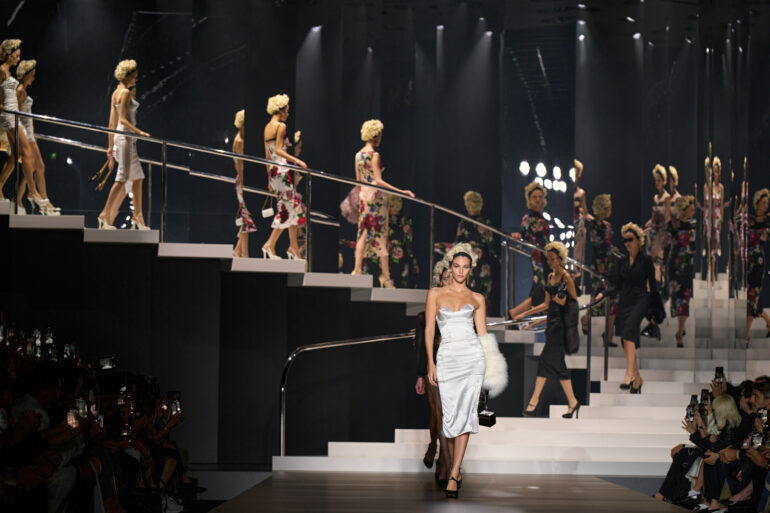
Add Texture to GoogleSalespeople on a runway set: at Gucci, the details set the tone. For his second collection presented on the brand’s runway, Demna transformed the space into a boutique. Beppe Nugnes, head of the luxury store Nugnes in Trani, sees it as the most compelling presentation of this Milan Fashion Week. His enthusiasm speaks volumes about the Spring/Summer 2027 season: the show is captivating when it also reminds us of what happens after the applause—in front of a rack or in a fitting room.
As Milan Fashion Week—held September 22–28—wraps up, buyers are championing a fairly simple yet difficult-to-fulfill requirement: clothing capable of living up to its promises beyond the runway. Their interpretation of the collections points to a fashion scene less concerned with creating a self-contained image and more focused on giving it a tangible continuation. It’s not a matter of giving up on ideas. Rather, it’s about knowing which ones will make people want to walk through a store’s doors.
The price must be justified by the garment
Michele Franzese, founder of Michele Franzese Moda in Naples, puts it bluntly: a customer must be able to understand what sets a piece apart and justifies its price. He therefore examines the collections through a series of concrete scenarios. First, does the garment catch the eye in the window display? Next, does it make you want to go inside? Finally, does it hold up when you try it on? A compelling photograph is no longer enough to answer these three questions. The fabric and cut take center stage, along with the quality of craftsmanship.
This commercial perspective is by no means a rejection of creativity. At Nugnes, too, customers expect a surprise—but one that can find its place in a wardrobe. Uniqueness is not at odds with practicality; rather, it should enhance it. This is precisely what Carla Cereda, from the Biffi boutiques in Milan, takes away from a season in which she considers the collections to be particularly well-executed, with clearly expressed brand identities. In her view, customers can already envision themselves wearing their future purchases.
Yet there remains a palpable tension behind this clarity. Luigi D’Aniello, from boutiques in Campania, describes a week that was very energetic but also high-pressure, with crowds that reminded him of Milan Design Week. The public was there. The challenge for shoppers now is to distinguish the hype surrounding the collections from the lasting appeal of their pieces.
A Prada skirt, and an entire look to rethink
Prada provides the clearest example of this convergence between creative vision and commercial potential. The skirt reappears in every segment of the runway show. A single garment thus becomes the vehicle for a statement—one that is clear enough to win over a diverse range of buyers. Daniela Kraler, of the Franz Kraler boutiques in South Tyrol, refuses to see it simply as a celebration of femininity; above all, she sees it as a radical choice.
This nuance matters. The collection’s appeal lies less in the revival of a familiar garment than in the way it is viewed anew. For Beppe Nugnes, Miuccia Prada and Raf Simons have given the skirt a new appeal; he anticipates a widely shared desire. Federico Giglio, of Giglio, emphasizes the strength of the ideas applied to the product, without breaking with the brand’s signature style. D’Aniello also ranks Prada at the top of his list for the clarity of its vision.
The Prada example helps clarify what buyers mean by a successful collection. It is not necessarily about offering a wide range of possibilities. A compelling idea, executed with sufficient conviction, can open up more possibilities than a scattered array of silhouettes. Here, the skirt gives the boutiques an immediately understandable focal point, without, however, exhausting the scope of the runway show.
Pieces that stand on their own
At Ferragamo, this quest for clarity is channeled through the body. Michele Franzese highlights an accentuated waistline, a softened tailored silhouette, and a sensuality fueled by draping, sheer fabrics, and the blending of men’s and women’s wardrobes. This sexier twist interests him particularly for what it enables in-store: building a collection around a piece that has enough character to stand on its own, separate from the runway silhouette.
A jacket must therefore remain desirable even without the ensemble it was paired with on the runway. The same standard applies to a knit or a skirt. This test of standalone appeal also sheds light on the reception Bottega Veneta has received. Cereda plans to buy extensively from the brand, drawn to a vision of luxury that maintains discretion without appearing subdued. Nugnes, for his part, emphasizes surface treatment, craftsmanship, and a lightness that prevents these distinctive garments from becoming difficult to wear.
Armani offers another solution to this equation. Giglio appreciates a stripped-down collection that isn’t austere—contemporary while remaining true to the house. The approaches differ, but the question remains: what remains of a collection once the set design, the music, and the meticulous staging of the runway show are stripped away? Buyers are looking for that residual strength—the strength of the garment alone.

Recognizing a fashion house without freezing it in time
At Fendi, memories of the 1970s and Raffaella Carrà’s “Rumore” left a lasting impression on Daniela Kraler. She also notes the contrast between lingerie and outerwear. Maria Grazia Chiuri’s collection, however, elicits comments that go beyond the mere pleasure of the reference: Nugnes recognizes in it a feminine elegance that he can easily envision on his current clientele, while Giglio focuses on the accessories and pieces likely to make it into his commercial selection.
This immediate recognition of an identity also runs through the reactions to Gucci. For Giglio, Demna refines his interpretation of the house by bringing together different styles. Cereda, too, counts Gucci among her highlights. The recreated boutique thus takes on special significance: it anchors this search for identity in the very space where products will be compared, touched, and chosen. Nugnes found in it more than just an ingenious setting—a way to make the relationship with the customer visible.
Other fashion houses have asserted their presence through means less directly commercial. D’Aniello was struck by Max Mara’s understated authority. At Moschino, under the new leadership of Loris Messina and Simone Rizzo, Kraler describes a collective moment, bringing together models and many ordinary people, with a tribute to Franco Moschino. What moved her was this desire to breathe new life into the brand, by involving people rather than keeping them at a distance.
For young labels, desire alone is not enough
The same high standards apply to emerging designers, with an added challenge: proving themselves over the long term. Franzese wishes to explore Francesco Murano’s work further, as his draping and volumes seem to him capable of meeting the demand for distinctive clothing. She is also keeping an eye on Marco Rambaldi for crochet and knitwear. These two lines are not intended to occupy the same space in her stores; each must bring something that is missing from the collection.
Kraler, for his part, appreciated the Retori showroom set up by Salma Rachid on Via della Spiga. The “Chapters” concept—which pairs each collection with an artist—strikes him as particularly well-executed. This artistic approach offers an alternative way to build an identity, without relying solely on fashion conventions.
But when considering a collaboration with a young label, Franzese also assesses its ability to deliver reliably. Creativity catches his eye; quality confirms his interest; and meeting delivery deadlines allows the relationship to continue from one season to the next. After Milan, part of the future of these collections will therefore hinge on a very concrete commitment: ensuring that the pieces that have sparked desire actually arrive in stores.