
Make Texture a preferred source on Google to support us
Add Texture to GoogleSome anniversaries are celebrated with a flurry of spectacular reissues, commemorative dials, and models packed with nods to the past. For the 30th anniversary of the Overseas, Vacheron Constantin has chosen a far more understated approach: a high-complication watch in azure blue, set in white gold, and limited to 200 pieces. It’s a way of reminding us that the collection, launched in 1996, has never needed to raise its voice to assert its place in the world of luxury sports watches.
Thirty Years of a Sport Watch That Embraces Restraint
The Overseas emerged as the heir to a certain vision of the integrated bracelet—one that Vacheron Constantin had explored with the 222. The latter has since made a comeback in the brand’s catalog, without blurring the lines between the two models. The 222 looks back fondly to its era; the Overseas embodies a more contemporary style—and a more versatile one as well—with its interchangeable bracelet systems and its design tailored to suit a variety of settings.
The new ultra-thin Overseas Perpetual Calendar, however, does not seek to be a sports watch in the strict sense. Its construction, its 18-karat white gold case, and its level of complication place it more firmly in the realm of travel elegance than that of a sports instrument. This is precisely where its appeal lies: preserving the Overseas’s dynamic aesthetic cues—notably the graphic presence of the integrated bracelet—while embracing a sophistication that calls for a white shirt, a dark jacket, or a bare wrist.
The 4300V/220G-H119 model encapsulates this tension without artificially resolving it. It measures 41.5 mm in diameter—a bold size—yet is only 8.1 mm thick. This figure is worth noting. An automatic perpetual calendar typically requires the layering of numerous displays and the integration of an oscillating weight—two constraints that rarely favor slimness. Here, Vacheron Constantin manages to maintain a low, almost taut profile, preventing this complication from becoming a bulky object.
Azure Blue as a Recent Reference
The detail that makes all the difference is found on the dial. Vacheron Constantin revisits the azure blue first introduced with the redesign of the Overseas in 2016. This is therefore not a color chosen at random to adorn an anniversary edition, but a specific reference to an important moment in the line’s recent evolution.
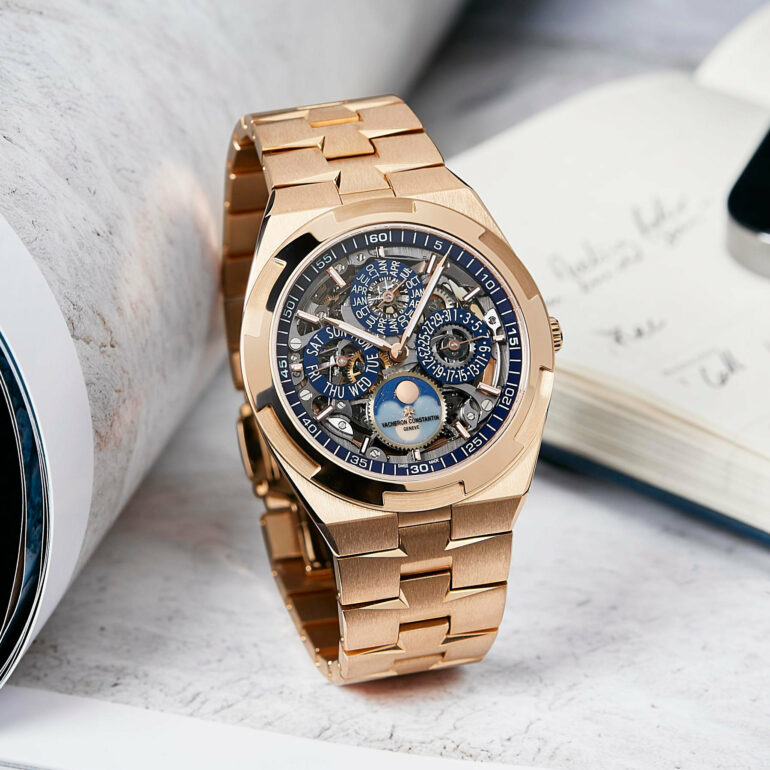
The shade is light, soft, and shifting. Under the light, the sunburst-finished central disc reflects light differently from the subsidiary dials, which feature a circular texture. This interplay of surfaces prevents the monotony of a monochrome dial and naturally organizes the presentation of information. On a perpetual calendar watch, where the risk of visual clutter is real, the material itself becomes a tool for readability.
The month, day, and date displays are housed in the subdials, while the moon phase is positioned at 6 o’clock. The hour markers and the moon disc are crafted from 18-karat white gold. A few sky-blue accents punctuate the design: the 60-minute peripheral minute track and the leap year indicator, integrated into the months counter at 12 o’clock. The latter does more than simply indicate the current leap year; it displays the entire four-year cycle.
The chromatic balance stems from the combination of white gold and this cool blue. The pairing is less conventional than a black, gray, or navy blue dial, but it does not seek contrast at all costs. The white metal retains its understated elegance; the blue brings light. The result gives the watch a look that is more airy than solemn, despite the technical complexity of its complication.
The Long Term, and Its Exceptions
On the case back, visible through a sapphire crystal, the 1120 QP/1 automatic movement powers the watch. It beats at 19,800 vibrations per hour—or 2.75 Hz—and offers a 40-hour power reserve. Its functions include hours, minutes, a perpetual calendar, and moon phases.
The perpetual calendar is one of the most appealing complications because it aims to tame the irregularity of the calendar. It distinguishes between months with 30 and 31 days, handles February, and accounts for the 29 days in leap years. As long as the watch remains in operation, its owner therefore does not have to manually correct the date at the end of a short month.
This promise theoretically extends until 2100, a year that reveals the full strangeness of the Gregorian calendar. A year ending in two zeros is a leap year only if it is divisible by 400. The year 2100 will therefore not have a February 29, despite appearing to be the fourth year of the cycle. This exception, which the mechanism must account for, serves as a reminder that a perpetual calendar is not merely a sophisticated display: it is a mechanical interpretation of a complex human convention.

The 40-hour power reserve introduces a very concrete element into this relationship with the long-term. Leaving the watch stationary for a few days then requires resetting all of its indications. A winding device thus becomes less of a convenience accessory and more of a logical ally in maintaining the continuity of the display. A watch designed to navigate the intricacies of February ultimately asks for only one thing: to keep running.
A Strap System That Sets a New Tone
Vacheron Constantin offers this edition with three wearing options. The 18-karat white gold bracelet, secured by a triple-blade folding clasp, is the one that most naturally extends the geometry of the case. It gives the Overseas its architectural poise—that of a wristwatch conceived as a unified whole rather than a case to which a strap has been added.
Two rubber straps also accompany the watch: one white, the other denim blue. An interchangeable white-gold pin buckle completes the ensemble. The white rubber leans the watch more toward its sporty side, while the denim blue establishes a direct dialogue with the azure dial. This modularity is part of the Overseas’s design language, but here it takes on a unique character: it allows a watch equipped with a perpetual calendar to shift styles without altering its essence.
The watch is water-resistant to 50 meters, or 5 bars. This level of water resistance is consistent with the spirit of the collection, though it remains secondary to the purpose of this model. The slim case, the perpetual calendar, and the white gold make it quite clear that the intended everyday use has nothing to do with aquatic adventures.
An Anniversary Edition Without Fanfare
Limited to 200 pieces, the ultra-thin Overseas Perpetual Calendar in white gold with an azure dial represents a subdued celebration. It does not introduce a new complication nor does it disrupt the collection’s identity. Rather, it brings together elements that are already integral to its history: the legacy of the integrated bracelet, the blue introduced during the 2016 redesign, Vacheron Constantin’s penchant for ultra-thin movements, and an approach to luxury where detail takes precedence over ostentation.
Its price is set at 119,000 pounds sterling. At this price point, the watch is obviously aimed at a select few, but the coherence of the offering stems from more than just its rarity. It is evident in the 8.1 mm thickness, in the sky-blue color of the leap year indicator, and in the contrast in texture between the sunburst dial and the azure-finished sub-dials. To explore this model and the world of the brand, visit the official Vacheron Constantin website.