
Make Texture a preferred source on Google to support us
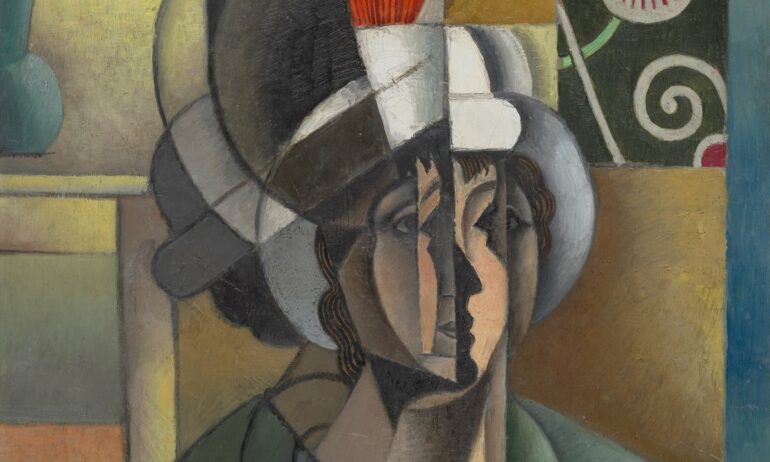
Add Texture to GoogleIn the subdued dim light of Gallery 391B at the Art Institute of Chicago, an empty space now marks the absence of a major work of French Cubism. On September 22, 2026, the American institution officially announced the permanent removal of “Woman with a Fan,” an oil on canvas painted in 1913 by Jean Metzinger. This decision is not the result of a collection rotation or an international loan, but the culmination of a rigorous provenance investigation that has shed light on the dark corners of 20th-century European history. This painting, once owned by a Dutch Jewish family, is set to be returned to the heirs of Emanuel Lewenstein, thus closing a chapter that began amid the violence of the Nazi occupation of Amsterdam.
A Key Work of Parisian Cubism
Painted in Paris in 1913, “Woman with a Fan” is an emblematic work from the period when Jean Metzinger (1883–1956) established himself as one of the most influential theorists of the Cubist movement. Signed in the lower left corner, the 92.7 × 65.7 cm canvas captures the aesthetic of the pre-war avant-garde, blending rigorous geometry with the fragmentation of perspective. At that time, Metzinger was no longer merely a painter but the co-author of “On ‘Cubism,’” the first major treatise on the subject.
The work’s provenance officially begins in 1919, when it was acquired by Paul Citroen, an artist and art dealer, from the gallery representing Metzinger. Citroen, who was also a cousin of the collector Emanuel Lewenstein, kept the painting for nearly a decade before selling it to Lewenstein in 1928. As the head of a thriving sewing machine company in Amsterdam, Emanuel Lewenstein was building a modern art collection of significant importance. Upon his death in 1930, his widow reportedly sought to protect this legacy by depositing several works—including Metzinger’s painting—at the Stedelijk Museum in Amsterdam. The painting remained in this relative sanctuary until the outbreak of World War II.
The Mystery of the 1940 Sale
The invasion of the Netherlands by Nazi Germany in May 1940 tragically upended the fate of the Lewenstein family and their collection. By that time, Emanuel’s widow had passed away, and his children had already fled the country to escape anti-Semitic persecution. In October 1940, just a few months after the occupation began, “Woman with a Fan” suddenly reappeared on the art market. It was auctioned at the Frederik Muller & Cie auction house in Amsterdam.
The exact circumstances of this transaction remain, even today, shrouded in documentary uncertainty. Archives from that period do not allow for the formal identification of the consignor who put the work up for auction, nor do they make it possible to determine with certainty who received the proceeds from the sale. However, the historical and legal analysis conducted by The Art Institute of Chicago led to an unequivocal conclusion: this was a “forced sale.” In the context of the occupation and racial laws, the dispossession of the Lewenstein family is recognized as a direct consequence of Nazi persecution, regardless of whether the artwork was physically confiscated or surrendered under financial and political duress.

The Journey to Chicago and the Revelation of the Invisible
After the dispersal of 1940, all trace of the “Woman with a Fan” was lost for more than a decade. It resurfaced on the Dutch art market in the 1950s, passing through Paris and then New York. In 1959, the painting entered the collections of the Art Institute of Chicago under accession number 1959.10. Although the museum’s official inventory lists the work as a gift from Mr. and Mrs. Sigmund Kunstadter, evidence suggests that the acquisition may have been made from the New York gallery Sidney Janis through the patronage of this collector couple.
For sixty-seven years, the painting was exhibited as a highlight of the museum’s modern art collection, without its problematic provenance ever being formally established. The decisive turning point came recently thanks to advances in scientific imaging. Under the direction of James Rondeau, president of the museum, and Dr. Jacques Schuhmacher, executive director of provenance research, the painting underwent infrared imaging analysis. This technique revealed, on the reverse side of the canvas, a pencil inscription that had become illegible to the naked eye. The name “Paul Citroen” appeared there, providing irrefutable physical evidence linking the work to the 1928 transaction and, by extension, to the Lewenstein Collection.
A Restitution Grounded in Ethics
This discovery marked the beginning of a collaboration between the Chicago institution and Mondex Corporation, a Toronto-based company specializing in the search for artworks looted during the Holocaust. Guided by Stuart Eizenstat, a leading figure in international agreements on cultural property from the Nazi era, the restitution process was based on the principles of the 1998 Washington Conference and the 2009 Terezin Declaration. These international texts commit museums to seeking “just and equitable solutions” for works identified as having been lost by their rightful owners between 1933 and 1945.
The announcement of the restitution, though devoid of any mention of the artwork’s financial value, marks a significant milestone for the Art Institute. By removing the Metzinger from its galleries to return it to the Lewenstein descendants, the museum reaffirms the primacy of historical ethics over material ownership. This gesture is part of a global movement toward transparency and historical justice, in which cutting-edge technology is harnessed to serve historical truth in order to redress, as much as possible, the spoliations of the past.