
Make Texture a preferred source on Google to support us
Add Texture to GoogleThe scent of green figs wafts through the hallways, weaving its way between the terracotta structures and the light-filled, wide openings. We aren’t in the lobby of a new hotel on the Riviera, but in the heart of Parque Eduardo VII, Lisbon’s green lung. Here, just minutes from the bustling Marquês de Pombal Square, Club 7 is redefining what it means to belong to an urban community. For newcomers who have chosen the Portuguese capital as their home base, the place has become the natural gathering spot—a space where business deals are sealed between two sets of padel or where social bonds are forged over a morning coffee. Carolina Melo Duarte, the general manager, embodies this new era: she knows every member by name, a personal touch that signals a radical paradigm shift for this institution, founded in 1997.
Unparalleled hospitality as a driver of performance
The club’s major turning point is measured not only by the quality of its clay courts or the clarity of its waters, but by a service philosophy imported from New York’s haute cuisine scene. Under the leadership of Carolina Melo Duarte, the site’s 140 employees spent the summer immersing themselves in Will Guidara’s book *Unreasonable Hospitality*. This choice is by no means trivial. The goal is to treat each member not as a mere user of sports facilities, but as a privileged guest of a luxury establishment. This approach transforms a visit to the club into a seamless experience, where the care taken to ensure a relaxing moment at the café is as meticulous as the maintenance of the playing surfaces. We’re no longer talking about a simple fitness center or wellness retreat, but rather a culture of service that puts people at the heart of the experience. It’s this attention to detail—almost like that of a hotel—that allows the club to stand out in an increasingly competitive urban landscape.
This vision is paying off. Since last February, Club 7 has been fully booked, operating at full capacity with a community of 3,500 adults and 600 children. The success is such that it validates a strong intuition: with the right infrastructure and a genuine spirit, a sports club can become much more than just a place for physical activity. It becomes an anchor, an indispensable “third place” where the line between professional and personal life blurs gracefully. The membership fee, set at 300 euros, supplemented by a monthly payment of 160 euros, grants access to an ecosystem where camaraderie takes precedence over athletic performance alone.
The Members’ Rescue and Architectural Rebirth
The recent history of Club 7 reads like a tale of collective resilience. After being founded by Portuguese investors, the club had come under the control of a British investment fund. Seeing their home slowly decline, 15 members decided in 2022 to take the reins of the club to prevent its deterioration. This group of passionate investors has since coalesced around three key figures, but the initial momentum remains the same: to restore the club’s national prestige while opening it up to the world. This acquisition was the prelude to a spectacular transformation, both structural and aesthetic.

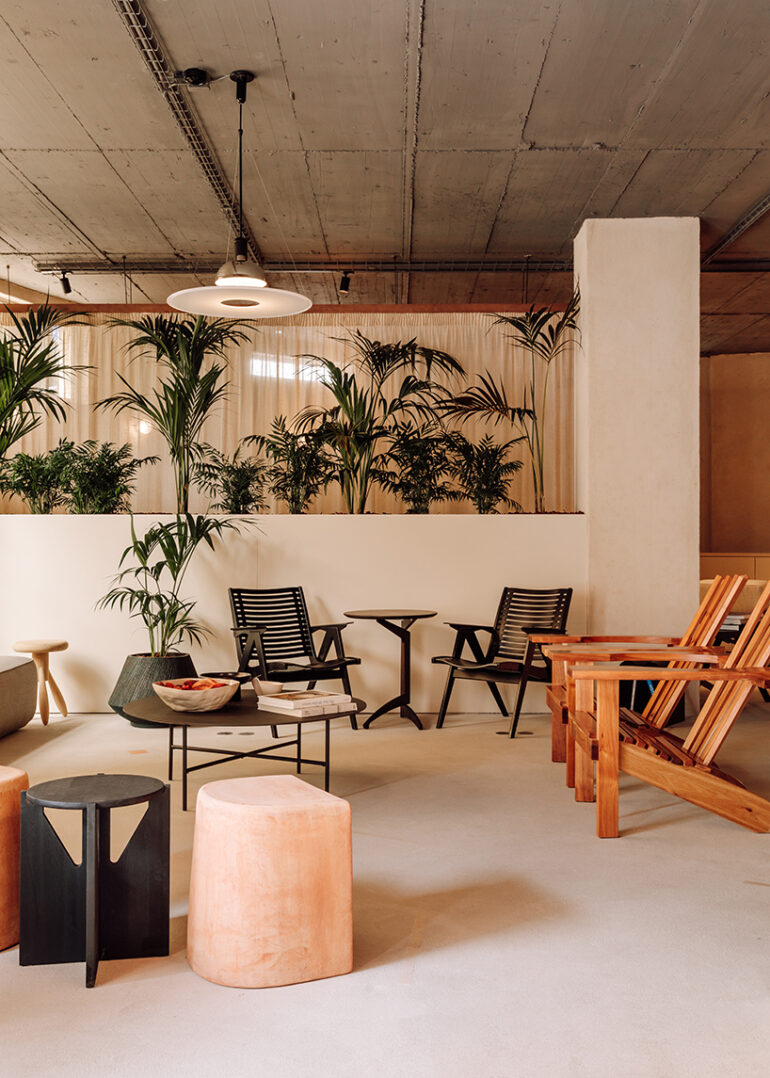
A budget of 8 million euros was allocated to a major renovation entrusted to the firm Saraiva e Associados. The result is a showcase of contemporary Lisbon design, with interiors conceived by the firm Andrez & Andrez. The 29-year-old space has been transformed into an airy sanctuary, featuring mineral tones and warm materials. The layout has been redesigned to promote a sense of openness, making visitors forget the density of the facilities. Today, the club features six tennis courts and seven padel courts—a sport whose meteoric rise has coincided with the club’s revival. Added to this are a state-of-the-art gym, a 25-meter swimming pool, and a full-service spa, forming a cohesive complex dedicated to holistic wellness—all accessible at club7.pt.
A microcosm of the new Lisbon
Club 7 reflects a Lisbon that has changed profoundly over the past half-decade. The days when you’d only run into local players there are long gone. Today, the tournaments held on the park’s hillside attract participants from twelve different countries. Luís Bonet, the club’s longtime tennis coach, has observed this transformation from the inside. According to him, the past five years have marked a true turning point, transforming a neighborhood club into a leading cosmopolitan hub. This international diversity brings a new energy, turning the club into a social laboratory where the Portuguese capital’s diversity is forged.
This appeal is based not only on the facilities but also on the unique atmosphere created by the mix of generations and backgrounds. The fact that 600 children frequent the facility ensures its long-term viability and a family-like atmosphere that prevents the club from falling into the trap of becoming an overly stuffy “business club.” People come here for the effectiveness of a morning workout, but they stay for the quality of the spontaneous interactions. Club 7 proves that by investing heavily in design and prioritizing hospitality over mere membership management, it is possible to create a major hub of attraction that extends far beyond the boundaries of Parque Eduardo VII. The strategy of Carolina Melo Duarte and her teams demonstrates that in Lisbon, sports are now the primary vehicle for a certain urban lifestyle.