
Make Texture a preferred source on Google to support us
Add Texture to GoogleAt 800 euros, a pair of sneakers remains a costly investment. You’re buying a design, a brand name, but also a certain idea of what justifies their price. At Gucci, this equation gets more complicated: as the brand seeks to win back customers who have become more cost-conscious, two models from its spring-summer collection are manufactured in China. Among them is the Drip, the first sneaker designed for the label by Demna. The issue goes beyond industrial geography. It touches on what Gucci can change to win back buyers, without undermining the reasons why they’re willing to pay more.
Winning Back Customers Without Undervaluing the Brand
This issue arises at a time when Gucci has little room for missteps. The brand’s sales have been cut in half over the past three years. This decline has weighed on profitability and led to the closure of dozens of stores. For Luca de Meo, who took over as CEO of Kering last year, turning the brand around is therefore the decisive challenge. The creative revival must do more than just generate buzz: it must bring customers back.
However, price itself has become a tool for adjustment. According to two sources within Kering, the group has implemented price cuts on select products, particularly in China, in order to regain market share. At Gucci, some discounts on handbags and ready-to-wear items are reported to have reached 30%. This is not a general price reduction, but the signal is significant. A luxury brand that revises certain prices acknowledges that its offerings must once again align with demand.
The Drip fits into this delicate balance. Priced at around 800 euros in Europe and 1,000 dollars in the United States, it is cheaper than many other Gucci shoes. Yet it remains a luxury purchase. The goal, therefore, is not to make the sneaker cheap, but to offer a relatively less expensive entry point into a world where prestige must remain intact.
The small label that shifts the debate
The country of manufacture introduces another angle. The “Made in China” label appears on Gucci’s website as well as on the pairs available in its Paris boutique. It applies to the Drip and a second model, a leather slip-on from the same spring-summer collection. All other shoes offered on the website, however, are labeled as made in Italy. The discrepancy is limited in scope, but it is nonetheless noticeable.
In this context, country of origin becomes a point of comparison among products sold under the same brand name. The buyer may appreciate the design and understand the price difference, while wondering what sets these two models apart from the rest of the lineup. This questioning does not imply any judgment on their quality. It simply serves as a reminder that, in the luxury sector, the information accompanying an item also contributes to its perceived value.
Analysts at Berenberg thus see a potential tension between this origin and the level of positioning that Gucci aims to regain. Milan-based consultant Simon Whitehouse expresses a more pointed reservation regarding the image implications of Chinese manufacturing. These reactions pertain to how the product is received, not to any identified defect. This distinction is crucial: the risk being discussed is commercial and symbolic, not a proven defect in the shoe.
A sneaker in Demna’s vocabulary
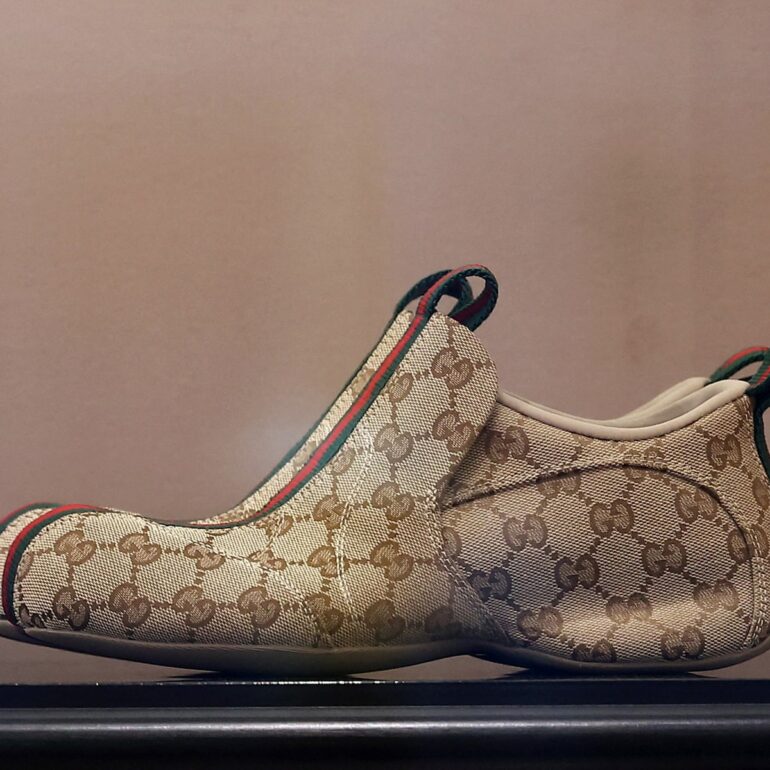
The design of the Drip, however, tells a story that is quite consistent with its creator’s career path. Lace-free and built around a sock-like silhouette, it evokes the voluminous sneakers Demna developed at Balenciaga. Presented in his spring-summer collection for Gucci, it brings this design language to a brand whose white leather Ace sneaker represents a more classic aesthetic.
The difference is also evident in the materials. The Drip is made of nylon, canvas, or suede, rather than the white leather associated with the Ace. Its character stems from its construction and silhouette, not from the reinterpretation of an existing model. For Demna’s first signature sneaker at Gucci, this choice affirms creative continuity with his previous work, while shifting the parameters of the brand’s footwear lineup.
This shift makes the industrial debate more interesting than a simple dichotomy between tradition and offshoring. A shoe with a different design may require different skills. But formal uniqueness alone is not enough to explain to the customer why the source of production is changing. Gucci must therefore simultaneously defend an aesthetic choice and the relevance of the selected manufacturer.

Technical Expertise Versus the Prestige of Origin
The brand’s response lies precisely in this area. Gucci states that it chose a Chinese supplier for its technological expertise and production capabilities, which were deemed suitable for the performance and quality standards sought. For the second slip-on model, a spokesperson also cited technical reasons related to the design. The argument presented is therefore not one of manufacturing cost savings, but rather one of the compatibility between a product and an industrial production process.
China plays a major role in global sneaker manufacturing, with factories whose expertise is recognized even among premium brands. To suggest that this production results in lower quality would be unfounded based on the available evidence. Gucci’s problem lies elsewhere: even a solid technical reputation does not automatically replace the attachment to Italian origins in the mind of a luxury buyer.
The company also points out that it has already used Swiss and Japanese suppliers for its watches and eyewear. It presents these choices as a search for specialized expertise suited to specific product categories. At the same time, it reaffirms Italy’s central role in its manufacturing and identity. Its spokesperson clarifies that no broader plans to move production outside the country are in the works.
Price-conscious customers do not sacrifice prestige
One challenge remains: offering a relatively more affordable price does not mean that the buyer will scrutinize what they’re getting any less closely. The so-called “aspirational” clientele—the segment that Gucci and other luxury houses are seeking to win back—is particularly price-sensitive. For this group, the financial investment can make justifying the purchase even more important. A sneaker priced at 800 euros must be desirable, but it must also align with the brand’s promise.
It would, however, be risky to directly link Chinese manufacturing to the price cuts implemented in other categories. The available information does not establish this connection. Rather, these decisions stem from how Gucci’s trajectory is perceived: on the one hand, commercial adjustments to regain volume; on the other, two manufacturing exceptions justified on the grounds of technical sophistication. It is up to the brand to make these choices clear without letting them become conflated.
The next key moment will take place on the Milan runway, where Gucci is scheduled to present its new collection during Fashion Week. This show is expected to lend substance to the renewal spearheaded by Demna. La Drip is already posing a very concrete question about this project: what place will these new shoes—manufactured in China—occupy alongside a product line that continues to emphasize its Italian origins?