
Make Texture a preferred source on Google to support us
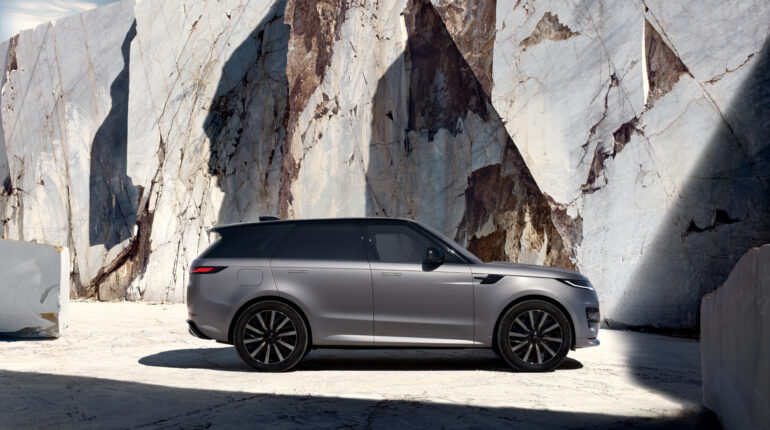
Add Texture to GoogleThe final test did not take place on a racetrack. To wrap up development of the Range Rover Sport Electric, the JLR teams took it to the marble quarries of Carrara, Italy, and had it climb more than 900 meters in elevation over boulders and stone dust. The test has a name: “Peak to Peak.” It speaks volumes about the challenge this SUV must meet: remaining a Range Rover capable of going anywhere while living up to the “Sport” moniker. On paper, the answer comes down to a single number. It’s not power, but torque.
850 Nm, and the hierarchy shifts
The Range Rover Sport Electric boasts 850 Nm, or 627 lb-ft. No production Range Rover Sport had ever reached this level. The internal-combustion variants that came before it fall short, including the V8. For years, the eight-cylinder engine was considered the top of the line. Now it’s been surpassed by a model that has neither pistons nor a transmission.
Maximum power matters, but how it’s delivered matters even more. The manufacturer claims a torque rise that’s 50% faster than on the larger Range Rover Electric, thanks to a calibration specific to the Sport. The traction control system, called Intelligent Torque Management, is said to react up to 100 times faster than on a combustion-engine version. For the driver, this translates to an almost instantaneous response to the accelerator and torque distribution between the axles that’s corrected even before wheel slip becomes noticeable.
The stopwatch keeps track. In the EV550 version, with 550 ch (404 kW), the 0 to 96 km/h—the equivalent of 0 to 60 mph—is rated at 4.3 seconds with Dynamic Launch mode activated. The 0 to 100 km/h time was measured at 4.5 seconds. That’s the acceleration time of the P540, the gasoline-powered twin-turbo V8 version. The parallel is clear: the electric model isn’t presented as a reasonable alternative, but as the equal of the family’s most prestigious engine.
Mechanics shared with its big brother
The Sport isn’t starting from scratch. It uses the MLA-Flex longitudinal modular platform and the twin-motor architecture of the Range Rover Electric. Each axle is powered by a 260 kW electric motor, or 354 ch. With no mechanical driveshaft to connect them, the all-wheel drive system becomes “virtual”: coordination between the front and rear is handled entirely by electronics.
A second variant, the EV450, is also reportedly part of the lineup, with 450 ch (330 kW) and a 0 to 100 km/h time of 5.6 seconds. This figure is widely reported, but the version has not yet been detailed in all of the manufacturer’s materials at the time of launch. It should therefore be viewed with caution, pending the release of a complete official spec sheet.
A Stiffer Body, a Lower Center of Gravity
The benefits of electrification are also evident in the vehicle’s structural specifications. Compared to the plug-in hybrid variants in the lineup, the Sport Electric gains 61% in torsional rigidity. Its center of gravity is lowered by 73 mm, as the battery is housed at the very bottom of the chassis. On an SUV of this size, these two factors directly influence cornering precision.
JLR adds its full suite of suspension technologies: Dynamic Air Suspension, Twin Valve Dampers, and four-wheel steering. The most spectacular feature remains the eARC electronic active roll control system, capable of applying up to 1,400 Nm of stabilizing force per axle. It is this system that prevents the body from leaning when the 850 Nm of torque is applied upon exiting a curve.

What the battery promises—and what remains to be seen
The lithium-ion battery pack, developed in-house by JLR, has a capacity of 118.5 kWh. It uses NMC chemistry and a structure consisting of 344 integrated prismatic cells. The electrical architecture operates at 800 volts and supports “split-charging” technology, which adjusts the voltage to optimize charging at 400-volt stations, which are still very common.
When it comes to range, several figures need to be distinguished. The manufacturer claims up to 609 km (378 miles) in the WLTP combined cycle. Another figure of 602 km (374 miles) is also circulating. The discrepancy appears to be due to the wheels, particularly the 22-inch aerodynamic options, but the initial press release does not provide model-specific certification details. As for “real-world” usage, JLR estimates it at around 533 to 536 km, or approximately 333 miles. This is an internal simulation based on a standardized route, subject to weather and driving style, and is not a certified independent measurement.
On the charging front, the official figures are clear: 22 minutes to go from 10% to 80% at a high-power fast-charging station, and approximately 220 km (136 miles) of range regained in ten minutes. Peak power is reported to reach 350 kW. This figure is consistent with the 800-volt architecture, but the manufacturer has not highlighted it with the same clarity as the charging times.

The battery is covered by an eight-year warranty or 160,000 km (100,000 miles).
From Marble to the Ford
Let’s return to Carrara. An electric SUV with over 500 chevaux capable of rivaling a V8 in acceleration might be content to stick to the pavement. That’s not the brand’s legacy. The Sport Electric claims the ability to climb slopes of up to 45 degrees and ford water up to 900 mm deep.
This last figure is worth noting, as submerging a high-voltage battery pack under nearly a meter of water imposes waterproofing requirements that internal combustion engines never faced. The torque available from a standstill and the electronically controlled torque distribution, however, are assets on rough terrain, where traction must be managed on a wheel-by-wheel basis. The blocks of Carrara marble—abrasive and slippery beneath their layer of dust—were specifically used to test this precise control rather than brute force.
Solihull, September 2026, and a British-made vehicle
The 2027 Range Rover Sport Electric is assembled in Solihull, United Kingdom. Orders open on September 30, 2026. The lineup includes four trim levels: Dynamic SE, Dynamic HSE, Autobiography, and First Edition.
In the United Kingdom, prices announced at the start of orders begin at £109,810 (approximately €131,000) for the Dynamic SE in the EV550 trim. The Autobiography starts at £122,780 (approximately €147,000) and the First Edition at £126,290 (approximately €151,000). The price of the Dynamic HSE has not been specified. In Ireland, the entry-level model starts at €123,830.
For both France and the United States, no prices have been announced to date. French buyers will therefore have to wait to find out at what price the most powerful model in Range Rover Sport history will arrive in their country—and whether the EV450 will be part of the lineup.