
Make Texture a preferred source on Google to support us
Add Texture to GoogleFor decades, her surname appeared in parentheses, reduced to a mere suffix appended to those of the giants of architecture. Le Corbusier, Pierre Jeanneret… and Charlotte Perriand. The history of twentieth-century design was long written from a male perspective, relegating one of its most brilliant minds to the role of a talented collaborator, a behind-the-scenes executor. The famous continuously adjustable reclining chair, known as the “LC4”? The art market and textbooks have long attributed it solely to the Swiss master. Yet it bears, right down to its hinges, the genetic imprint of this woman who, as early as the late 1920s, introduced the concepts of the body, flexibility, and movement into an interior design world then frozen by dogma. Institutional recognition today rectifies this structural amnesia, restoring her work to the center of modernity.
The Break on Rue de Sèvres
Legend often recounts a flat refusal. In 1927, the young woman knocked on the door of the studio at 35 Rue de Sèvres. Le Corbusier dismissed her with a curt remark, making it clear that cushions were not embroidered within his walls. It wasn’t until the architect visited the Salon d’Automne a few months later and was stopped in his tracks by *Le Bar sous le toit*—a radical installation of leather, glass, and nickel-plated steel designed for his own apartment on Place Saint-Sulpice—that he realized his mistake. He called her back and entrusted her with the interior design of the firm’s buildings.
From then on, tubular metal became her signature style. In contrast to the heavy, bourgeois interiors cluttered with wood paneling and tapestries, Charlotte Perriand championed clean lines. She bent chrome-plated steel, streamlined the space, and conceived of storage not as a massive, added piece of furniture, but as an integrated architectural element. Standard cubbies, designed to delineate rooms without closing them off, emerged from this relentless logic. Yet, behind the agency’s doors, a division of roles crept in insidiously. The chief architect is responsible for the exterior envelope and the masterful theory; the designer is tasked with organizing functionality, seating, and daily life. This division largely obscures the deeply political dimension of Perriand’s work. Close to left-wing intellectual circles, she did not design for a worldly elite. Her ambition was focused on mass production, industrial optimization, and comfort accessible to as many people as possible. This democratic vision of design would often clash with the economic realities of the interwar period.
Exile in Asia and the Discovery of Materials
This turning point—both aesthetic and personal—took place geographically at the dawn of World War II. In 1940, as Europe was plunging into conflict, Charlotte Perriand set sail for Japan. The Japanese Ministry of Commerce and Industry had invited her to serve as an advisor to steer domestic production toward exports. This stay, lasting several years, served as a jarring yet fruitful revelation. Faced with a scarcity of metals—which had been massively requisitioned by the Imperial Army—she turned to local resources: solid wood, bamboo, and woven straw.
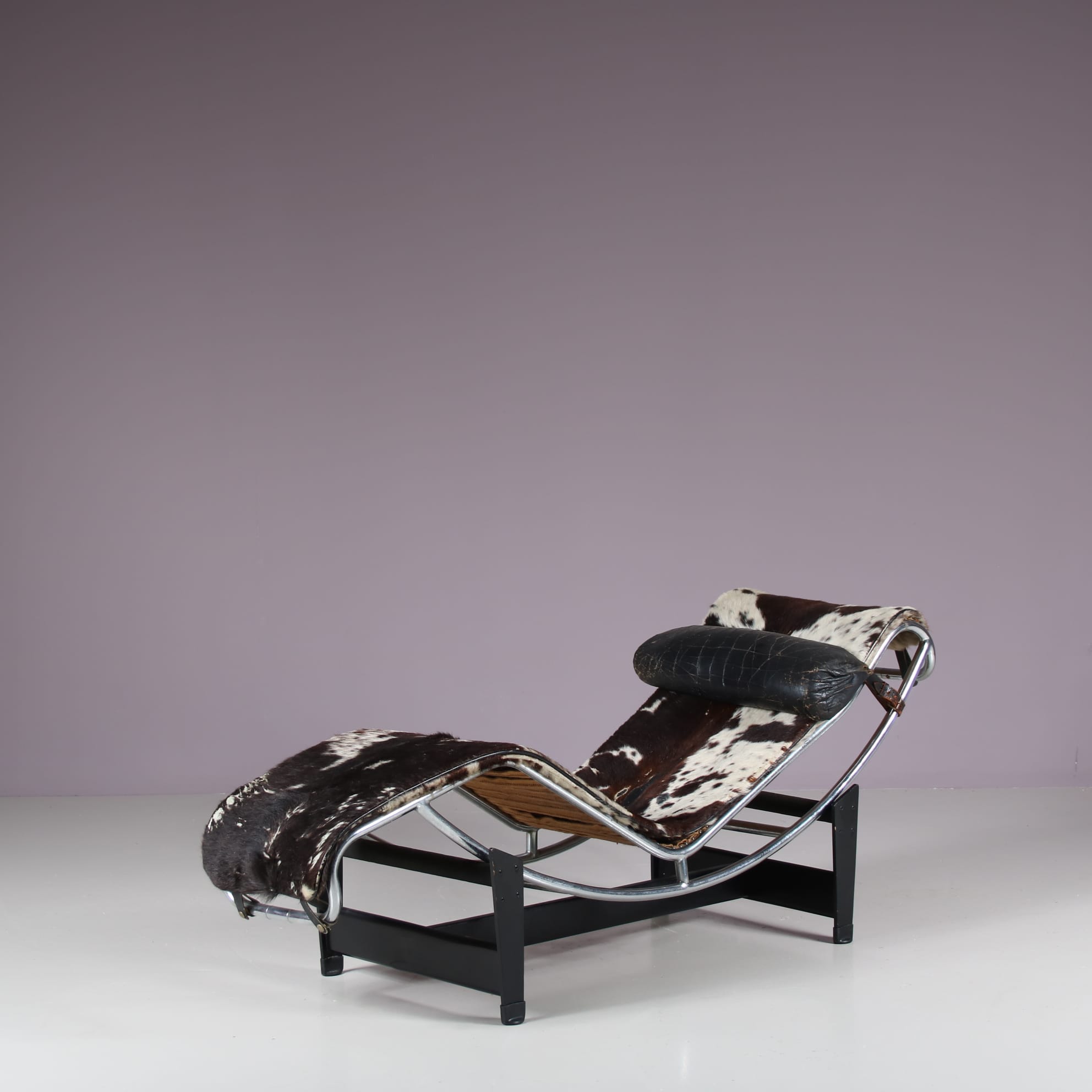
Her daily exposure to Japanese craftsmanship, and her engagement with the Mingei movement—which celebrates the beauty of everyday folk objects—radically transformed her relationship with materials. The clinical coldness of tubular steel gave way to organic textures and a more tactile approach. The famous rocking chaise longue is entirely reimagined using bamboo slats, shedding its hygienist-like appearance to gain an unprecedented warmth. This bridge between the Western rationality of mass production and Asian vernacular craftsmanship shapes a new syntax. The designer understood ahead of her time that standardization does not exclude humanity, and that strict geometry can perfectly accommodate the curve of a fold in wood or the irregularities of a type of timber. Upon her return to France, this synthesis would infuse all of her postwar work, particularly in her collaborations with Jean Prouvé, where bent sheet steel would be paired with solid oak tabletops.

Les Arcs: A High-Altitude Utopia
While her furniture captures the attention of collectors, Charlotte Perriand’s intellectual legacy can be found on the mountainside in Savoie. The vast Les Arcs resort project, launched in the 1960s with developer Roger Godino and a team of local architects, represents the dizzying culmination of her spatial vision. For twenty years, she orchestrated the development of several thousand housing units designed for a booming mass tourism industry. Her primary obsession: erasing the traces of human intervention in favor of the topography.
Unlike the Brutalist resorts that were then marring the Alps, the buildings at Les Arcs follow the natural slope. The roofs slope in accordance with the terrain so as never to obstruct the view of the Mont Blanc massif. Inside the studios, spatial engineering achieves watchmaker-like precision. Every square meter is maximized to provide a sense of space despite the cramped conditions. She designs kitchens that open onto the living room, installs prefabricated polyester bathrooms—inserted as a single unit during construction—and designs raised beds to free up storage space. Traffic flows smoothly, and natural light streaming through large floor-to-ceiling windows floods the living space. Les Arcs embodies her commitment to accessible, high-quality recreation, a far cry from opulent, imitative chalets. It is a masterclass in high-altitude urban planning, where high population density is accommodated through rigorous organization and a deep respect for the landscape.
Beyond the Market: A Language of Freedom
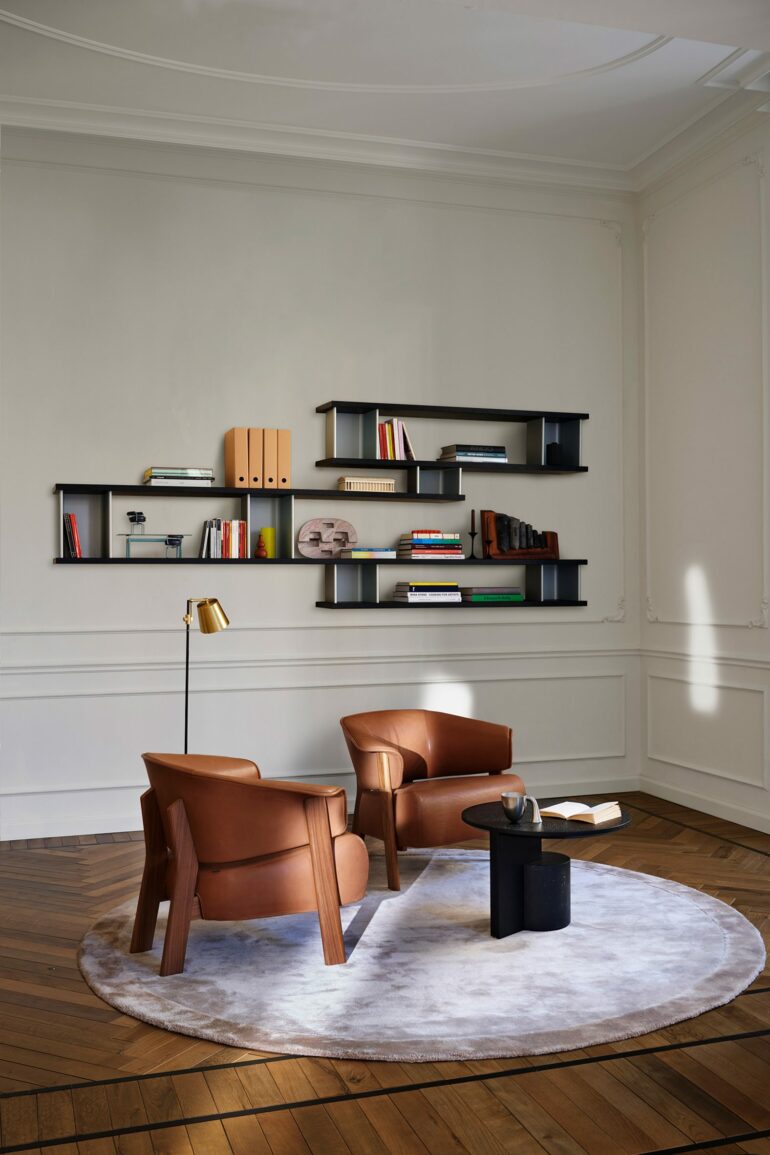
Today, international galleries are scrambling to acquire his “Nuage” bookcases with their colored aluminum bases, his free-form tables, and his shepherd’s stools. The value of her original pieces is skyrocketing at auction, and the meticulous reissues produced by historic firms such as Cassina confirm her place in the pantheon of contemporary taste. But to reduce Charlotte Perriand to six-figure collectibles would be a major misinterpretation of the nature of her commitment. Her approach has always shunned the fetishization of the object for its own sake.
What drove the designer was the study of the space between walls, the precise understanding of the choreography of bodies within the home. She conceived of the home as a tool for emancipation. The art of living according to her principles was free of any ostentation or superfluous decoration. It was about eliminating physical constraints to liberate the mind. If her spatial syntax seems so natural to us today, it is precisely because she won the battle of functionality. The removal of partitions, the opening up of reception areas, furniture designed to modulate space rather than fill it: this architectural grammar of everyday life, which we inhabit almost unconsciously, bears the silent signature of a woman who always refused to separate beauty from utility.