
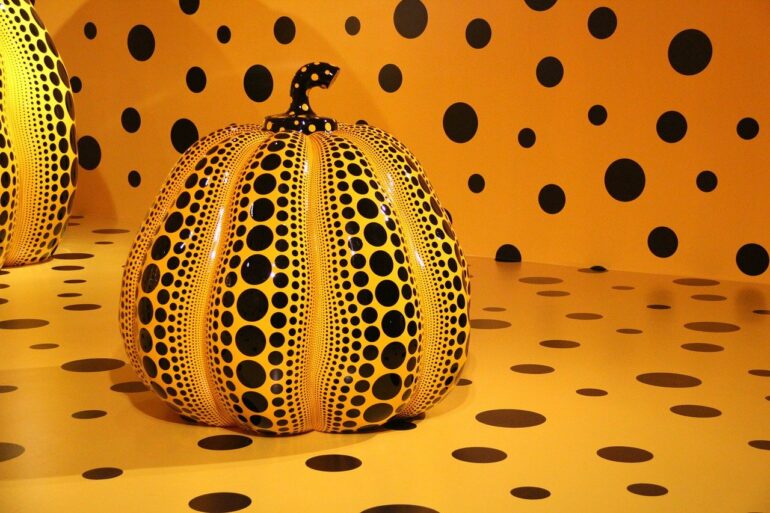
The experience often begins with a perceptual disturbance—a retinal afterimage that refuses to fade. One thinks one sees spots or circles floating before one’s eyes, before realizing that this saturation is not a visual defect, but the very essence of an artistic language. For six decades, this Japanese artist has been creating a world in which the motif is never merely an ornament, but a way of understanding emptiness and space. Over the course of her sixty-year career, she has transformed a visual obsession into a monumental body of work, capable of covering everything from canvases to entire landscapes.
The Persistence of a Vision Over Six Decades
Maintaining such aesthetic consistency for sixty years requires a form of discipline that is almost spiritual. For this artist from Japan, time has not been a factor of dispersion, but a tool of refinement. Looking back on her career is to observe how a simple idea—the repetition of a form—can become a structure capable of sustaining a lifetime of creation. This exceptional longevity now allows us to appreciate the scope of a body of work that has spanned the ages without ever compromising its fundamental principles.
The perspective we take today on these six decades of work is not merely nostalgic. It is about understanding how a visual signature—so distinctive and striking—has managed to retain its original impact. What might have been merely a phase or a fleeting experiment has become the foundation of an entire career, proving that radicalism, when pursued with such intensity, does not fade over time. The Japanese artist’s trajectory shows that repetition is not a mere rehash, but an ever-deeper exploration of the same optical mystery.
From the Abstraction of the Dot to the Presence of the Pumpkin
The transition from dots to pumpkins marks a crucial stage in this visual odyssey. While the dot represents the minimal unit—the atom of her universe—the pumpkin introduces an organic and sculptural dimension. This shift from an abstract motif to a more concrete, almost corporeal form reveals the artist’s ability to adapt her own artistic language. The pumpkin is no longer merely a surface to be covered with dots; it becomes an entity in its own right, a figure that engages in a dialogue with the dots that cover it.
This stylistic transition highlights a fascinating contrast. On one hand, the dot, which tends toward infinity and the erasure of boundaries; on the other, the pumpkin, with its mass, its curves, and its obvious physical presence. Over the course of sixty years, the artist has managed to bring these two poles together, creating a bridge between pure graphic design and natural form. The choice of this vegetable, which has become central to her repertoire, reflects a desire to anchor her work in a tangible reality, while retaining that filter of dots that renders each object alien and fascinating.

Selecting Seven Fundamental Milestones
To grasp a career of such depth, it is necessary to focus on key moments—works that serve as landmarks. Selecting seven major works allows us to trace a clear line through the decades, from the earliest experiments to the most recent creations. These seven milestones are not merely aesthetic successes; they are tangible evidence of constant evolution, demonstrating how the artist’s perspective has shifted and broadened without ever losing sight of his starting point.
Each of these seven stages tells a different part of this sixty-year history. Some emphasize accumulation, others the engagement with public space, or the integration of sculptural form. By isolating these specific moments, we gain a clearer understanding of the internal logic of a body of work that, though dominated by an obsession with pattern, has managed to reinvent itself and surprise. It is in this journey—between the rigor of the point and the generosity of the curve—that the true signature of this major figure in the Japanese art scene lies.
A study of these works reveals that the artist does not merely present forms; she offers a holistic mode of perception. As we view these seven works, we come to adopt her own vision of the world—a vision in which every object, every being, and every space is bound by this same infinite fabric. The dot is no longer merely decorative; it becomes the universal binding force of a universe that seems to never want to stop, driven by the undiminished energy of six decades of relentless exploration of form and color.