
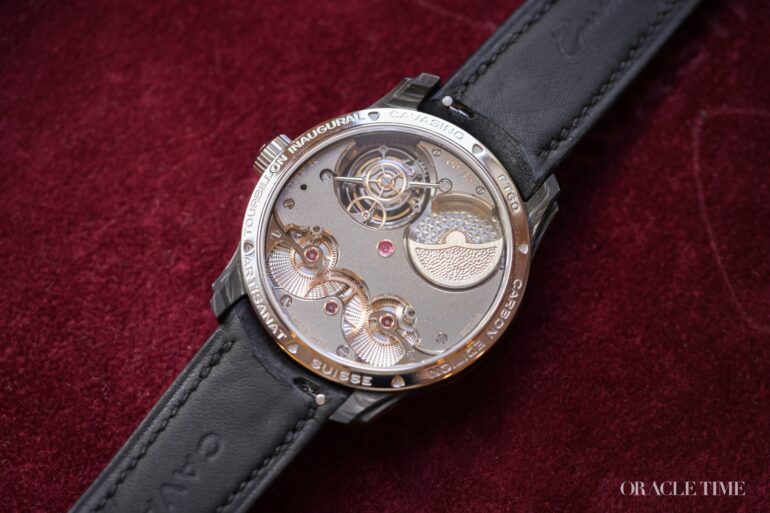
Some watches seek to impress through sheer excess. The Cavasino DCT-02 Carbon Opal takes a more focused approach: it juxtaposes two elements whose design languages rarely intersect so clearly—a tourbillon movement designed with symmetrical composition and a dial crafted from a individually selected opal. The very name of this edition, Carbon Opal, conveys the tension between mechanical construction and mineral material.
The concept, therefore, is not limited to simply telling time. It lies in the encounter between two systems of precision. On one hand, the tourbillon, the movement’s central, moving component; on the other, the opal, whose presence on the dial introduces an element of variation that cannot be reduced to industrial repetition. The DCT-02 affirms this duality without seeking to conceal it.
Symmetry as a Point of Anchor
The symmetry of the movement is the defining feature of this Cavasino. In a watch, it is never merely a graphic detail: it dictates how the eye is guided. The eye spontaneously seeks a center, correspondences, and masses that echo one another. Here, the tourbillon fits into this logic of balance, giving the mechanism a visible role in the watch’s overall identity.
This approach sets the DCT-02 apart from a design where the movement would remain hidden behind the dial. The mechanism becomes a focal point in its own right, just like the material that accompanies it. Cavasino does not seem to pit technical architecture against decorative expression; the two are meant to coexist within the same visual field.
The choice of a symmetrical tourbillon also reflects a commitment to composition. Watchmaking mechanics are often appreciated for their density, for the profusion of their components, or for the impression of life created by their movement. Symmetry introduces a different kind of discipline. It channels this richness. It provides a framework for what moves, a geometry for what rotates.
An Opal That Defies Uniformity
Set against this rigor, the opal dial brings a different sense of time. The stone is described as hand-selected—a phrase that matters here less as a claim of rarity than as a reminder of the obvious: a natural material never appears in strictly identical forms. Each selection therefore involves an assessment of surface, tone, and presence.
In the DCT-02 Carbon Opal, this dial does more than simply serve as a backdrop. It shapes the character of the watch. Where the movement offers orderly lines, the opal introduces a visual uniqueness. This is not a contradiction. It is precisely the principle that seems to structure this edition: bringing together a precise construction and a material whose appeal lies in its unique nuances.
The word “opal” also holds a special place in the model’s name. It is not relegated to a secondary mention. It appears in the name of the edition, alongside “Carbon.” This pairing indicates that the dial was not conceived as a mere chromatic variation of the DCT-02, but as one of its distinctive features.
Carbon and the stone
Carbon Opal: the name juxtaposes two materials with vastly different connotations. Carbon immediately evokes a man-made presence, while opal refers to a selected gemstone. Between the two, the watch establishes a dialogue that is anything but decorative. The name prepares the eye for an object rooted in contrast.
This contrast extends to the relationship between the dial and the tourbillon. One stems from the chosen material; the other from the engineered mechanics. One draws attention to variations; the other reveals a symmetrical organization. Their coexistence defines the piece’s aesthetic: precision is not merely about order; it can also involve harmonizing a structure with an element that retains its own personality.
This approach to combining elements avoids an overly showy interpretation of watchmaking. The DCT-02 Carbon Opal is defined not only by its tourbillon, nor solely by its dial. It depends on the dialogue between the two. Removing the opal would diminish the emotional impact of the whole; setting the tourbillon aside would cause the architectural strength of the design to vanish.
A Carefully Selected Dial, Not Simply Applied
The precision with which the opal is hand-selected deserves to remain at the heart of the experience. It shifts the focus to the decision that precedes assembly. Even before the dial is set into the watch, a specific stone must be selected. This choice establishes a direct link between the edition’s identity and the material used to create it.

This detail gives the DCT-02 Carbon Opal a less standardized presence. It is not a matter of attributing characteristics to it that are not stated, but of taking seriously what an individual selection signifies: the dial is considered on its own merits. In a timepiece where the movement demands symmetry, this focus on the opal introduces a form of counterpoint.
The result, as suggested by the model’s presentation, lies in this delicate balance. The stone must not overshadow the mechanics; the mechanics must not overshadow the stone. The watch rests on a constant visual interplay between these two elements.
A Less Expected Interpretation of the Tourbillon
The tourbillon naturally draws the eye with its movement. On this Cavasino, it also contributes to a sense of order. The term “symmetrical” changes the way we approach it: rather than viewing the mechanism as an isolated spectacle, it must be understood as a component of the entire composition.
This nuance is decisive. A watch equipped with a tourbillon may choose to focus its entire expression on this element. The DCT-02 Carbon Opal seems to prefer giving it a counterpart. The opal dial isn’t there simply to fill the remaining space; it provides a material response to the movement’s graphic precision.
Perhaps this is what makes the whole design so compelling: the watch does not require a choice between fascination with the mechanism and appreciation for the material. It orchestrates their interplay. The tourbillon offers a form of constancy within the movement; the hand-selected opal, for its part, introduces a touch of individuality to each dial.
A timepiece built on contrast
The Cavasino DCT-02 Carbon Opal distills its concept into a few clearly identifiable elements: a symmetrical tourbillon, a hand-selected opal dial, and a limited edition whose name combines carbon and stone. Nothing here suggests an intention to pile on visual effects. On the contrary, the watch’s character stems from the close relationship between these components.
This timepiece will particularly appeal to those who appreciate the artistry of mechanical watchmaking but are reluctant to separate it from the question of materials. The DCT-02 Carbon Opal places the tourbillon within a balanced structure, then disrupts this order with an opal chosen for its own sake. It is in this tension—between deliberate symmetry and a unique dial—that the model finds its voice.