
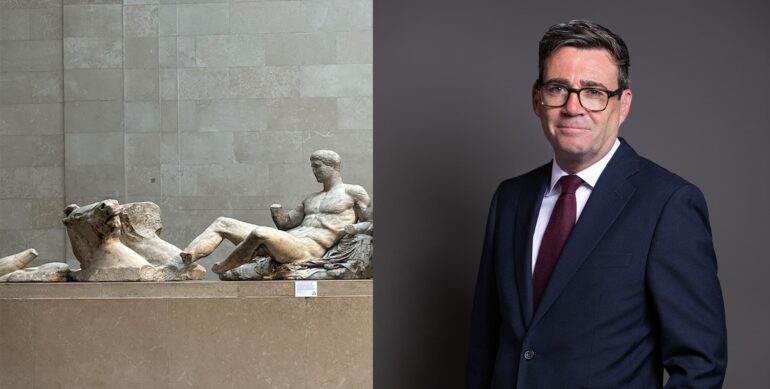
The year 2023 will undoubtedly go down in the annals of cultural diplomacy as the year in which the fault lines shifted in unexpected ways. While the corridors of London’s major institutions were mired in semantic caution, a voice rose from the north of England to shake up a status quo that had lasted two centuries. Andy Burnham, then head of Greater Manchester, chose to break with the usual restraint of British elected officials on the contentious issue of the Parthenon Marbles. His stance was not only surprising for its clarity; it also redefined the terms of a debate that many believed was mired in endless technical compromises.
A Break with the Diplomacy of Half-Measures
The support expressed by the then-Mayor of Greater Manchester was unburdened by any of the customary rhetorical precautions. Where diplomatic discussions often get bogged down in proposals for long-term loans or exchanges of deposits, the 2023 message carried a very different ambition. By advocating for the outright return of the sculptures to Athens, Andy Burnham introduced a rare sense of political candor. This was not the speech of a museum curator, but that of a local leader asserting a moral vision that transcended the boundaries of his own metropolis.
This speech marked a turning point in the way regional leaders approach issues of national heritage. By taking such a clear-cut stance, the elected official bypassed the usual layers of negotiation to address the core issue directly: the legitimacy of ownership. For Manchester, a city built on exchange and openness, making this argument in 2023 amounted to challenging the cultural centrality of the capital and its management of global heritage sites.
The Boldness of “No Strings Attached”
At the heart of this statement, one phrase resonated particularly strongly in the hushed world of art and politics: “no strings attached.” This choice of words—which could be interpreted as a total absence of conditions or quid pro quos—represents a radical break with the British Museum’s doctrine. Typically, any discussion of restitution is accompanied by complex clauses, guarantees of return, or requests for equivalent objects as compensation. In 2023, Andy Burnham swept these formalities aside.
The approach advocated by the mayor suggested that redressing a historical wrong should not be subject to bargaining. By advocating for unconditional return, he shifted the debate onto the ground of ethics rather than that of pure property rights. For observers of the art market and the museum world, this stance served as a wake-up call, proving that a prominent political figure could view restitution not as a loss, but as an act of necessary clarity. This “unconditional” stance cut through, with a stroke of the pen, the Gordian legal knots that have entangled discussions between London and Athens for decades.
A Regional Voice for a Global Issue
The fact that this initiative came from the Greater Manchester City Council is significant. In 2023, Andy Burnham embodied a form of decentralized power that no longer hesitates to challenge the central government’s prerogatives on matters of sovereignty or those of high symbolic importance. World Heritage, usually the preserve of foreign ministries and the leadership of major national institutions, has, under his leadership, become a matter for the city. This reflects a desire to see the United Kingdom reconcile with its history, moving away from the sometimes stifling cultural protectionism of London’s institutions.
The support of the Manchester elected official brought new political weight to the Greek cause. It was no longer just a country demanding the return of its national treasure, but a segment of British public opinion—represented by one of its most influential figures—that validated the legitimacy of this request. This unambiguously expressed inter-city and international solidarity demonstrated that the issues surrounding ancient art could become a major lever of political differentiation for a metropolis seeking moral leadership.
The Legacy of an Unambiguous Statement
Emphasizing the “unequivocal” nature of this support is essential to understanding the impact of Andy Burnham’s statement. In the political landscape of 2023, nuance is often the norm, especially when it comes to national collections. By rejecting any shades of gray, the mayor forced his contemporaries to take a stand. Either the presence of the marbles in the United Kingdom is an anomaly to be corrected, or it is a right to be defended; for him, the answer left no room for further debate.
This stance has left a lasting mark on how the public perceives the role of museums in the 21st century. By linking his mayoral tenure to a matter of aesthetics and international justice, Andy Burnham reminded us that culture is never disconnected from the city. Greater Manchester thus positioned itself as a counter-model to a heritage management approach perceived as rigid, preferring the brilliance of a pure act of restitution to the silent possession of fragments of history. The significance of this 2023 commitment continues to fuel reflections on what it means for a modern nation to fully embrace the end of an era of cultural appropriation.