
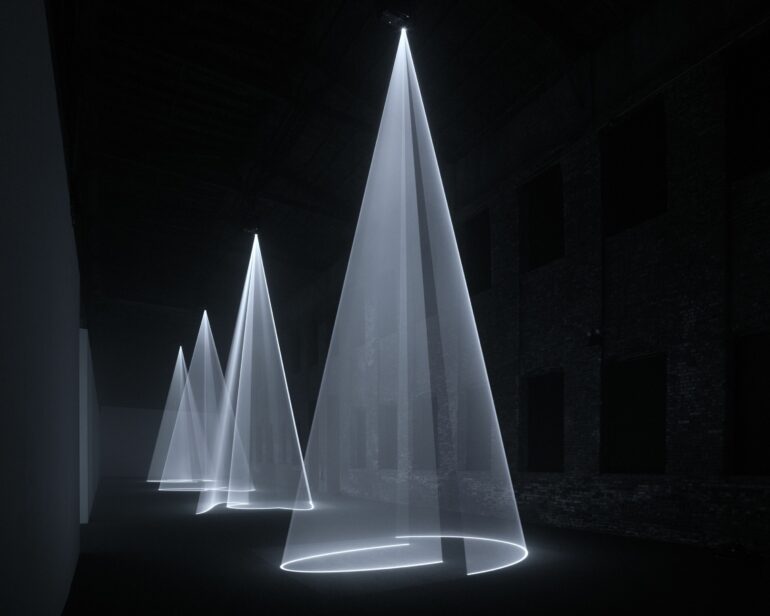
The experience always begins with an immersion in total darkness. In the silence of a gallery at the Tate Modern in London or in a Manhattan loft, a beam of light pierces the darkness. What we are looking at is not an image projected onto a wall, but the path of the light itself. This beam, which seems to possess a physical density—an almost palpable texture—defines what Anthony McCall calls “Solid Light.” Since the early 1970s, this British artist based in New York has been transforming the immaterial into volume, inviting visitors to be no longer mere passive spectators, but inhabitants of the sculpture.
The Minimalist Style of the 1970s: From Dust to Cone
Born in 1946 in St. Paul’s Cray in Greater London, Anthony McCall studied at the Ravensbourne College of Design and Communication before settling in New York’s Tribeca neighborhood in 1973. It was that year that he created his seminal work, *Line Describing a Cone*. The installation is radically simple: a 30-minute, silent 16mm film. On the screen at the back of the room, a point of light gradually traces a circle. But the essence of the work unfolds in the space between the projector and the wall.
At the time, the illusion of the beam’s solidity depended on the precarious, lived-in conditions of artists’ lofts. The light took on a tangible form thanks to suspended dust particles, cigarette smoke, or incense burned for the occasion. In this saturated atmosphere, the beam becomes a hollow cone of light, 9 to 15 meters long, that one can walk through. McCall thus aligns himself with the “expanded cinema” movement, shifting the work’s center of gravity: the event is no longer what is projected onto the wall, but the sculptural form that occupies the empty space of the room. This conceptual approach is complemented by meticulous craftsmanship; each image in his geometric animations is executed by hand, using pen and gouache, frame by frame.
The Technological Eclipse and the Digital Revival
Despite the critical success of his early installations, Anthony McCall moved away from creating light sculptures in the late 1970s. This hiatus would last about twenty years. The reason was purely technical: exhibition spaces became more sterile, regulations banned smoking in galleries, and without this “atmospheric medium,” his volumes of light disappeared, reverting to mere two-dimensional projections invisible in the clean air.
The return took place in the early 2000s thanks to the advent of haze machines. These devices emit a constant, fine mist composed of water and cornstarch, providing a uniformity that cigarette smoke could not achieve. In 2003, the work *Doubling Back* marked this renaissance. McCall abandoned 16mm film in favor of digital media. Vector animation files and high-definition video projectors now enabled geometric movements of unprecedented complexity—shapes capable of intertwining and modulating with surgical precision.
The Physics of Perception: The Illusion of a Wall
What the viewer perceives as a solid wall or an opaque membrane is in reality nothing more than a specific optical phenomenon: the backscattering of light, or the “Mie effect.” The microparticles of water projected by the fog machines intercept the photons. When the eye encounters the beam at a certain angle, diffraction creates this sensation of tangible volume. Anthony McCall plays on this phenomenological ambiguity: light is not physically solid, but the illusion is so strong that the body hesitates before passing through what appears to be a frosted glass surface or a white metal wall.
Interactivity is at the heart of his approach. In works such as *You and I, Horizontal* (2005), the audience is encouraged to enter the volumes, to walk inside the luminous structures. As they move, visitors become performers: their bodies block part of the light beam, cast their shadows within the sculpture, and thereby alter the work for other participants. This physical dimension recalls the artist’s early performances, such as *Landscape for Fire* (1972), in which grids of fires were lit outdoors at dusk to structure the space through flame.

International Recognition, from London to Shenzhen
Anthony McCall’s work is currently enjoying exceptional visibility on the global stage. The institutional exhibition “Anthony McCall: Solid Light,” on view at the Tate Modern through June 2025, attests to the historical and contemporary significance of his work. Meanwhile, the Guggenheim Bilbao hosted the installation *Split Second* in 2024, while the MAAT in Lisbon is exploring his “Rooms” through spring 2025.
The expansion of his work into Asia is also marked by major events, notably at the Shenzhen Bay Cultural Park in China in November 2025, followed by the Ulsan Art Museum in South Korea in early 2026. In New York, his long-standing gallery, Sean Kelly Gallery, is planning a major exhibition for September 2026 titled “Solid Light, 1973, 2020, 2026,” which will feature the creation of a major new work: Swarm.
The Art Market for Light: Rarity and Editions
Represented by leading galleries such as Sprüth Magers and the Martine Aboucaya Gallery in Paris, McCall manages the distribution of his work with a strictly conceptual approach. The large-scale installations in “Solid Light” are produced in very limited editions, often restricted to three copies accompanied by one or two artist’s proofs. These monumental pieces, which can cost galleries several hundred thousand dollars, are primarily acquired by major public institutions and private foundations.
For private collectors, his work is available in more traditional but equally rigorous formats. Photographic prints and works on paper, such as the “Smoke Screen” series (2017/2018), offer a way to explore his artistic universe, with estimates ranging from $3,000 to $15,000 (or approximately €2,700 to €13,500). These drawings and photographs document and extend the exploration of the geometry of light, capturing on paper what, in exhibition spaces, is merely a fleeting apparition sustained by a wisp of mist. Although the monumental project *Column*, planned for the 2012 London Olympics, could not be realized technically, McCall’s current installations confirm that his ambition to sculpt the void remains perfectly tangible.