
The Paradox of Collections: Immobility in the Face of Territory
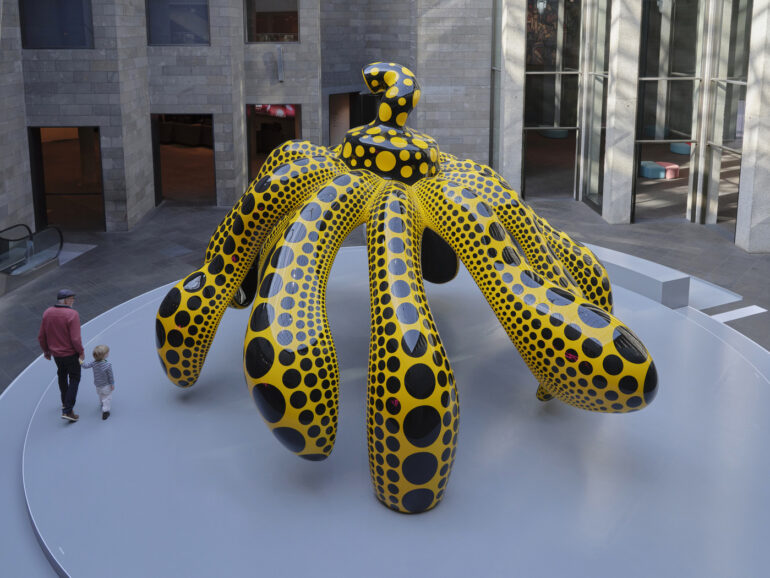
In the contemporary museum ecosystem, the logic of conservation often produces a geography of exclusion. Gather to protect, centralize to manage: this doctrine ultimately creates fortresses where art languishes in the dark. In Canberra, the National Gallery of Australia (NGA) confronts this contradiction head-on. The basements and storage areas of this federal institution house a staggering collection of over 155,000 works. This massive collection includes, notably, the world’s largest and most thoroughly documented collection of Aboriginal and Torres Strait Islander art. However, this accumulation of major works is at odds with the scale of the Australian continent. Vast distances effectively isolate a large portion of the population from its own heritage, confining it to the gallery walls of the capital. To break this deadlock, the government has chosen to reverse the dynamic: since audiences in remote regions struggle to travel to see the masterpieces, the masterpieces themselves will make the journey.
The initiative, dubbed “Sharing the National Collection” and conceived as one of the pillars of the “Revive” cultural policy, marks a radical departure from romantic discourses on the democratization of art. The approach is surgical, almost industrial. It stems from a stark reality: a masterpiece locked away in a secure vault generates no social interaction or economic benefit. Unlocking this dormant value and injecting it into the local economy requires extensive logistics, which the government has decided to take on head-on.
The Diplomacy of Transportation and Insurance
Bringing art history outside major metropolitan areas generally hits a financial wall. Regional institutions, suburban art centers, and municipal galleries lack both the operating budgets and the security standards required to host masterpieces. To circumvent this barrier, the Ministry of Infrastructure has established a fund of 11.8 million Australian dollars. This credit line, spread over a four-year cycle, acts as a safety net for host institutions by covering peripheral costs—which are major obstacles to touring exhibitions.
The NGA thus provides state-of-the-art logistics entirely at its own expense. Lending a work of art requires the fabrication of custom climate-controlled crates, conservation condition assessments, escorted or highly supervised transport, and the deployment of specialized curators to oversee installation at the final site. Even more crucially, the program covers the full cost of insurance premiums, from the time the artwork is picked up in Canberra until the end of the exhibition period. This “end-to-end” arrangement completely relieves regional galleries of an overwhelming financial risk, allowing them to participate in major events without jeopardizing their own budgetary stability.
The Ripple Effect of Historic Signatures
Data compiled over the past three years attests to the scale of this regional redeployment. No fewer than 327 exhibitions have left the national capital to be hosted by 42 institutions spread across all Australian states and territories. The impact of this shift is not merely an administrative abstraction. According to figures presented by Minister Tony Burke, the two-million-spectator threshold has been surpassed, proving the effectiveness of a policy that relies on highly renowned artists to disrupt local attendance patterns.
The “visual shock” strategy is working. When a community far from traditional art circuits hosts a name that typically appears in school textbooks, the cultural balance of power shifts. The loan of Claude Monet’s painting *Haystacks, Midday* to the Tweed Regional Gallery & Margaret Olley Art Centre illustrates this dynamic. The arrival of an Impressionist painting of this caliber acts like a magnet, drawing in an audience that would never have visited the institution otherwise. The presence of such a piece in a regional setting instantly redraws the map of attractiveness.
Andy Warhol in Perth: Art as an Economic Asset
The full impact of this strategy becomes apparent when applied to large-scale collections over the long term. On the west coast, the Wanneroo Regional Gallery in Perth has received more than fifty works by Andy Warhol, on loan from the NGA for a two-year period. The introduction of the “Pope of Pop Art” into this specific context sparked an immediate surge in visitor numbers. Statistics from the first four months of operation show a 754% jump in attendance.
These percentages do not merely reflect a box-office triumph. They outline the contours of a circular economy fueled by culture. Reports from the cultural administration highlight an average 56% increase in foot traffic across all host venues during the first six months of the loan. Behind this average lies the entire local service sector springing into action. The physical journey to view Warhol’s colorful blocks or stand before a monumental abstraction by Barnett Newman in Shoalhaven changes visitors’ behavior. They linger, have lunch at local restaurants, shop at nearby stores, and sometimes stay at local hotels. The artwork, beyond its priceless heritage value, becomes a catalyst for direct spending in the municipality.
The Long Term and the Redefinition of the Relationship with the Work
The true ingenuity of this network lies in its temporality. Unlike the model of the temporary exhibition—conceived as a fast-moving consumer product designed to generate a spike in attention over a three- or four-month window—the system implemented by Canberra prioritizes the long term. By remaining on display for several years in a municipal or regional gallery, the works cease to be fleeting curiosities.
They become part of the region’s cultural landscape, find their way into the educational curricula of nearby schools, and enable the local institution to forge a strong identity. Decentralization, in this context, no longer consists of granting a fleeting favor from the capital, but rather of delegating the stewardship of the national heritage. By assuming the cost and complexity of such a traveling exhibition, the state transforms the static value of art into a concrete driving force, reshaping the economy and cultural geography of the continent.