
The Ultimate Point and the Vertigo of Infinity
The art world awoke to a sense of emptiness, as if one of its most enduring motifs had just faded away to rejoin the space it had always represented. At the age of 97, the woman who had made repetition a form of survival passed away, leaving behind a body of work that redefined the perception of the contemporary gaze. She was not merely a creator; she was the architect of a visual semantics in which the smallest element—the dot—served to measure the immensity of the cosmos. Her career, marked by exceptional longevity, came to a close at the impressive milestone of nearly a century, signaling the end of a journey that today seems to belong to modern mythology.
From Japan to Conquering the World
Nothing foreshadowed that a life begun in rural Japan would one day set the standards for global aesthetics. Yet it was in this humble setting, far from the creative hubs, that a determination was forged that would upend established norms. The rise was complete. Moving from the anonymity of the Japanese countryside to the status of an international star is not merely a change of address; it is a cultural metamorphosis. She transformed the isolation of her origins into a universal force, proving that art, when it borders on obsession, knows no geographical boundaries.
This path to global fame was not a straight line, but a continuous expansion, much like the motifs she loved. By breaking free from her original milieu to become a central figure in contemporary art, she demonstrated an extraordinary capacity for resilience. Her success is measured not only by the recognition of her peers but by the way her name has become inextricably linked to a certain idea of modernity. She lived her era with an intensity that ultimately made her a pillar, a reference point upon which many reflections on contemporary creation now rely.
The Grammar of the Polka Dot and the Language of Proliferation
At the center of her universe lies a simple, almost childlike unit that she elevated to the status of a philosophical concept: the polka dot. For her, it was not merely an ornament, but a fundamental building block used to construct a complete system of thought. Through the obsessive repetition of this circular form, she sought to convey a worldview in which the individual is merely one particle among many. The dot became her signature, her fingerprint, the means by which she colonized the visual space of our century.
This accumulation of dots is never merely decorative. It responds to an inner need to saturate the field of vision, to offer an alternative to reality through proliferation. In her hands, the motif becomes a tool for transforming reality. By covering surfaces, she erases the hierarchies between the object, the space, and the observer. It is this radicalism that has allowed her to define an entire era of creation, imposing an aesthetic of overload where others sought simplicity. The dot, in its radical simplicity, has become the vehicle for a complex emotion, blending wonder with a sense of anxiety in the face of the infinite.

Mirrors and the Vertigo of Erasure
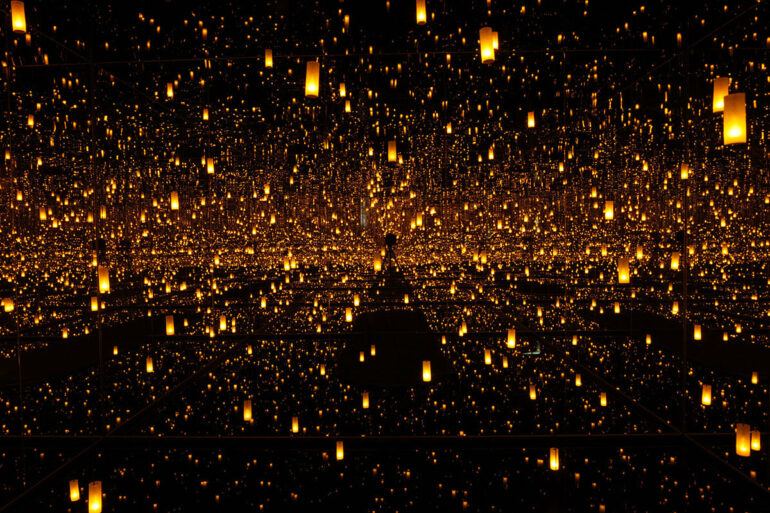
The other major pillar of her approach lies in her masterful use of mirrors. While the dot saturates space, the mirror abolishes it. By creating environments where reflections multiply as far as the eye can see, she has offered the public a physical experience of the concept of infinity. These installations are not mere optical devices; they are invitations to lose oneself, to experience the dissolution of the self in an immensity without beginning or end. One enters to confront one’s own multiplicity, to see one’s image fragmented and projected into a dimension that transcends human understanding.
Here, the mirror acts as a multiplier of consciousness. It transforms a closed room into an expanding universe, physically illustrating this quest for infinity that has spanned her entire life. This search for the boundless is not merely a technical feat; it is the beating heart of her work. She has used reflection to question our place in the universe, placing us at the center of a galaxy of points and lights. This ability to materialize the immaterial—to give form to the idea of eternity—explains why her creations have sparked such fascination around the globe. She succeeded in capturing the void and making it tangible through the interplay of reflections.
The Legacy of a Pioneering Figure
At the age of 97, her passing brings a major chapter in art history to a close. She leaves behind not only her works but also a visual philosophy that has influenced design, fashion, and society as a whole. By becoming an indispensable figure, she proved that aesthetic perseverance could ultimately alter the very structure of mainstream culture. She was no longer just a Japanese expatriate artist; she had become an institution in her own right, an anchor for all those seeking to understand how art can influence the modern world.
Her status as a cornerstone of contemporary art is well-deserved. She has spanned the decades with remarkable consistency, remaining true to the obsessions of her youth while adapting them to an increasingly monumental scale. The longevity of her career allowed her to witness the unfolding of her own legend and to observe the impact of her artistic language on subsequent generations. Today, as the final chapter of her own life has just come to a close, her work continues to resonate. She leaves us facing these mirrors and these dots, reminding us that while existence is finite, art itself has the power to project us into an endless eternity. The circle is complete, but the reflections she created will continue to multiply long after silence has settled in.