
Make Texture a preferred source on Google to support us
Add Texture to GoogleThe Silent Horizon: Nomadic Life in the Age of Electronics
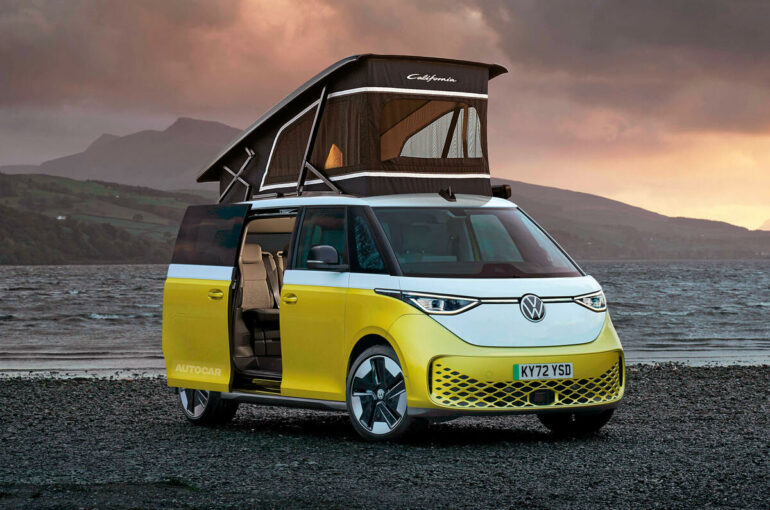
The very idea of getting away—of leaving the city streets behind to venture deep into the forests or along wild coastlines—has long been punctuated by the muffled rumble of an internal combustion engine. It was a paradox: seeking out nature while simultaneously introducing the vibrations and emissions of a diesel or gasoline engine. Today, this contradiction is fading away. The announcement of the first fully battery-powered camper van marks a breakthrough that is not only technical but also cultural. This shift to electric power for a mobile home is not merely a catalog update; it is a complete redefinition of the self-sufficient travel experience.
By choosing to base this transformation on the ID. Buzz Pro platform, the manufacturer is doing more than just switching the powertrain. It is shifting the focus toward an approach where silence becomes the camper’s greatest asset. Imagine arriving at a protected natural site where the only audible sound is the roll of tires on gravel, without the awakening of the surrounding wildlife being disturbed by the roar of an internal combustion engine. This acoustic discretion radically changes the relationship with the landscape and the intimacy of the campsite.
The Pro platform as an architectural foundation
The choice of the Pro variant to serve as the foundation for this first electric camper van is no accident. Within the modular architecture of the Volkswagen lineup, this version stands out for its space management and energy capacity, which meet the requirements of a home on wheels. Transforming a transport vehicle into a living space requires particular structural precision. It must be possible to accommodate kitchen modules, sleeping areas, and storage without compromising the platform’s balance or the efficiency of the electric drivetrain.
The ID. Buzz Pro offers this flexibility. Its wheelbase and the arrangement of its batteries in the floor allow for a low center of gravity—a crucial advantage for a vehicle whose total weight will inevitably be affected by its interior equipment. Road stability—often a weak point for raised or heavily loaded vans—benefits directly from the vehicle’s all-electric design. Instead of being added to a complex mechanical system, the camping furnishings are integrated into an interior space already optimized by the absence of a transmission tunnel and a bulky engine compartment up front.
The Challenge of Range in Uncharted Territory
The main challenge of this transition remains energy management, an issue that takes on critical importance when it comes to wild camping. The shift to an “all-battery” system for a camper van requires travelers to adopt a new way of thinking. It’s no longer just a matter of keeping an eye on the fuel gauge to reach the next stop, but of managing a supply of electrons that powers both mobility and daily life on board: lighting, refrigeration, and possibly cooking.
However, this apparent constraint hides an unprecedented opportunity. The presence of a high-capacity battery, inherited from the ID. Buzz Pro, transforms the vehicle into a giant energy reservoir. Unlike conventional setups that rely on auxiliary batteries—which are often limited—the central electrical system can power onboard equipment for much longer periods. The challenge, then, is to find the right balance between driving range and comfort while stationary. The traveler then becomes a strategist of their own energy consumption, perhaps opting for shorter but more immersive trips, where the charging network allows the vehicle to recharge while they take advantage of the break to explore the surroundings.
An Aesthetic of Continuity and the Future
Visually, drawing on the ID. Buzz Pro to create this first camper van model allows for a familiar silhouette while asserting a radically modern aesthetic. The vehicle’s design undeniably evokes a lineage of vans that have shaped the collective imagination of freedom for decades. However, the transition to electric power requires more fluid, aerodynamic lines—essential for maximizing energy efficiency. Every curve and every body joint is designed to cut through the air with as little resistance as possible, a must for maintaining range on the highway.

Inside, the approach is just as innovative. The use of sustainable materials and the pursuit of simplified ergonomics align with the values embodied by electric propulsion. We leave behind the sometimes austere and utilitarian world of older models to enter a cabin that is more reminiscent of contemporary furniture design. The absence of mechanical vibrations and the heat generated by traditional engines allow for greater freedom in interior design, using textiles and textures that would have been unthinkable in a noisy, greasy thermal environment.
Travel as an Experience of Decarbonization
Beyond its technical aspects, this first battery-powered camper van symbolizes a commitment to making nomadic travel compatible with today’s environmental imperatives. “Van Life,” often glorified on social media, is sometimes criticized for its significant carbon footprint, linked to the high fuel consumption of heavy-duty vans. By switching to the ID. Buzz Pro platform, the brand is offering an alternative that eliminates local emissions both during travel and while parked.
This shift also requires tourism infrastructure to evolve. We’re already seeing charging stations appear in some nature parks and high-end campgrounds, blending discreetly into the landscape. The traveler of tomorrow will no longer necessarily seek out the nearest gas station, but rather a charging point that will allow them to set off again with a full battery while having used electricity ideally generated locally from renewable sources. This is a circular vision of travel, where the vehicle no longer merely passes through a region but connects to it in an almost organic way.
The decision to base this project on the ID. Buzz Pro confirms that the recreational segment is no longer a niche overlooked by electrification, but rather a testing ground for real-world use. If battery technology can meet the needs of demanding travelers—who cover thousands of kilometers and live in their vehicles—it will prove its full maturity. This first step toward electric camping is just the beginning of an era in which the open road will no longer be synonymous with inconvenience, but rather with a silent glide toward new horizons.