
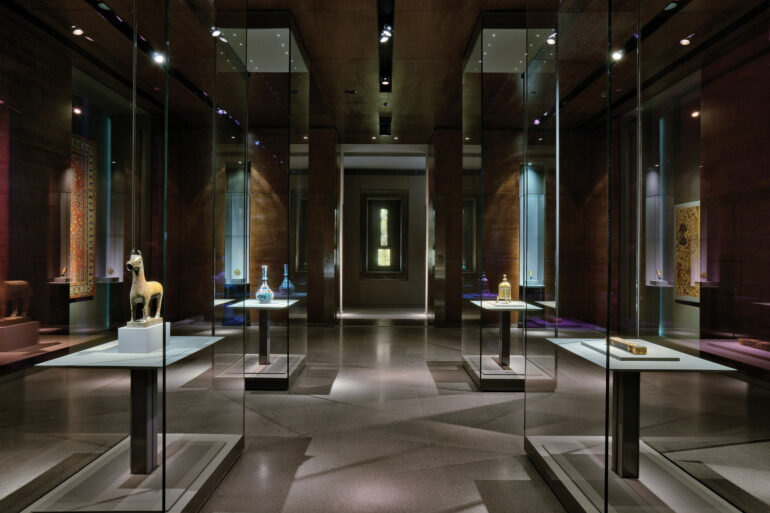
When diplomatic channels become bogged down and official negotiations hit a wall due to intransigence on both sides, another network quietly takes over. Far from being merely a marketing tool or a flashy showcase for collections, cultural diplomacy has established itself as a parallel channel of communication, capable of operating where political maneuvering runs out of steam. This alternative mechanism has found a clear platform in Doha. Recently, the Museum of Islamic Art hosted in-depth discussions on the diplomatic impact of art. Organized under the auspices of the fall-winter season of the “Qatar Creates” program, this roundtable provided an opportunity to compare the experiences of two key figures in institutional relations: Sheikha Al Mayassa bint Hamad Al Thani, who chairs the Qatar Museums Council, and Anne-Claire Legendre, head of the Arab World Institute.
The Mechanics of Points of Contact
The starting premise avoids the naivety often associated with discourses on bringing peoples closer together. Sheikha Al Mayassa identifies a primary, raw, and essential driving force: curiosity. It is this specific intellectual impulse that compels an individual—or a nation—to scrutinize the other with newfound depth, moving beyond caricatures to seek out a shared humanity. Diplomatic archives are replete with examples where, in the face of a complete freeze in bilateral relations, the exchange of artworks and artists has maintained a thread of communication. Career diplomats and curators share this empirical certainty. Organizing a joint exhibition, hosting an artist-in-residence program, or lending historical artifacts creates neutral ground. These projects forge direct points of contact that foreign ministries—bound by their strict protocols—struggle to establish on their own.
These spaces for interaction alter the very nature of the institutions involved. Museums are moving away from their traditional role as mere custodians of inert objects. They are transforming into generators of social and intellectual relationships. The challenge is no longer merely to display, but to accustom audiences from diverse backgrounds to converse, to debate, and to tolerate the ambiguity inherent in all aesthetic creation. The Qatari initiative, supported in this specific context by the French Embassy in Qatar and the Institut français, illustrates this strategic shift in the museum world.
The Emotional Approach
Anne-Claire Legendre’s approach complements this vision by shifting the focus toward psychology. The president of the Arab World Institute argues that cultural dialogue breaks through habitual defenses because it targets a more intimate level of consciousness. Encountering a painting, a sculpture, or a contemporary installation directly evokes emotions. Embracing this investment in positive emotions thus becomes a deliberate tactic to defuse deep-seated mistrust.
Traditional foreign policy generally operates in fits and starts. International summits, joint press releases, or emergency resolutions are characterized by a disjointed, highly sporadic timeline. The work of a cultural institution, by contrast, is part of a long-term process. A program spanning several seasons helps establish continuity in the relationship. Building on this regularity, the partnerships forged between Paris and Doha seek to fill the space with opportunities for dialogue, thereby avoiding the relational vacuum that often precedes political crises.
The Significance of Geography and the Long Term
The choice of building to host these discussions is by no means incidental. The Museum of Islamic Art in Doha serves as a real-time demonstration of the concepts under discussion. Its galleries document how manuscripts, craft techniques, scientific theories, and architectural motifs have traveled through the centuries. The objects on display transcend modern national borders. They serve as a physical reminder that the absolute compartmentalization of societies is a historical fiction and that knowledge thrives on constant hybridization.
Today, many governments are reassessing the mandate of their cultural networks in light of this reality. Institutional expectations are shifting: museums are being called upon to assume their role as architects of international understanding. This behind-the-scenes diplomacy requires extreme patience. It is built by aligning cross-disciplinary programs, creating artistic consortia, and engaging in continuous dialogue with the public. Art does not claim to erase economic disparities or resolve stark geopolitical disagreements with a single brushstroke. It lacks the binding force of an international treaty. Instead, it undertakes a much more subtle preliminary mission: to shift the prevailing atmosphere, make the air breathable, and establish the climate essential for any future negotiations.