
On September 26, 1960, seventy million Americans were glued to their television screens. In the CBS studios in Chicago, Richard Nixon and John F. Kennedy faced off in the first presidential debate in history. Attention was focused on their faces—one’s confidence, the other’s pallor. Yet the silent star of this political evening stood in the spotlight, physically bearing the weight of this historic moment. It was the chairs in which the two candidates were seated. No massive armrests, no gilding, and no padded velvet. Just clean lines, a curved backrest carved from a single piece of wood, and a woven seat. This chair, simply named “The Chair,” would propel Danish design into homes around the world. For its creator, Hans J. Wegner, this global exposure was almost a misunderstanding. His ambition had never been to furnish television sets, but to solve a physical and anatomical equation through woodworking.
The gouge, the plane, and the refusal to compromise
Before becoming the creator of a staggering catalog of more than five hundred designs, Hans J. Wegner was, at his core, a man of the workshop. Born in 1914 in Tønder, a town in southern Denmark, he learned the craft of cabinetmaking as a teenager. This visceral familiarity with the material would dictate the entirety of his visual language. While his contemporaries, influenced by the shockwave of the Bauhaus, rushed to embrace tubular steel and pursued industrialization to the extreme, Wegner kept his hands covered in sawdust. Oak, ash, walnut, and cherry are not mere backdrops; they are the sole protagonists of his creations.
He refused to jot down vague sketches on paper only to hand them off to impersonal factories. He spent entire days alongside artisans—particularly in the workshops of PP Møbler—carving, filing, and sanding his prototypes. He pushed each wood species to its breaking point. His method involves refining a wooden leg without ever compromising its stability, or curving a backrest so that it conforms to the lumbar region without requiring any padding. For him, a chair has no front or back: it must reveal the same high standard of finish from every angle, including those we never see.
From Chinese dynasties to bourgeois dining rooms
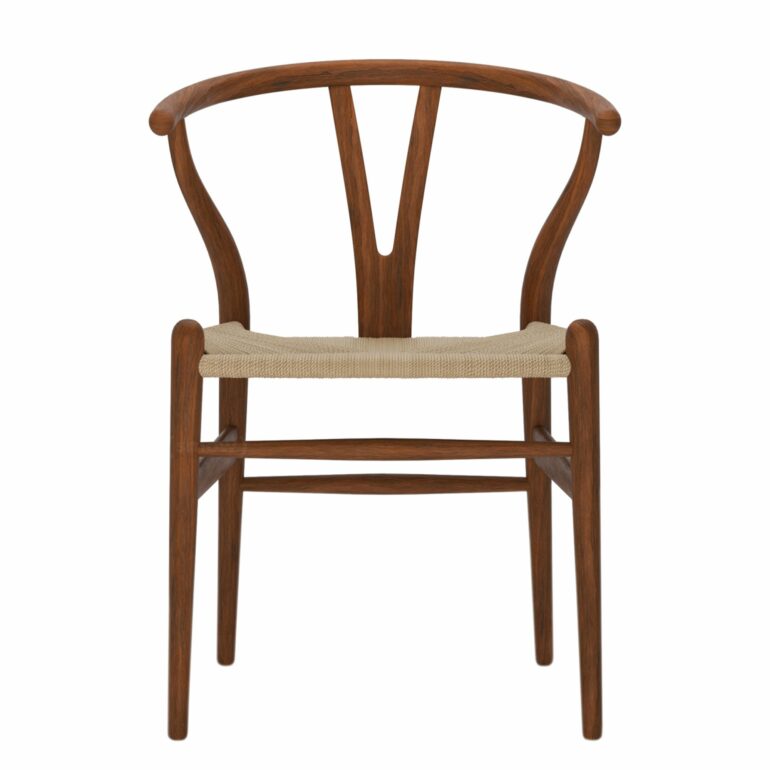
Wegner does not claim to make a clean break with the past. Contrary to the myth of a Scandinavian modernism that emerged out of nowhere, he draws on the history of global furniture to strip it down to its essence. The clearest example of this minimalist approach remains the CH24. In 1950, the Carl Hansen & Søn factory began production of this model, whose origins trace back to the observation of portraits of Danish merchants seated in large Ming Dynasty armchairs. Wegner looked at these massive Asian chairs and decided to strip away their heaviness, retaining only a sleek, slender frame.
The Y-shaped backrest—which earned it the nickname “Wishbone Chair” in the English-speaking market—serves a strictly mechanical purpose. It acts as a central pillar to support the steam-bent upper arch, while allowing the seated person’s spine to remain unobstructed. The seat abandons solid wood in favor of a hand-woven design requiring more than 120 meters of reinforced paper cord. This combination of structural rigidity and flexible support makes the CH24 an exercise in anatomical minimalism. In continuous production for over seven decades, it transcends passing trends.
The same logic of reinvention can be seen in the lines of the Peacock Chair, designed in 1947. Wegner took on the classic British Windsor armchair with its slats. He chose to flatten the central section of the wooden spindles, precisely where the shoulder blades rest. The visual effect immediately brings to mind the tail of a peacock in courtship, but this aesthetic innovation stemmed first and foremost from an ergonomic necessity.
The raw intrusion of metal and nautical rope
While he remains the master of light, soap-finished woods, the designer allows himself sudden deviations in materials. The Flag Halyard Chair, sketched in 1950, stands out like a bolt from the blue amid his archives. The idea didn’t spring from the scent of wax in the workshop, but during a summer afternoon on a beach in Aarhus. Seeking the perfect angle to gaze at the sea without straining his neck, Wegner dug into the sand around his body to shape the ideal incline. Back at home, he translated this posture with brutal coldness: a solid stainless steel frame that marks a sharp break from the warmth of his previous pieces.
To weave the seat, he set aside organic materials and wound 240 meters of flag rope—an extremely durable nautical cord—around the metal frames. A piece of sheepskin casually draped over the frame softens the industrial harshness of the construction. This armchair demonstrates that Wegner’s obsession is not with cabinetmaking for its own sake, but with the strict alignment between the function of a seat, the physical properties of a material, and the posture of the human body.

An animalistic and sensual embrace
When Wegner turned away from dining chairs to focus on the lounge chair, his design became broader and more enveloping. The Papa Bear Chair (1951) marks a break in the handling of volumes. This upholstered behemoth makes a bold statement with its high, sloping backrest and long, prominent armrests. Design lore has it that a critic, sinking into it for the first time, described the sensation as being grabbed from behind by the paws of a large, protective bear.
Beneath the wool upholstery, the raw wood frame remains highly complex, requiring carpenters to possess a rare mastery of angles and stress points. The stroke of genius in this piece lies in a seemingly minor detail: the ends of the armrests pierce through the fabric, revealing the bare wood. These “paws,” made of teak, oak, or walnut, provide a firm grip for rising from the chair. They protect areas subject to intense friction from dirt and wear, while providing a smooth surface for the hand to instinctively brush against while reading.
Surface Tension and the Patina of Time
At the dawn of the 1960s, technical advances in molded plywood opened up a new field of exploration. In 1963, he sketched the curves of the Shell Chair (CH07). The chair rests on just three legs. Its seat takes the form of a wing curved upward, topped by a floating backrest. The boldness of these lines is instantly disconcerting. The public shunned this chair with its wide, frozen smile; critics remained unmoved; and production ceased quickly after a limited run.
The design would not be unearthed from the archives and reintroduced to the market until the late 1990s. The precision of its proportions and the tension of its wooden surfaces then became immediately apparent. The Shell Chair demonstrates its designer’s ability to set aside his own formal certainties to shape emptiness with the same rigor as solid material.
Unlike sculptures that demand a reverent distance, the furniture designed by Hans J. Wegner defies the very notion of being turned into a museum piece. It calls for weight, movement, and friction. The light oak darkens upon contact with light and the palms of the hands; the paper cord softens and molds itself to the owner’s frame; the wool weaves smooth out. The formal refinement of a chair cannot be judged at a trade show or on the glossy pages of a brochure, but rather in the slow transformation of an object forced to endure decades in the middle of a living room.