
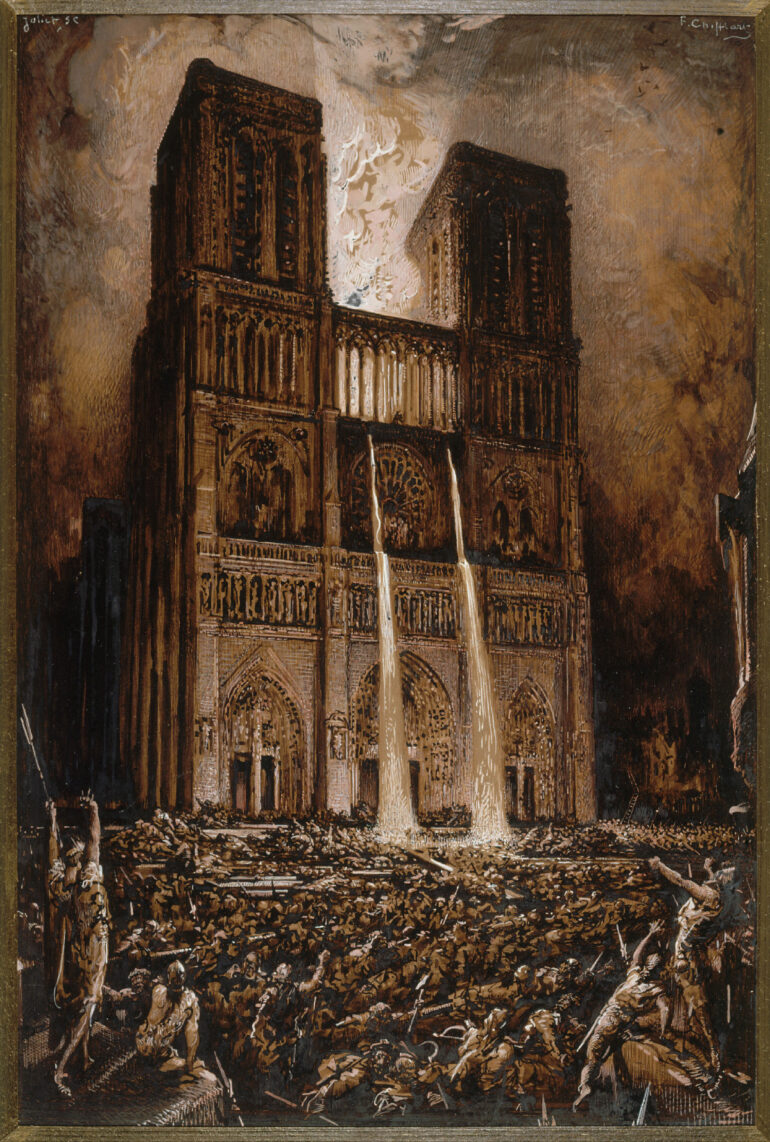
On December 2, 1804, as Napoleon I prepared to be crowned emperor, Notre-Dame Cathedral in Paris presented the sight of a mutilated giant. To conceal the dilapidated state of the walls and the ravages of time, the architects in charge of the ceremony deployed an arsenal of deceptions: scaffolding structures, thick silk drapes, and decorations made of papier-mâché or stucco. Behind this ceremonial pomp, the medieval monument was on its last legs. A few years later, civil administrators and Parisian speculators even considered, with chilling pragmatism, its outright demolition or partial razing to make way for urban modernity. It would take the romantic fervor and the pen of a twenty-nine-year-old man to transform this scorned heap of stones into a sacred national symbol.
A Stone’s Agony Under the Blows of the Revolution
The state of disrepair in which Victor Hugo found the building in the early 19th century was the result of a decade of ideological fury. Between 1789 and 1799, the French Revolution relentlessly attacked this bastion of “fanaticism.” The sculptures on the portals were mutilated, and the Gallery of the Kings of Judah—mistaken by the insurgents for the Gallery of the Kings of France—was systematically destroyed. In 1792, the original spire, a 13th-century masterpiece, was dismantled. Notre-Dame lost its verticality and its function: in November 1793, the Paris Commune banned religious worship and transformed the nave into the Temple of Reason, before relegating it to the status of a storage warehouse.
Despite the signing of the Concordat in 1801 and the return of the site to the Catholic Church the following year, no budget was allocated for its preservation. The monument suffered another blow during the July Revolution of 1830. Anti-corporatist and anticlerical riots devastated the adjoining archbishop’s palace, while the stained-glass windows were shattered. It was against this backdrop of imminent ruin—with the cathedral’s fate seemingly sealed by the authorities’ indifference—that Victor Hugo entered the scene.
The Literary Campaign: The Monument as a Character
Hugo’s campaign did not begin with fiction. As early as 1825, he published a “Note on the Destruction of Monuments in France,” a pioneering text denouncing vandalism and the neglect of medieval heritage. But it was in March 1831, through the publisher Charles Gosselin, that the writer delivered the decisive blow with the publication of his novel *Notre-Dame de Paris*. For the first time in literary history, Gothic architecture served as more than just a backdrop; it became the central protagonist of the narrative, the stone body in which the fates of Esmeralda and Quasimodo intertwine.
The success was immediate and overwhelming. Hugo did not stop there. In the 1832 reprint, he added a vehement note denouncing the inappropriate neoclassical restorations that distorted the spirit of the place. At the same time, he published his pamphlet “War on the Demolishers!” in the *Revue des Deux Mondes*, in which he called for a law to protect ancient monuments. Public opinion rallied around this old lady of stone, whose tragic beauty Hugo had revealed. The outpouring of emotion sparked by the text made the building’s demolition politically impossible from that point on.
The Invention of Modern Restoration
Spurred by this popular enthusiasm, the July Monarchy stepped up to the plate. In 1837, the Commission des monuments historiques was created, led by figures such as Prosper Mérimée. The national restoration project was officially launched in 1842 by the Ministry of Justice and Religious Affairs. A government competition was organized in 1843 to select the architects capable of taking on this colossal challenge.

On March 11, 1844, the proposal submitted by Eugène Viollet-le-Duc and Jean-Baptiste Lassus was declared the winner. The following year, in July 1845, a state law was enacted to allocate an initial budget of 2,000,000 French francs. This budget was later supplemented by an additional allocation of 3,000,000 francs, bringing the total investment to approximately 5 million francs at the time (a sum estimated today, theoretically, at between 15 and 20 million euros in present-day terms).
The restoration project, which spanned from 1845 to 1864, restored the cathedral to its former splendor and its fantastical bestiary. Viollet-le-Duc restored the facades, recreated the Gallery of the Kings of Judah, and sculpted the famous chimeras. The crowning achievement of this renaissance, the new spire was completed in 1859, restoring the cathedral’s medieval silhouette to the Paris skyline. To learn more about the poet’s life and his activism, visit the Maisons de Victor Hugo website.
The Premonition of 1831 and the Fire of 2019
Victor Hugo’s shadow still looms over the cathedral’s vaults, especially since the novelist seems to have had a unsettling premonition. In Book X of his masterpiece, he describes a fictional fire at the cathedral with striking precision: “All eyes had turned upward toward the top of the cathedral. What they saw was extraordinary. At the very top of the highest gallery, higher than the central rose window, a great flame rose between the two bell towers, accompanied by swirls of sparks. ” He even mentions molten lead flowing from the gutters—an image that found a tragic echo during the fire on April 15, 2019.
In the aftermath of that disaster, Hugo’s novel immediately shot back to the top of the bestseller list in France, as if readers were searching its pages for a remedy for the collapse. Today, the restoration work coordinated by the public institution Rebâtir Notre-Dame de Paris is part of this long tradition of rescue efforts in which political will responds to a profound cultural need. Under the supervision of the Ministry of Culture, the cathedral is preparing to open a new chapter, confirming Hugo’s prophecy: the monument is a book of stone that time—sometimes aided by poets—refuses to close.