
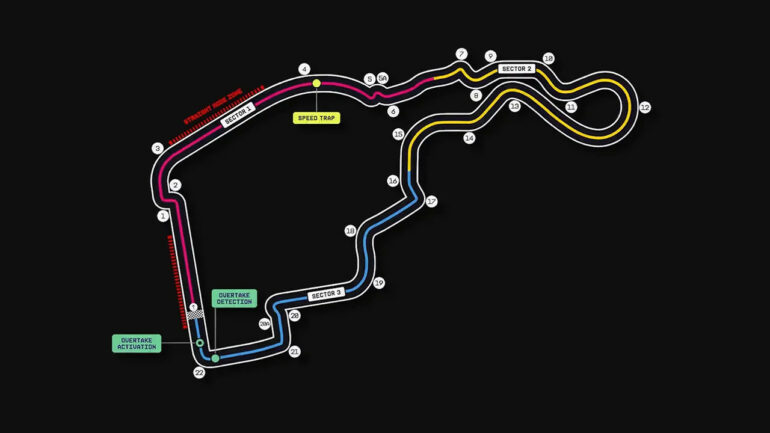
The asphalt has its own architects, and Jarno Zaffelli belongs to that category of engineers whose pen strokes reshape the geography of capital cities. In Madrid, the future Formula 1 Grand Prix—scheduled to become a permanent fixture from 2026 to 2035—will not be a mere succession of urban straights. The “Madring” project, officially named Circuito IFEMA Madrid, is shaping up to be a hybrid structure, a cross between a temporary track and permanent infrastructure. Yet behind the numbers and curves of this 5.414-kilometer circuit lies a complex interplay where the Italian engineer’s creative vision clashed with contractual realities and the requirements of the Fédération Internationale de l’Automobile (FIA).
The Genesis of an Urban Hybrid
It all began in 2022. Originally, the Italian firm Studio Dromo, led by Jarno Zaffelli, was commissioned to renovate the historic Jarama Circuit. But Madrid’s ambitions quickly expanded in scope. The developer, IFEMA Madrid, redefined the scope of the project: the goal was no longer to restore the old track, but to design a brand-new circuit around the exhibition complex in the Barajas/Valdebebas district. The technical challenge was considerable. The circuit had to wind its way between the existing exhibition halls and extend onto adjacent land, creating a semi-urban course connected by two short tunnels.
Zaffelli then designed a 22-turn track, certified as Grade 1 by the FIA, capable of accommodating 110,000 spectators upon its opening, with the potential to expand to 140,000. The structure of this “Madring” is based on an alternation of temporary urban sections and permanent sections in Valdebebas. It is in this area that Madrid’s terrain dictates the pace: a descent along the escarpment followed by a steep climb, creating a topographic elevation change of 12 to 13 meters.
La Monumental and the Challenge of the Incline
The beating heart of this circuit lies in Turn 12, known as “La Monumental.” Here, Zaffelli designed a 500-meter-long banked corner—a rarity on modern circuits. With a maximum incline of 24% (approximately 13.5° to 14°), it stands as the longest banked curve on the Formula 1 calendar. For the designer of Dromo, the inspiration is clear: the Zandvoort circuit in the Netherlands, where he had already demonstrated his talent for reintroducing spectacular inclines.
However, Zaffelli’s initial design was even more radical. In 2024, early studies envisioned a dizzying incline of up to 66%. This architectural boldness was ultimately tempered by the FIA and Formula 1 officials. Faced with technical uncertainties regarding the behavior of the 2026-generation cars, the sporting authorities adopted a precautionary approach, scaling the turn back to its current proportions—more moderate but still extraordinary.
High-Stakes Driving Technique
Beyond the spectacular Turn 12, the Madrid circuit hides sections of great technical complexity. Jarno Zaffelli identifies Turns 5 and 6, located in the section known as the “Bunker,” as the most daunting stretch of the track. Before entering the tunnel, drivers must navigate an 8% uphill slope—a section where precise line choice will be crucial for the rest of the lap.

The exit from the tunnel won’t be any easier. Zaffelli has designed a high-speed section where the walls run very close to the track. The stated goal of this layout is to test the drivers’ sheer commitment by placing them in an environment where the margin for error is minimized, accentuating the sensation of speed between the concrete walls. This contrast between the open spaces of Valdebebas and the narrowness of the IFEMA section defines the Madring’s unique identity.
The Discrepancy Between Design and Execution
While the design bears the indelible mark of Studio Dromo, the history of the circuit’s construction is marked by an abrupt rupture. In September 2025, before the project was completed, the contract between Dromo and the developer IFEMA Madrid was terminated prematurely. The final project management, including the layout and the final stages of construction, was entrusted to Tilke Engineers.
This transition was accompanied by a significant legal dispute. Although the license governing the intellectual property rights to Zaffelli’s design remains in effect, the original designer found himself excluded from the final phase of his work. As a direct result of this dispute, Jarno Zaffelli did not receive an invitation from the developer to attend the inaugural race scheduled for September 2026. The architect will therefore not be able to watch, from the official boxes, as the single-seaters race through the 22 turns he himself designed.
Located right next to Adolfo Suárez Madrid-Barajas Airport, the circuit now awaits its first roar of engines. With the technical daring of its banked turn and the complexity of its “Bunker” section, the Madring is poised to become a new landmark on the global motorsports map—even if its creator will, for the time being, remain a distant spectator.