
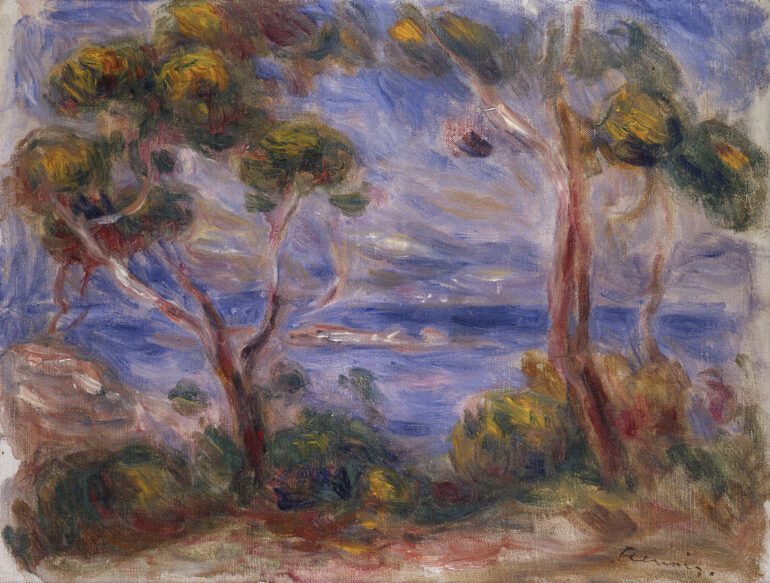
You enter a room dedicated to Pierre-Auguste Renoir as if stepping into a candy store that’s a little too warm. There’s that immediacy of color, that roundness of form, and that light that seems to have been filtered through an incorrigible optimism. Yet behind the glossy surface of these scenes of popular jubilation and portraits of young women with porcelain cheeks, an aesthetic trench war has been raging for over a century. As an internationally acclaimed retrospective prepares to tour the world, the question stirring art circles is no longer whether Renoir is famous—his status as a pillar of Impressionism is set in stone by the institutions—but whether he is, at heart, a good painter. This paradox between the commercial power of his name and the growing disavowal by some critics and the contemporary public lies at the heart of a debate that extends far beyond the confines of gilded frames.
The Industry of Traveling Success
The concept of the large-scale traveling exhibition—that famous “blockbuster” format—rests on a precise mechanism. It requires a name capable of drawing crowds from Tokyo to New York, a signature that guarantees immediate profitability and universal appeal. In this regard, Renoir is the ideal candidate. His painting requires no complex instructions; it reveals itself with a kind of joyful clarity. But this very effectiveness is what is beginning to let him down with an audience seeking depth or subversion. The currently touring exhibition highlights this ongoing tension: how to present a legend whose mere mention is enough to fill museums, while directly addressing the disaffection he provokes among those who see his brushwork as a form of laziness or decorative excess?
The tour of these major works serves as a litmus test for the artist’s reputation. In every city, the same pattern repeats itself: the galleries are packed, but the conversations outside the galleries are harsher than those regarding his contemporaries, such as Monet or Degas. He is criticized for a form of academicism disguised as revolution, a complacency in the pretty that, with the passage of decades, eventually becomes overwhelming to the eye. This omnipresence on merchandise—from calendars to cookie boxes—has ultimately created a smokescreen between the actual work and how it is perceived. The blockbuster not only celebrates genius but also questions the erosion of a myth.
The Aesthetics of Discord
Why is Renoir so divisive? The most common criticism—the one that fuels the most heated debates—stems from the very nature of his technique. To his detractors, his painting lacks structure. Whereas Cézanne sought geometry beneath nature, Renoir seems content to let masses of flesh and flowers float in a hazy atmosphere. It is this sense of perpetual “blurriness,” this lack of rigor in his drawing, that fuels the arguments of those who believe he did not master the fundamentals of his art. He is accused of confusing light with sugar, and softness with flabbiness.
The debate sometimes takes on almost political overtones. In an art world that often values rupture, suffering, or social commitment, Renoir’s ostentatious happiness is seen as a lapse in taste, or even a form of blindness. One wonders whether this obsession with effortless beauty—with these “flower-like” women and radiant children—was not an escape from the social realities of his time. This is where the divide becomes entrenched: on one side, the defenders of a painting of pleasure, in the tradition of Fragonard and Watteau; on the other, the advocates of a more demanding art, who refuse to see the paintbrush as merely an instrument of visual seduction.
The Legendary Impressionist on Trial
It is rare for an artist of this caliber to be subjected to such collective soul-searching. The status of “legend” normally acts as a shield, protecting the work from overly harsh scrutiny. But with Renoir, that shield has cracked. The very idea that he might “be bad” at painting is no longer a joke told in the break room, but a hypothesis seriously debated by experts and knowledgeable art lovers. It is not his historical significance that is being denied—no one can take away his role in the Impressionist movement—but rather the intrinsic quality of his technical execution from a certain period of his life onward.

The end of his career is under particular scrutiny. Are his increasingly red nudes and increasingly distorted forms the result of a final exploration of color vibration, or a sign of a decline in precision? The question remains open and serves as the central theme of the current exhibition. By juxtaposing the masterpieces of his mature period with the more controversial works of his later years, the curators do not seek to settle the debate, but rather to show how a legend is also built on its gray areas and misunderstandings. Renoir has become the artist we love to hate—or hate to love—which is perhaps, after all, proof of his enduring relevance.
A Cultural and Generational Divide
The divide surrounding Renoir’s work also reveals a paradigm shift in the way we consume art. Today’s audience, fed on digital images and stark contrasts, sometimes struggles to connect with the milky subtleties of the artist’s palette. What was perceived as luminous audacity in 1880 is sometimes felt as kitschy blandness in 2024. The accusation of incompetence leveled against Renoir also reflects an era that suspects beauty of being a form of manipulation. The “sweetness” of his paintings becomes hard to stomach for a contemporary sensibility that often prefers rough edges.
Yet this division of opinion is a boon for institutions. Nothing is more damaging to an artist than indifference. By becoming a subject of controversy, by provoking almost visceral reactions, Renoir breaks free from the category of “waiting-room painters” to once again become a lively topic of conversation. The question “Was Renoir really talented?” is not an insult to his legacy, but an invitation to look at his paintings with fresh eyes, free from the automatic reverence we owe to the great names. By questioning his supposed weaknesses, we paradoxically end up rediscovering the raw power of a painter who, whatever people may say, has imposed his vision of the world on generations of viewers.
The exhibition currently touring the globe does not offer a hagiography, but a confrontation. Between those who see him as the last of the classical masters and those who see him as nothing more than an inspired decorator, the divide will likely never be bridged. And perhaps that is the true success of this world tour: proving that even a century after his death, an Impressionist can still spark such fiery passions. Renoir’s painting has lost none of its power to unsettle—not because of its subject matter, but simply by virtue of its existence and his technique. Beyond the question of whether his painting is “good” or “bad,” there remains this physical, sensual presence that continues to haunt museums and challenge our assumptions about what art should be.