
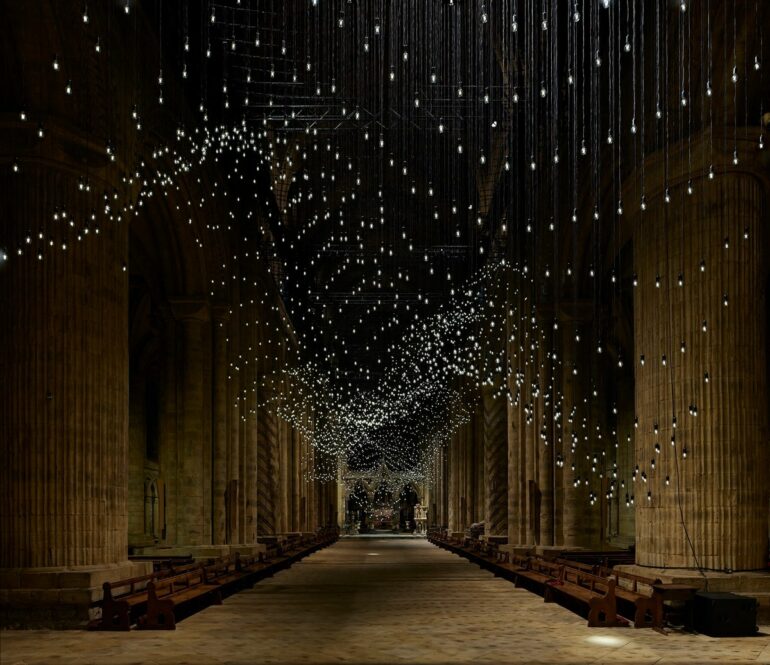
The Renewed Radiance of the Banks of the Wear
The cement-gray hues of military memories are fading away, giving way to a new brightness. In Durham, a new era is dawning. What was long the bastion of regimental memory—the Durham Light Infantry Museum and Art Gallery—has just completed its transformation. After a hiatus brought on by construction and strategic planning, the institution is reborn under a name whose brevity stands in stark contrast to its former solemnity: The Light. This is not merely a reopening that the city in northern England is celebrating, but a true shift in its cultural center of gravity.
In this city, where medieval stone typically imposes its weight and history, the emergence of this architectural and museographic project marks a break with the past. The name change is not merely a public-relations gimmick. It symbolizes the transition from a place of preservation—sometimes perceived as impenetrable or frozen in the glorification of past exploits—to a space that, by its very nature, seeks to share knowledge. The term “redevelopment” takes on its full meaning here: it was necessary to deconstruct an image in order to reconstruct a new purpose.
The Metamorphosis of a Military Legacy
For decades, the site’s identity was inextricably linked to the Durham Light Infantry. This unit, whose very name evokes forced marches and the sacrifices of the world wars, anchored the building in a kind of martial reverence. The museum was a sanctuary. Today, The Light offers a different perspective—one that is less linear, perhaps more ethereal. The very structure of the space has been reimagined so that art and history no longer coexist merely in parallel corridors but intertwine along a fluid path.
The challenge was immense: how to transform a space steeped in the memory of an infantry unit—by definition earthy, heavy, and rooted in the ground—into an entity bathed in light? The answer lies in the depth of the restructuring. It required clearing out the space, rethinking the volumes, and above all, reinventing the way the public interacts with the collections. Visitors no longer simply tour a memorial; they engage with a space of cultural life that seems to have chosen transparency over the opacity of the display cases of the past.
The Math Behind a Regional Ambition
Behind this transformation lies a figure that speaks volumes about the project’s importance to the region: seventeen million pounds. Such an investment, in the current context of managing local cultural budgets, demonstrates strong political will. These 17 million are not allocated solely to renovating the building or bringing it up to energy efficiency standards. They fund a vision—that of culture becoming a major draw for Durham, capable of attracting visitors beyond the usual circle of military history enthusiasts.
This funding has made it possible to restore the building while incorporating modern exhibition technologies, a far cry from the dusty, outdated museum displays one might have feared for an institution dedicated to a light infantry regiment. The redevelopment aimed for structural excellence, ensuring that every pound spent contributes to making The Light a world-class facility. It is a bet on the future, a way of affirming that Durham does not rely solely on its UNESCO-listed heritage but also knows how to generate new, contemporary points of interest.
From Art Gallery to Social Hub
The other facet of this site has always been its art gallery. In the old layout, the juxtaposition of military artifacts and visual artworks sometimes created a striking—even disconcerting—contrast. The Light project appears to aim to harmonize these two facets. The redevelopment has created spaces where aesthetics and historical documentation complement each other without overshadowing one another. Art is no longer an afterthought to the regiment’s history; it has become an essential component of the overall experience.
Visitors rediscover a place that has managed to preserve its soul while shedding its constraints. The circulation areas have been expanded, and light—once again—has become a building material in its own right, guiding the eye through the rooms. It is a rebirth that invites visitors to wander rather than follow an orderly path. Durham residents and passing travelers are rediscovering a part of their community that had become less familiar to them, now returned to the city in a more welcoming and accessible form.
The Light now stands as the new beacon of a city in the midst of transformation. By choosing to reinvent the Durham Light Infantry Museum and Art Gallery, the project’s designers took a risk in embracing modernity. As the doors open once again, the project’s success seems to be measured by its ability to honor its past while shedding new light on the cultural practices of tomorrow. Durham did not merely restore a museum; it has created a powerful statement within the British art scene.