
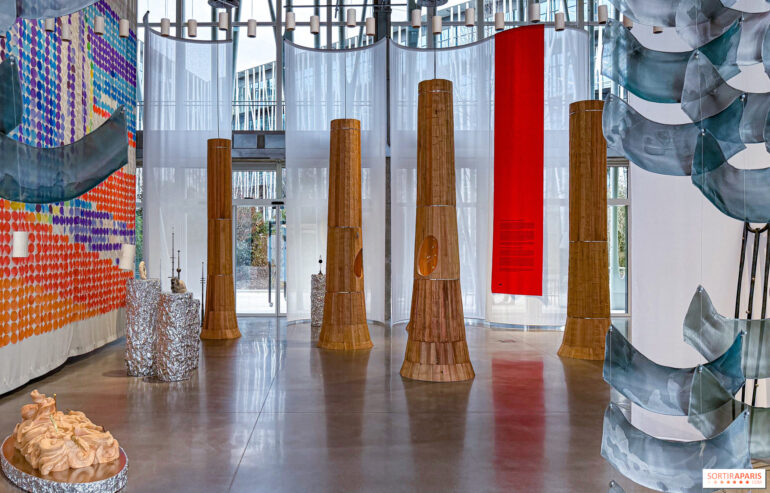
At the WHAT MUSEUM in Tokyo, an innovative exhibition spotlights eight emerging studios, exploring architecture as a field of research rather than merely the creation of finished objects, while weaving a subtle dialogue between materials, forms, and ecological considerations.
With Corrugated / Coral, the Tokyo-based institution presents an exhibition that goes against the grain. Rather than celebrating established names, it chooses to spotlight eight emerging studios, all founded after 2010. A choice that challenges our perceptions: architecture is no longer revealed as a mere catalog of completed buildings, but asserts itself as a true research discipline, rich in hypotheses and divergences.
The architectural model as an object of thought
The museum, which already holds more than 800 models in its ARCHI-DEPOT archives, treats the architectural model here as an autonomous instrument. It is no longer a mere reduction of the building, but a condensed form of reflection. The exhibition, which runs through September 13, 2026, cultivates this fruitful ambiguity: it explains, imagines, and critiques, avoiding the pitfall of being confined to the logic of the commission alone.
The title of the event alone sums up this tension. The term “corrugated” evokes corrugated sheet metal, a raw, industrial, and often temporary material. Conversely, “coral” refers to slow, organic growth, with a fragility that is almost geological. Between these two polarities, architecture emerges as the art of dual duration: the ephemeral duration of the construction site, and the enduring duration of use and the long term.
Between brilliance and abstraction
While some installations can be deciphered instinctively, others require more distance, inviting the visitor to immerse themselves in the artist’s statement to grasp their essence. This deliberate imbalance in no way hinders the experience. In a curation of such high standards, opacity is an integral part of the approach, although it may occasionally create a certain analytical distance.
The ecological issue, the backdrop of the project, is expressed with subtlety. At a time when the climate crisis and the scarcity of resources are redefining our paradigms, the evocation of the coral reef goes beyond a mere poetic metaphor. It invites us to rethink, with genuine political acuity, the materials and rhythms of contemporary construction.
The exhibition reaches its peak when it succeeds in linking a spatial intuition to a physical sensation, while taking care not to get lost in purely conceptual jargon.
Eight paths to rethinking space
With Inter-Embodiment, the ALTEMY studio conceives of the city as a space of reciprocal perception where bodies act as structural elements. An ambitious vision that offers a welcome resonance in our era saturated with algorithmic surveillance.
The Yuasa Office takes a more poetic approach with Darkness, Afterglow. Through a wall and five desks coated in phosphorescent paint, the installation captures the luminous memory of past gestures. Time materializes, transforming the act of reading into a true spatial event.
Studio Garage, through Disentangled Boundaries, returns to the fundamentals: the floor, the body, and the threshold. This temporary structure redefines the notion of passage, reminding us that borders are often social conventions rather than immutable lines.
For its part, GROUP draws inspiration from the banality of everyday life with City Asleep, a reflection on sleep amidst the hustle and bustle of Shibuya. This intrusion into public space reads as an elegant critique of the hyper-scheduled city: sleeping there becomes an act of escape from the diktat of productivity.
DOMINO ARCHITECTS, with PULP FICTION (jetway), reimagines the aesthetic of the boarding bridge. By multiplying this functional corridor, the studio creates a transitional space with no specific destination. A refined, almost dizzying proposal that transforms a transit zone into a true existential experience.
Elementary geometries and mental landscapes
The project What is ○△□?, orchestrated by Tetsuo Hatakeyama, Taiki Yoshino, and Archipelago Architects Studio, questions the geometric foundations of the discipline. The circle, the triangle, and the square—figures that are deceptively familiar in architecture—reveal here their full historical and symbolic weight. A work that judiciously invites the viewer to slow down their gaze.
With A Hakoniwa Plan for Tokyo, Toshiki Hirano combines individual psychology, urban imagination, and generative intelligence. Tokyo is transformed into a mental landscape rather than a mechanical megalopolis. An approach that raises a very contemporary question: is artificial intelligence merely a tool for execution, or a true amplifier of intuition?
Finally, RUI Architects approaches the metropolis on the scale of the pedestrian with Prop. The studio focuses on these ordinary urban fragments that seem to have found a precarious balance within their own contradictions. Rejecting the heroic gesture, this approach demonstrates a critical patience of infinite precision.
Architecture as a tool for exploration
Taken as a whole, these eight proposals sketch out less a manifesto for a new school than a vast field of experimentation. Far from confining themselves to a single formal language, these young architects navigate from the body to memory, from fiction to geometric abstraction, from the observation of daily life to introspection.
Their common denominator undoubtedly lies in a methodological rather than a stylistic approach. They forge new tools of expression: models, videos, immersive installations, 1:1 scale fragments, narratives, or diagrams. For this generation, building is no longer the sole purpose of architecture; it becomes a powerful medium for questioning our world.
It is in this interstice that the event truly shines. It reminds us that before becoming a monumental construction site or a globally recognized brand, architecture is often born from a fragile idea. And it is precisely this conceptual distance that allows us to decipher our present with the greatest acuity.