
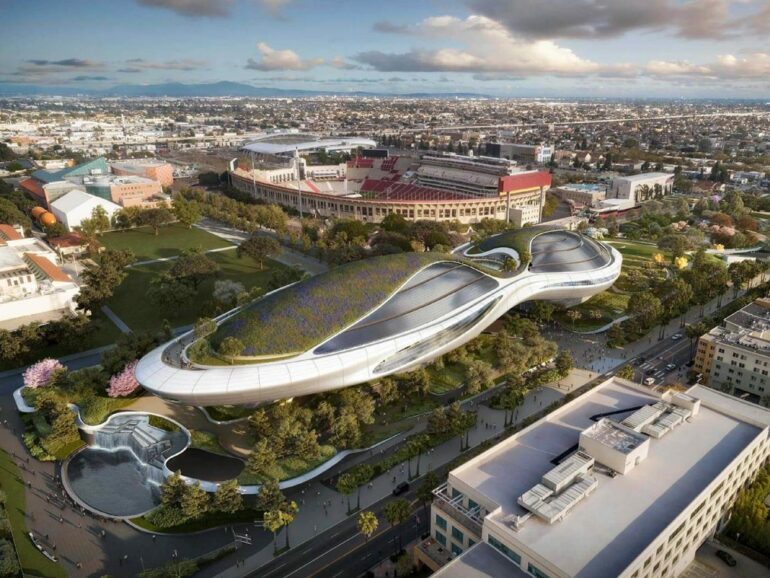
A concrete-and-steel vessel in the California sky
On the grounds adjacent to the University of Southern California, where the asphalt of an ordinary parking lot once absorbed the Los Angeles sun, an architectural anomaly is taking shape. On September 22, 2026, the landscape of Exposition Park will be permanently altered by the inauguration of a structure that early observers still struggle to define, wavering between the cottony mass of a cloud and the streamlined silhouette of a futuristic aircraft. This building with its floating lines, designed by architect Ma Yansong of the MAD architectural firm, will house the culmination of two decades of perseverance.
It took George Lucas nearly twenty years to bring this vision to life. The man who redefined the global collective imagination with the Indiana Jones and Star Wars sagas had to overcome numerous obstacles before seeing this monumental project rise from the ground. The choice of Los Angeles—and more specifically, this neighborhood—stems from a personal connection to the area. The nearby university is none other than the filmmaker’s alma mater. For Tracey Bates, the institution’s president, this California connection was a natural choice, forging a direct link between the founder’s personal history and the identity of a metropolis built on the film industry.
The End of Academic Hierarchies
Behind the organic facades designed by Ma Yansong lies a space of dizzying proportions. With more than 9,300 square meters dedicated to exhibitions and spread across some thirty galleries, the venue immediately makes its ambition clear. Visitors’ first steps will take them beneath the familiar canopy of a yellow Naboo N-1 fighter, a relic straight from the set of *The Phantom Menace*. The presence of this craft at the entrance might lead one to believe this is yet another Hollywood mausoleum dedicated to pop culture merchandise. The rest of the collections immediately disprove this assumption.
The museum’s walls orchestrate a deliberate collision between disciplines that art history has long kept at a distance. Paintings by renowned 20th-century masters mingle here with the artwork of giants of the comic book and illustrated press. Visitors will thus move from the surrealist brilliance of Frida Kahlo to the social murals of Diego Rivera, from Andy Warhol’s raw silkscreen prints to Banksy’s subversive stencils. Works by major figures in African American art, such as Jacob Lawrence, Charles White, and Robert Colescott, will engage in dialogue with a myriad of objects related to filmmaking.
Above all, the institution offers unprecedented institutional recognition to the masters of the drawn line. Comic book pioneers like Winsor McCay and Jack Kirby share the space with masters of heroic fantasy such as Frank Frazetta. Chroniclers of everyday American life—from Norman Rockwell to N.C. Wyeth, including Jessie Willcox Smith—find formal recognition here. This dizzying density of still and animated images has, in fact, prompted Taschen to publish an impressive two-volume monograph that examines both the collection’s archives and the unique aesthetic of *Star Wars*.
The Mechanics of Narrative Through Images
The common thread that ties this eclectic collection together is a concept that the institution aims to place at the center of global cultural discourse: narrative art. According to Tracey Bates’ definition, it is a self-sufficient form of expression, capable of unfolding a complex story through a simple visual composition, without ever requiring the support of a caption or explanatory text. This approach runs counter to a certain contemporary trend often deemed too conceptual or obscure.
During a press briefing on the project’s progress, George Lucas spoke at length about the ability of this fusion of aesthetics and storytelling to captivate the human mind. His stated intention is to right a historical injustice by paying a resounding tribute to the profession of illustration. These creators, often relegated to the status of mere executors or commercial artists by traditional critics, are hereby restored to their rightful status as full-fledged storytellers of myths. The founder fully embraces his approach: popular culture is not merely a form of mass entertainment. It carries heroes, fears, and imagery that ultimately permeate the global collective memory, constituting the only true language shared by individuals from radically different backgrounds.
A Space Designed for the City
Beyond conservation and exhibition, the project claims a special place within the urban fabric of Los Angeles. George Lucas does not hesitate to describe his creation as a “temple of the people’s art.” This phrase reflects a rejection of elitism and a desire to use the museum as a tool for social cohesion.
In the minds of its designers, the exhibition of illustrated stories carries a responsibility that goes beyond mere aesthetic contemplation. The leadership team believes that the mythology conveyed through images plays a unifying role. Lucas advocates the idea that the stories we view and pass on to one another shape our relationships with others. They weave invisible bonds within a community and, through a mutual understanding of these narratives, foster dynamics of cooperation rather than conflict.
When the glass and metal doors of this architectural colossus open in the fall of 2026, the California cultural scene will be enriched by more than just a new exhibition space spanning over 9,000 square meters. It will welcome a built manifesto, a physical statement advocating the idea that drawing, illustration, and film possess an evocative power that finally deserves a home commensurate with its influence.