
The Twilight of an Institutional Renaissance
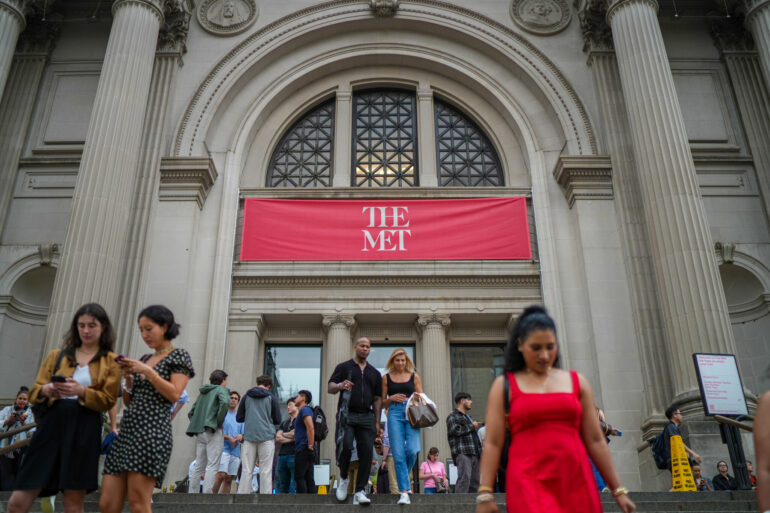
The fashion world had expected a grand finale, but instead it will be met with digital silence. In a lengthy message posted on his social media accounts, John Galliano has put a definitive end to speculation surrounding his return to favor at the pinnacle of New York’s cultural scene. The exhibition “John Galliano: Horizons,” which was set to open in the galleries of the Costume Institute at the Metropolitan Museum of Art next spring, has been officially canceled. It was not the museum that made the decision, but the designer himself, citing a choice made with “great sadness” after weeks of intense consultations with his close friends and family and the museum’s leadership.
This voluntary withdrawal marks the failure of a rehabilitation strategy that began more than a decade ago. Despite the unwavering support of Anna Wintour, editorial director of *Vogue* and a pillar of the Met’s board of trustees, the pressure became unbearable. The project, which aimed to trace his forty-year career, foundered on the lingering memory of the events of 2011. At the time, anti-Semitic remarks made in a Parisian café had led to Galliano’s ouster from the House of Dior and the very exclusive circle of haute couture. Fifteen years later, the wound has clearly not healed, and the idea of a national tribute at one of the world’s most prestigious museums acted as a political and social flashpoint.
The Impossible Balance Between Art and Ethics
Yet the Met was not proceeding blindly. Max Hollein, the museum’s director, and Andrew Bolton, curator of the Costume Institute, were well aware of the minefield they were navigating. The institution had planned to directly address the designer’s “gray areas” within the exhibition, steering clear of any uncritical hagiography. Galliano himself had made numerous gestures of goodwill, meeting with leaders of the Jewish community under the auspices of Anna Wintour in an effort to foster dialogue ahead of the exhibition. These efforts at cultural diplomacy aimed to transform a past scandal into a lesson in resilience and atonement.
However, political reality has overtaken aesthetic ambition. For John Galliano, institutional recognition cannot serve as a bargaining chip for definitive forgiveness. In his statement, the designer emphasizes that reparation is an ongoing process, a “responsibility” demonstrated through daily conduct and active listening rather than through the glitz of museum display cases. He candidly admits that celebrating his work on this scale would have been, for many, a source of pain too acute to bear. This acknowledgment of failure also reflects an era that no longer knows how to separate the work from the individual, especially when the offense strikes at the very foundations of human rights.
A Political and Media Storm
The backlash did not come out of nowhere. It took the form of a united front comprising local elected officials, influential donors, and prominent media figures. The New York City Council, through Sam Raskin, spokesperson for Council Member Zohran Mamdani, described Galliano’s past use of anti-Semitic rhetoric as “despicable,” noting in passing that while the Met is an independent entity, its reputation is not immune to public criticism. Even more scathing was Elisha Wiesel, son of Nobel Peace Prize laureate Elie Wiesel and head of the foundation bearing his father’s name, who publicly lambasted the idea of this tribute, calling it a “very bad idea.”
The fashion press was not to be outdone. Dana Thomas, the designer’s biographer and a contributor to The New York Times, published a scathing op-ed arguing that the Metropolitan Museum was making a major historical mistake. In it, she describes a man whose verbal outbursts were not limited to a single incident but were part of a pattern of aggressive behavior toward those around him. Thomas also revealed that this exhibition project, originally scheduled for 2024, had already been postponed once following the global geopolitical tensions that erupted in October 2023. To its critics, the decision to proceed with the event in 2027 seemed to demonstrate a disconcerting blindness on the part of the museum’s leadership.
The Met Gala: A Schedule Amid a Conflict of Memories
Beyond Galliano’s personality, it was the event’s very timing that crystallized the tensions. Traditionally, the opening of the major spring exhibition coincides with the Met Gala on the first Monday in May. In 2027, May 3 falls directly on Yom HaShoah, the day of remembrance for the Holocaust and heroism. This unfortunate coincidence transformed what was supposed to be a celebration of fashion into a symbolic affront to a large part of New York’s Jewish community.

Faced with this clash, Anna Wintour’s support, though reaffirmed, ultimately seemed out of touch with broader societal issues. While she continues to praise the “courage” of Galliano’s decision and to support his creative genius—believing that a career cannot be reduced to a single moment of misstep—the museum’s abrupt reversal highlights a flaw in the influential editor’s strategy. Some observers see this belated withdrawal—after more than a year of preparations—as a lack of foresight on the part of the Costume Institute. The withdrawal is perceived by some media outlets as an admission of weakness: if the museum truly believed in the intellectual merit of this exhibition, it should have been able to defend it rather than yield to external pressure.
From archives to ready-to-wear: the new playground
While the doors of this temple of culture may be closing, those of the fashion industry remain ajar through a more pragmatic and commercial approach. John Galliano is not, however, stepping away from the creative scene. While the museum world debates his morality, fast-fashion giant Zara is preparing to welcome his talents. Starting this fall, the first fruits of this unexpected collaboration will be unveiled.
The two-year contract calls for the British designer to rework the archives of the Inditex Group’s flagship brand to design seasonal collections. This pivot toward mass-market ready-to-wear represents a radical paradigm shift. Far from the unattainable haute couture gowns and the academic honors of the Met, Galliano is set to dress the masses. It is perhaps here—in the democratization of his style and far from the glitz of galas—that the true next chapter of his career will unfold: a comeback through mass-market fashion, where aesthetic debate often takes a back seat to commercial efficiency.
The Met will soon announce the new theme for its spring exhibition and the plans for the 2027 Gala. As for John Galliano, he is leaving the New York scene with a message of gratitude to those who have stood by him during his fifteen years of sobriety and personal rehabilitation, leaving behind an unanswered question: Can artistic genius ever fully atone for moral failings in the public arena?