
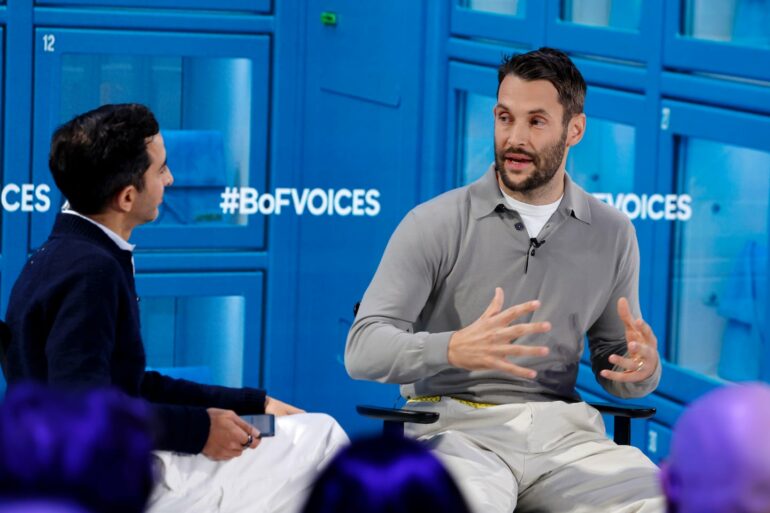
The pastoral seclusion of Soho Farmhouse, a cozy retreat nestled in the hills of Oxfordshire, offers a striking contrast to the harsh reality of global crises. Yet it is within this exclusive British enclave—accessible by invitation only—that the next BoF VOICES summit will take place from December 1 to 4, 2026. Far from being merely an exercise in mutual admiration among luxury industry leaders, this latest edition serves as a wake-up call. The fashion and luxury industry has realized that it can no longer operate in a vacuum. Designed to dissect the blind spots of a sector often accused of frivolity, the program features a head-on collision between artistic direction, geopolitical turmoil, the climate emergency, and the emerging supremacy of algorithms. Against the backdrop of these four days of discussions, the unveiling of the highly anticipated *The State of Fashion 2027* report, co-produced with McKinsey & Company, will serve as a data-driven compass for an industry in search of direction.
Creative Volatility Put to the Test by Boards of Directors
The days when a luxury house operated within a long-term timeframe, driven by an omnipotent designer over several decades, seem to be definitively over. The summit will address this disruptive acceleration through the testimony of Dario Vitale. His meteoric tenure as creative director at Versace epitomizes the nervous energy of the contemporary market. Appointed in March 2025, the designer was already packing his bags by December of that same year. Nine months in the role—a microscopic window of opportunity by fashion standards—barely allowed him to imprint a sensual vision, heavily laden with references to the ’80s and ’90s. This one-off collection had nevertheless captured attention, before the Italian brand announced—with characteristic haste—the arrival of Pieter Mulier in July 2026.
In a highly anticipated conversation with critic Tim Blanks, Dario Vitale will dissect this Milanese interlude. His case study proves that stability is today the rarest commodity—and therefore the ultimate luxury—within design studios. In the face of this artistic instability, BoF has brought together those who control the purse strings and define long-term strategy. Kering executives, represented notably by Luca de Meo, will meet with Sidney Toledano, Michelle Gass, Joanne Crevoiserat, and Geoffroy van Raemdonck. This executive lineup isn’t just there for show: the aim is to directly scrutinize the governance of these conglomerates, caught between the need to reassure financial markets and the obligation to win over consumers whose expectations are constantly rising.
When clothing becomes a tool of diplomacy and identity
While finance sets the pace, geopolitics is redrawing the boundaries of what is possible. This is one of the strongest themes of the 2026 edition: bringing the fashion industry to the table in global climate and political negotiations. In this regard, Mary Robinson’s speech promises to be one of the forum’s defining moments. The former President of the Republic of Ireland (1990–1997) and former United Nations High Commissioner for Human Rights (1997–2002) is not here to discuss trends. Currently an adjunct professor of climate justice at the School of Natural Sciences at Trinity College Dublin, she will offer a harsh assessment of a multilateral order that is cracking on all sides. For an industry whose supply chains span every continent, the observation that international crisis management mechanisms are wearing thin is not a diplomatic abstraction—it is a major operational risk.
This macro-level, institutional perspective will be countered by Willy Chavarria’s visceral approach. The American-Mexican designer, who works under his own name, uses textiles as a manifesto. His personal heritage fuels an openly provocative aesthetic that rejects neutrality. Already recognized by U.S. authorities with his win of the prestigious CFDA/Vogue Fashion Fund, he recently brought his political message to Europe by presenting his Spring/Summer 2026 collection, titled “Huron,” during Paris Fashion Week. His presence confirms that neutrality is no longer a viable commercial option for a young generation of designers who view clothing as a political manifesto.
Redefining Desire in the Face of Algorithms and the New Asian Order
Understanding where fashion is headed requires mapping out how technology and new economic geographies are redefining the act of purchasing. Jamie Bartlett will challenge the assumptions of the executives in attendance with a clinical analysis of artificial intelligence. Author of the Sunday Times instant bestseller *How To Talk To AI (And How Not To)*, he will go beyond the simple question of inventory optimization or the creation of virtual campaigns to examine the societal and cultural impact of a technology that is altering the very structure of businesses.
Alongside this technological upheaval, the question of the Middle Kingdom remains central, but its rules have changed. Angelica Cheung, a leading figure in Asian publishing after having headed Vogue China for sixteen years, will decipher this new landscape. Now a partner at Hongshan Capital and a consultant for Western fashion houses through her firm AMH, she observes a post-COVID Chinese market that is no longer satisfied with compulsive, high-volume consumption. The new paradigm is based on subtlety and the circulation of influence. The balance between hyper-commercialization and creative authenticity has never been more fragile, and Cheung embodies precisely that delicate equilibrium needed to survive in this complex landscape.
Time and Emotion as the Ultimate Frontiers to Conquer
In this landscape saturated with data, rapid shifts in artistic direction, and international tensions, how can we continue to spark authentic desire? The answer hinted at by the program lies, paradoxically, in slowness. By bringing together fine jewelry designer Jessica McCormack and Marie-Louise Sciò, head of a prestigious hotel group, the forum shifts the focus from the material transaction to the sensory experience.
Their respective sectors impose a timeframe that is the polar opposite of seasonal fashion. Choosing a precious jewelry set or booking an exceptional getaway requires the buyer to make a psychological investment and exercise a level of patience that goes beyond the impulse purchases dictated by social media. This dialogue illustrates an inescapable economic reality: the handbag no longer competes solely with shoes; it must now rival an exceptional dinner or a night in a Tuscan villa. The industry no longer sells objects to fill closets; it must rise to the level of the intangible and justify its legitimacy by, in turn, offering a unique way of experiencing time.