

The Challenge of Growth in Troubled Waters: The Prada Group’s Lesson in Balance
In a luxury landscape where certainties are crumbling under the weight of geopolitical tensions and a macroeconomic environment that Patrizio Bertelli readily describes as “turbulent,” the industry is watching with particular attention the trajectories that manage to defy the odds. The Prada Group’s first half of the year fits precisely into this dynamic of active resilience. By crossing the symbolic threshold of three billion euros in revenue—3.048 billion to be exact—the company led by Andrea Guerra is doing more than just playing it by ear. It posted an 11% increase at current exchange rates, a figure that rises to 16% when currency fluctuations are factored out. But beyond the cold, hard numbers, it is the agility of this Italian behemoth that stands out, as it has managed to maintain 5% organic growth amid a complex consolidation process, marked in particular by the integration of Versace.
This performance is no miracle, but rather the result of meticulous strategic planning. While the first quarter had already laid a solid foundation, the second quarter showed a notable acceleration with a seven-point jump in organic growth. This is a sign of a company that knows how to adjust its sails as the wind shifts. Admittedly, margins are feeling the impact of this expansion and the massive investments associated with the acquisition of Versace. Adjusted EBIT stood at 530 million euros, representing a margin of 17.4%, down from 619 million in the previous fiscal year. Net income followed a similar trend, coming in at 327 million euros compared to 386 million last year. However, this apparent erosion of profits masks a more sustainable reality: the group’s ability to generate cash remains intact, allowing it to pay out 403 million euros in dividends and invest 247 million euros in Capex without weakening a financial structure that maintains a controlled net debt of 693 million euros.
Prada’s Resurgence and Miu Miu’s Controlled Landing
The group’s historic driving force, the Prada brand, appears to have found a particularly vigorous second wind. After a period of transition, it returned to growth of 3.3% for the half-year, a trend that accelerated significantly between April and June to reach +6.3%. This success rests on a solid three-pronged foundation: a coherent collection structure, a firm full-price policy, and unwavering desirability, particularly in the strategic markets of the Americas and Japan. The company is reaping the rewards of in-depth work on its product offering, which appeals to both long-time collectors and newcomers to the luxury sector, all supported by flawless retail execution.
In contrast to this resurgence, Miu Miu is entering what analysts and management refer to as a phase of “normalization.” After a string of seasons of exponential growth, Prada’s prodigious little sister brand is stabilizing its performance. With retail sales up 2.5% over the half-year, the brand is maintaining its position despite a historically high comparison base—remember that last year, it posted a staggering 40% jump. While Europe is showing signs of slowing for the brand, the Americas and Asia-Pacific remain strongholds. This relative slowdown can also be attributed to external headwinds, notably the persistent instability in the Middle East, which is weighing on tourist flows and regional consumption.
The Versace Bet and the Pieter Mulier Era
The most closely scrutinized topic in this half-year report is undoubtedly Versace. With €305 million in sales over the period, the Medusa brand is entering a phase of profound transformation under the leadership of Patrizio Bertelli’s group. The goal is clear: to elevate the brand’s image and streamline the distribution network to prioritize quality over volume. Pieter Mulier’s highly publicized arrival last July marked the true starting point of this creative repositioning. While the impact of his vision on sales won’t be evident for several quarters, enthusiasm is palpable among management. The goal is to restore Versace to its former glory while integrating it into the operational rigor that is the Italian group’s strength. It is a labor of patience, far removed from the immediate gratification of fleeting trends.
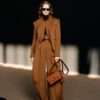
The wholesale channel, although a minor component of the overall strategy, has paradoxically surged by 36% at current exchange rates to reach 299 million euros. This spectacular surge—which rises to 40% at constant exchange rates—reflects sustained demand from multi-brand partners for the group’s signature pieces, even as the priority remains the expansion and optimization of the company-owned store network, the true engine of financial growth with 7% retail growth.
Contrasting Geographies: The U.S.’s Remarkable Health Amid European Doubts
The global luxury landscape is being redrawn before our eyes. This half-year confirms the United States’ dominant position as the group’s primary growth driver. With a staggering 30% increase at current exchange rates (and an impressive 37% year-over-year), the Americas region is literally driving the group’s results. This performance is all the more remarkable given that it is underpinned by robust local demand and an acceleration observed over the course of the months. Asia-Pacific is not far behind, with 10% growth, proving that despite economic uncertainties in China, consumer demand for the Group’s brands remains firmly rooted in the region’s spending habits.
Europe, on the other hand, presents a more complex picture. While it posted 3% growth at current exchange rates, the picture is bleaker on an organic basis, with a 4% contraction. Nevertheless, a glimmer of hope emerged in the second quarter, driven by the gradual return of tourist spending and a slight recovery in domestic demand. The case of Japan is symptomatic of the current paradoxes: while sales there rose by 6% at constant exchange rates thanks to a steady flow of visitors drawn by attractive prices, the yen’s depreciation turned this success into a 7% decline once converted to euros. Finally, the Middle East is bearing the brunt of geopolitical tensions with a sharp 29% drop—a stark reminder that the luxury sector is never entirely immune to the turmoil of the world.
For Andrea Guerra, CEO, these results validate the company’s long-term strategy. The goal is not to chase short-term growth records, but to build a structure capable of outperforming the market average through discipline and responsiveness. By investing heavily in communications and the customer experience while welcoming new creative talent, the Prada Group is preparing for the coming months with cautious confidence. Its ambition remains unchanged: to transform every period of turbulence into an opportunity to consolidate its already exceptionally solid foundations.