
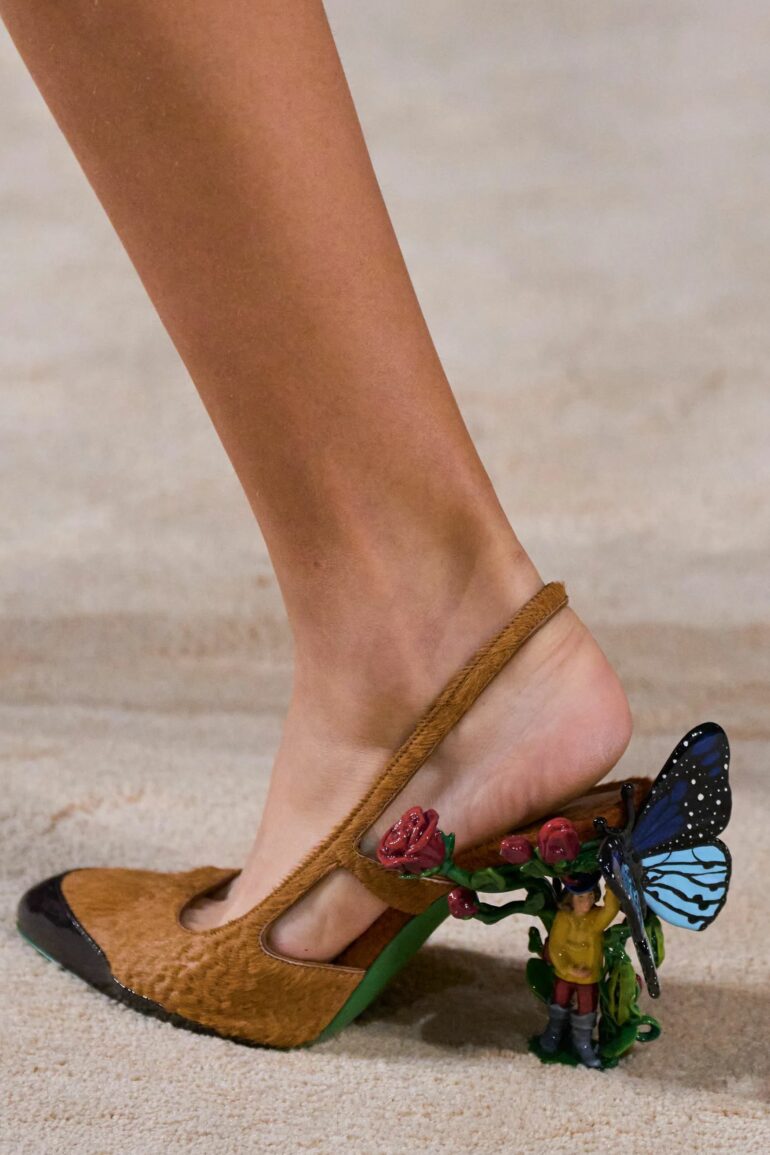
The Shoe in the Display Case: When Extravagance Finds a Home at Our Feet
There is a category of buyers for whom the primary function of a shoe no longer matters. Walking is a mere detail—or even a contraindication. According to Ryan Kleman, vice president of accessories at Moda Operandi, a segment of the clientele now buys shoes knowing full well that they will never touch the pavement. The item becomes part of a private collection, just like a sculpture or a masterpiece painting. The executive goes even further, noting that it’s not uncommon to encounter people who own more pairs than there are days in a year. This phenomenon of fetishistic hoarding is reaching unprecedented proportions in light of the Fall/Winter 2026 couture collections, where the accessory sheds its supporting role to become the central character in a complex narrative.
For a long time, stylistic escapism was achieved through a complete look. John Galliano’s era at Dior remains the ultimate illustration of this: attending one of his fashion shows was like physically stepping into a fantastical period film, an immersive epic where clothing dictated space and time. While this longing for a dreamlike otherworld persists, its scale has changed radically. Fashion seems to have realized that escaping reality no longer necessarily requires a theatrical wardrobe covering the body from head to toe. A single shoe—provided it embodies extreme uniqueness—is now enough to effect this shift into fiction.
The Botanical Anecdote and the Golden Heel
This concentration of poetry on the ankle has manifested itself with startling clarity in recent collections. At Chanel, Matthieu Blazy injected a dose of literary surrealism by drawing on the fairy tale of the magic beans. The imagery of Jack and the Beanstalk did not get lost in the overall silhouette but crystallized right at ground level. The overall look remained true to its roots with skirts cut from silk-mousseline tweed or classic little black dresses, simply playfully disrupted by a layering of mismatched necklaces. But the eye was irrevocably drawn downward.
There, eccentricity took center stage. Shoes were transformed into miniature dioramas. We saw styles literally overrun with beaded climbing bean stalks, resting on heels sculpted into the shape of golden eggs. The shoe no longer complemented the outfit; it almost contradicted it with its narrative richness. The toes of some shoes, rendered completely transparent, gave way to tangles of beads that directly echoed the jewelry adorning the wearers’ chests. Other pairs served as a canvas for enamel butterflies, delicate petals, and tiny figurines, transforming the walk into a moving exhibition of curiosities.
The same desire to distill a dreamlike quality was evident at Dior. Jonathan Anderson reimagined the classic pump—whether pointed-toe or square-toe—as a vessel for opulent front-facing embellishments. Metallic bows vied with chunky embellishments and pom-poms, creating unexpected volume. The house’s floral signature was taken to its peak: heels were adorned with saturated colors and embossed flowers, giving the illusion of having been plucked from the flowerbeds of the Tuileries Garden during a nighttime stroll.

The Pumps as an Antidote to Chaos
Using a statement shoe to enliven a minimalist silhouette is not a new tactic. The combination of simple jeans and a white T-shirt, energized by a spectacular pump, remains a staple of the stylistic vocabulary. However, the shift observed for the coming seasons—from Dries Van Noten’s Spring/Summer 2026 collection to Valentino’s Fall/Winter 2025 collection—goes beyond the simple question of color accents or shine.
The issue is emotional. At Dries Van Noten, for example, the pictorial maximalism of Julian Klasner’s prints finds a saturated echo in shoes covered in sequins and awash with crystals. The shoe becomes a playful anchor, a safe haven for boldness. New York-based fashion consultant Sophie Cohen analyzes this shift as a gateway to fantasy that avoids the total commitment required by an eccentric garment. Adopting a design covered in tactile details and playful nods—as seen in the very feminine interpretations by Chanel and Dior—allows one to embrace a touch of whimsy without veering into costume.
Beyond the strict mechanics of trends, this craze for fantastical shoes responds to a contemporary urgency. The climate of environmental anxiety and the saturation caused by constant cultural chaos are draining the imagination. In this oppressive context, the search for immediate and tangible joy becomes paramount. According to Sophie Cohen, shoes possess this intrinsic and immediate ability to bring a smile to one’s face. A golden egg-shaped heel or an oversized metal buckle won’t solve the crises of our time, but they offer, on the intimate scale of the woman who wears them—or who is content simply to admire them on a shelf— a moment of absolute lightheartedness, a miniature fairy tale confined to a few square centimeters of leather and enamel.