
Make Texture a preferred source on Google to support us
Add Texture to GoogleCorsica doesn't usually top the list of destinations one would call "lucky." Since ancient times, the history of the Isle of Beauty has been marked more by tales of fierce rebellions, tragic romanticism, and a chronic inability to capitalize on its exceptional geostrategic position at the heart of the Mediterranean.
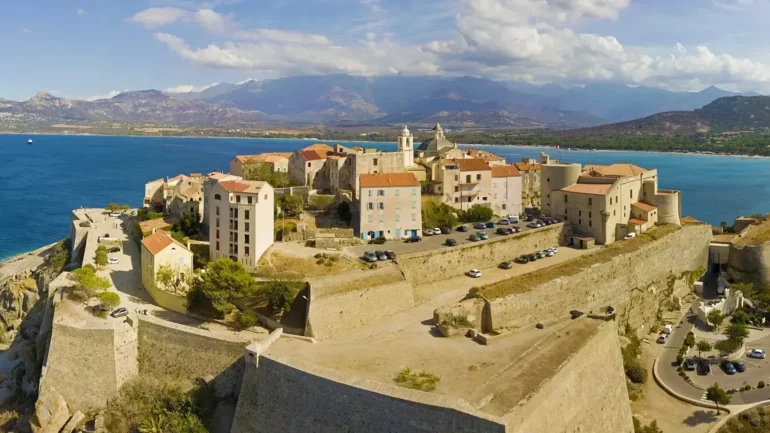
Yet Calvi, nestled on the island’s northwest coast, occupies a place as discreet as it is essential in the history of modern tourism. This unique destiny rests on the vision of a single man. And no, we’re not talking about Napoleon, the island’s patron figure.
More than seventy-five years ago, a plane chartered by the British agency Horizon Holidays took off from London bound for Calvi. At the helm of this company was Vladimir Raitz, a Russian émigré whose innovative idea was to offer a comprehensive vacation package: flights, lodging, meals, and entertainment, all included in a single price.
A pioneer who weathered the invasion
If you’re thinking this sounds strikingly similar to the early days of package travel, you’re absolutely right. Raitz first tested this novel concept with a group of teachers in 1950, before opening it up to the general public the following year.
Although it was the absolute pioneer of this vacation model, Calvi never succumbed to waves of tourists, unlike other Mediterranean resorts. Despite its head start in the market, its undeniable glamour, access to cheap flights, and an almost novelistic origin story, the city has managed to avoid the trap of mass-market sun-and-sand resorts and standardized hotel complexes.
“We get a lot of people in the summer, but a large portion of the guests dining here arrive directly by yacht from the French Riviera,” a local told me during a recent off-season visit, as I savored a warm goat cheese salad on the terrace of Café Île de Beauté.
The Double Shield: Geography and Political Choices
If Calvi has failed to become a mass-tourism hub—which, in my view, is a tremendous victory—it is thanks to a clever blend of geography, political decisions, cultural identity, and a certain rugged natural character.
The first line of defense against this invasion lies in the majestic mountainous terrain that encircles the city. Compare this unyielding landscape with the endless, concrete-covered coastlines of Spain’s Costa Blanca. Furthermore, the package tour model is intrinsically dependent on low-cost access. While Calvi did welcome the first waves of vacationers, its airport has remained modest: erratic landings subject to weather conditions, runways that cannot be extended, and limited direct flights.

Added to this was post-war France’s strategy, which prioritized domestic tourism by promoting the development of small hotels, family-run guesthouses, and campgrounds. In contrast, Francisco Franco’s Spain rolled out the red carpet for foreign tour operators and invested heavily in its airport infrastructure during the 1960s and 1970s.
From Humanist Utopia to Industrial Tourism
Strolling today through the picturesque alleys and charming little squares of Calvi, one feels deeply that the very soul of the city is fundamentally incompatible with mass tourism. This impression was further reinforced when I looked into the profile of the very first customers on that inaugural Horizon Holidays flight.
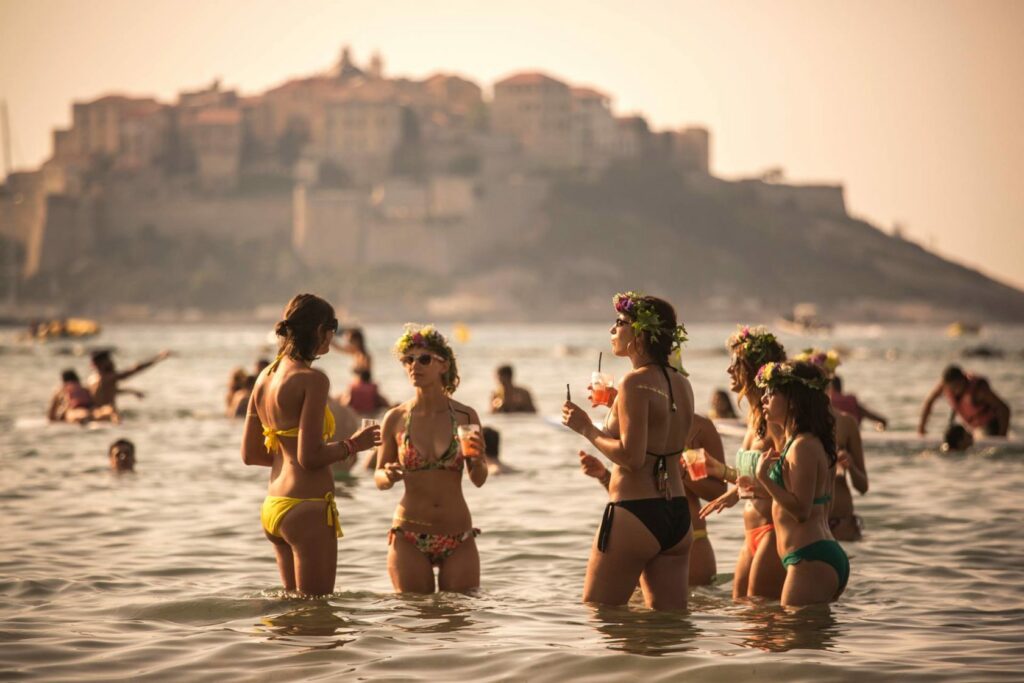
As Vladimir Raitz later recounted in his memoirs (Flight to the Sun), the followers of his concept were not necessarily the people one might imagine today. He described his vacationers as ordinary citizens who “developed a taste for wine and foreign cuisine, tried their hand at French, Spanish, or Italian, and forged connections in the countries they visited; in short, they became more ‘cosmopolitan,’ with all that that entails.”
According to its creator’s recollections, package travel was thus born of noble ideals of openness to the world, long before it evolved into a reassuring standardization based on giant resorts, English-style breakfasts, and prefabricated experiences.
It is certainly difficult to pinpoint a magic formula that would allow a coastal gem like Calvi to preserve its small inns at the expense of massive “all-inclusive” resorts, or to prevent its proud citadel from becoming mere scenery for souvenir shops. However, being surrounded by rugged mountains helps considerably. As does adopting, consciously or not, this saving philosophy: “Whatever Spain may have done in the 1960s, let us be eternally grateful that we did not follow the same path.”