
The Empordà, the untamed haven of the Costa Brava
From the small town of Blanes to the French border, the Catalan coast offers a landscape of striking contrasts. While the Costa Brava sometimes conjures images of frenzied tourism, the Empordà region embraces a very different philosophy: that of a discreet vacation destination, deeply rooted in its past. It is a paradoxical land, torn between unabashed hedonism and fierce conservatism, where coastal pine forests hide secluded villas and plowed fields stretch right up to the coves. Swept by the formidable Tramontana—that cold wind which, it is said, shapes the strong and sometimes eccentric character of the locals—the region has always captivated free spirits. The writer Josep Pla praised the ethereal magic of its landscapes, while Salvador Dalí drew the lifeblood of his surrealist genius from this “geological delirium.”
La Gavina: The Invention of Seaside Elegance
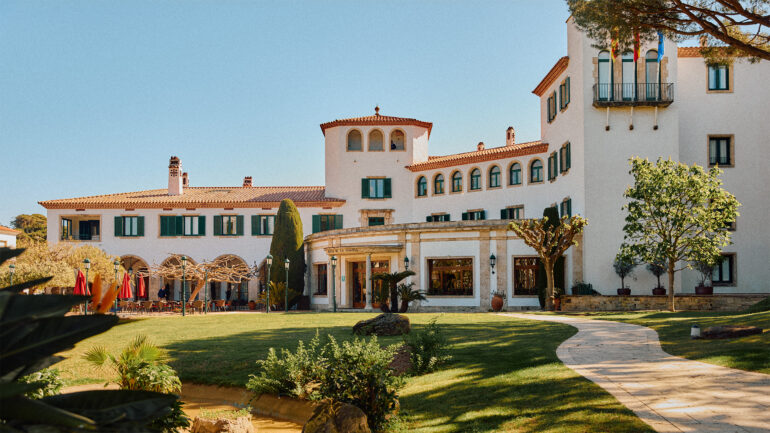
Long before the Spanish coast became the epicenter of summer tourism, a handful of visionaries laid the groundwork for a unique way of life. In the heart of S’Agaró, the Hostal de La Gavina is the ultimate embodiment of this way of life. Opened in 1932 by the Ensesa family—whose grandchildren still run the establishment—the hotel is the jewel of an ambitious urban planning project launched in 1924. Designed in collaboration with architect Rafael Masó, this “garden village” is a masterpiece of Noucentisme, a refined and bourgeois response to the flourishing of Catalan Modernism.
Behind its tall arched windows overlooking the Mediterranean, time seems to stand still. The hotel endured the hardships of exile during the Civil War before rising from the ashes in the 1940s, attracting Hollywood’s elite—from Orson Welles to Ava Gardner. Today, in the face of the standardization of hyper-design boutique hotels, La Gavina embraces its status as a grand patrician estate. As its management points out, running such an institution requires evolving without ever betraying its essence, while religiously preserving the period furnishings and the hushed atmosphere of the lounges.
Culinary Heritage and Weathered Stone
Further north, under the blazing sun of Calella de Palafrugell, the charm works in a different way. Nestled among the old, pastel-colored boat sheds, the Tragamar restaurant is a local institution. Recently taken over by restaurateur Tomás Taruella and his daughter Gina, the place exemplifies this tenacious commitment to preserving family traditions. Here, fresh fish caught early in the morning is enjoyed in its purest form, with a view of the waves dancing in the distance, far from any artificial rush.
This quest for meaning recently led Taruella to venture into the hinterland, to the heart of the charming medieval village of Madremanya and its 280 residents. By taking over the Hotel Madremanya, he has infused it with a genuine spirit of hospitality, where every detail—right down to the tableware crafted by local artisans at Ceràmiques Pantaleu—celebrates the local identity. For in the Empordà, visitors are invited to contribute to the beauty of the place rather than simply consume it.
When contemporary art awakens the ghosts of the past
The hinterland is teeming with historic retreats where the dialogue between eras reigns supreme. A few kilometers away, the small village of Púbol is home to the castle where Gala, Dalí’s iconic muse, found refuge. This passion for art in all its forms is evident at the Palau de Casavells, an imposing 16th-century building transformed into a contemporary art gallery. Far from being stuck in nostalgia, the residents and curators use these centuries-old walls as powerful platforms for modern creativity.
It is precisely this creative tension that can be found at Mas de Torrent. This five-star estate, centered around a majestic masia (traditional farmhouse), houses an impressive art collection, including frescoes by Josep María Sert. The property proves that luxury of the highest order—with its masterful spa and cutting-edge cuisine—can flourish while strictly respecting local architectural traditions.
Ultimately, to understand the Empordà is to walk the rampart path that winds through the pine trees and along the rugged cliffs. It means stopping at the Hostal Empúries, built in 1907 to house archaeologists excavating the nearby Greco-Roman ruins, and watching the sea relentlessly pound the coast. Nearly a century after journalist Ferran Agulló i Vidal dubbed this coastline the “Wild Coast,” the magic still holds. Facing the horizon yet fiercely protective of its roots, the Costa Brava remains a sublime act of resistance.
Guide: Our Retreats in the Empordà
1. Hostal de La Gavina (S’Agaró)
This 77-room institution literally pioneered luxury tourism on this stretch of the Mediterranean. With its legendary padel courts, seawater pool, and the Taverna del Mat right on the beach, the hotel has cultivated a rare sense of loyalty, both among its guests and its staff.
2. Tragamar (Calella de Palafrugell)
On Platja de Canadell, this seaside restaurant is a paradise for leisurely lunches. People come here for the seafood tapas, the laid-back lifestyle, and that inimitable atmosphere where time stands still.
3. Hotel Madremanya (Empordà)
Nestled amid rolling hills and cobblestone streets, this 12-room gem—which reopened last spring—offers a total immersion in Catalan craftsmanship and design. An ideal base for cycling enthusiasts and those who enjoy contemplative walks.
4. Palau de Casavells (Empordà)
A branch of the renowned Alzueta Gallery, this 16th-century palace contrasts the ruggedness of its ancient architecture with the brilliance of bold contemporary exhibitions.
5. Mas de Torrent (Empordà)
Part of the prestigious Único collection, this 39-room hotel is the epitome of refinement. Guests come here for the cuisine created by a former chef at El Bulli (Eugeni de Diego), for its exceptional spa, and for its lounges perfect for long conversations over tea.
6. Toc Al Mar (Aiguablava)
A high-end beach bar overlooking the turquoise waters of Aiguablava. For over a decade, oak embers have been used here to bring out the best in local mussels, fideua (that famous vermicelli paella), and delicious plates of ricotta with anchovies.
7. Hostal Empúries (Alt Empordà)
Just a stone’s throw from the ruins of the ancient city of Empòrion, this 54-room hotel with its sleek colonial architecture is the perfect starting point for exploring the coastline on foot or by bike, gazing out at the vast blue expanse.