
The Art of Escapism in the Riviera Maya: The Esencia Hotel Manifesto
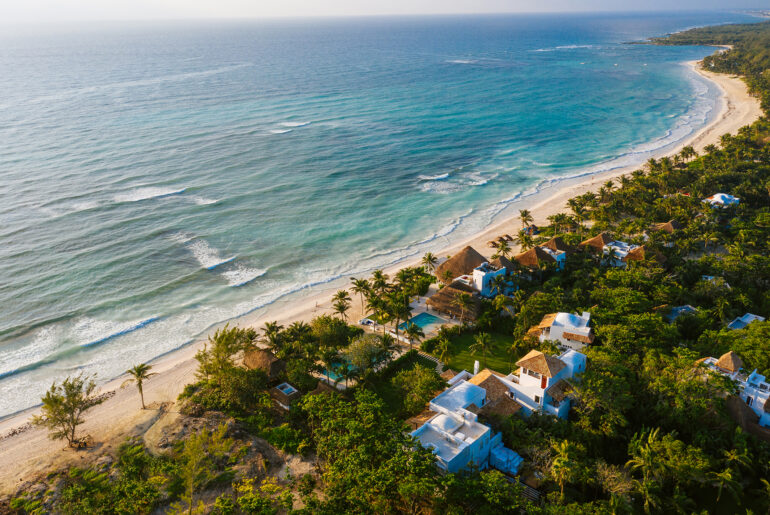
There is a tipping point—almost imperceptible—where the roar of engines and the clamor of mass tourism fade away, giving way to the sound of the surf. To reach it, you must leave behind the hustle and bustle of Cancún Airport—a veritable frenetic crossroads of Mexico—and drive ninety minutes south. The road is lined with opaque walls—concrete ramparts behind which hide sprawling all-inclusive resorts and noisy water parks. Then, suddenly, the dense tropical forest reclaims its territory. It is here, on a twelve-hectare estate nestled between the dense jungle and the turquoise waters of the Caribbean, that the Hotel Esencia unfolds. An enclave that seems to defy the laws of physics and the region’s rampant urban sprawl.
While most travelers head for the beach bars of Playa del Carmen or are lured by the siren call of Tulum—that former bohemian retreat which, in just a few years, has become a meticulously staged backdrop for Instagram posts—the Hotel Esencia cultivates a form of nonconformity. Here, there are no skyscrapers on the horizon, only birdsong and the rustling of leaves beneath your feet. This luxury of silence and space has become the most precious commodity on a Mexican coastline where three million visitors flock each year.
The Rise of Discretion Over Overtourism
The fate of this stretch of coastline has changed radically over the past two decades. While Cancún established itself as early as the 1990s as the mecca of spring break and endless parties, Tulum followed a more insidious path. Long preserved, this fishing village has been swept up in a wave of overdevelopment that today gives pause for thought: open-air beach clubs, traffic jams of taxis, and the opening of an international airport to handle an ever-increasing influx of visitors. What some celebrate as an economic success, others lament as the destruction of a once-wild natural environment.
Kevin Wendle, the owner of the Hotel Esencia, has observed this transformation up close. Twenty years ago, he was already scouring the Tulum area in search of a pied-à-terre. Faced with the impossibility of finding the ideal spot, he resigned himself to looking a little further afield. That’s how he stumbled upon an old mansion that had once belonged to an Italian duchess. What might have been seen as a second-best option turned out to be a blessing. Wendle discovered a stretch of pristine white sand that he vowed to protect. By working closely with his few neighbors, he erected an invisible barrier against unchecked development, preserving the integrity of his shoreline while the rest of the coast succumbed to the siren song of immediate profit.
A Duchess’s Legacy and an Artisan’s Flair
Transforming a private residence into an icon of the global hospitality industry took eighteen months of relentless work. The idea was not to build a hotel, but to extend the soul of a home. The casitas, scattered among the vegetation and along the seashore, reflect this philosophy of seclusion. Luxury is palpable here, but never ostentatious. The whitewashed walls serve as a backdrop for a carefully curated collection: handwoven rugs, mid-century chairs, and pieces of furniture designed by Studio Giancarlo Valle or crafted in the workshops of Ceramic Suro.
The estate has evolved in small, subtle steps, almost as if by gradual accumulation. Unlike many hoteliers who delegate management to anonymous investment funds, Kevin Wendle is the sole decision-maker. This financial independence affords him a rare freedom: the freedom to ignore trends. When he decides to add a gym, a spa, or new suites, he does so with an obsession for detail that borders on craftsmanship. “Sometimes, the improvements simply involve removing faucets I no longer like, reselling them, and replacing them with more suitable models,” he explains. It is this attention to the smallest details that ensures the place will never age poorly, unlike those establishments that shine for ten years before falling into obsolescence.
An Artistic Vision Rooted in Haute Couture
To forge the hotel’s visual identity, Wendle turned to an unconventional choice: Juan Carlos Gutiérrez. This Mexican graphic designer worked for Chanel in New York before joining the Esencia venture. Initially tasked with reimagining the brand’s image and menus—he even served as executive chef for a time—he now holds the position of artistic director. His role is to ensure the overall coherence of the project, drawing on a vision he himself describes as “old-world.”

In contrast to the standardization plaguing the international luxury hotel industry, Gutiérrez insists on bespoke design. Nothing should come from an industrial catalog. Every object, every texture must tell a story and possess its own character. The goal is clear: to create an environment where guests feel at home, far from the rigid conventions of traditional luxury hotels. In the Master Beach Suite, a simple touch of bright red is enough to break the chromatic monotony and give the space character, reminding us that design is, above all, a matter of emotion.
Gastronomy and the Local Area: The “Sedentary” Strategy
A few years ago, guests at the Hotel Esencia would leave the property in the evening to try out Tulum’s trendy restaurants. But with the city becoming increasingly congested and the proliferation of real estate projects, the experience has become a hassle. Faced with this reality, Wendle decided to transform his hotel into a self-sufficient gastronomic destination. His ambition: to offer compelling reasons never to step outside the resort’s gates.
The culinary approach adheres to the same high standards of quality as the architecture. For the pizza oven, a pizzaiolo was recruited directly from Naples. For the sushi menu, advice was sought from Miami’s top experts. More recently, the opening of a Beefbar branch has cemented the hotel’s reputation among international gourmets. By raising the bar for service and cuisine, the hotel has successfully built a loyal clientele, transforming the stay into a complete retreat where every desire is anticipated without having to face the chaos of the outside world.
The Future of the Riviera Maya Is Rooted in the Past
Despite the radical transformations of the peninsula, Kevin Wendle remains optimistic about the region’s future. For him, the richness of the Maya heritage and the power of the surrounding nature are unshakable pillars. Just a few minutes’ walk from the hotel lies a secluded lagoon where manatees swim in complete tranquility, far from prying eyes. The cenotes and nature reserves remain accessible to those who know how to venture off the beaten path.
Accessibility, in fact, remains one of this enclave’s major assets. Its proximity to the Cancún airport—which offers direct flights to major global cities such as London and New York—allows for a sudden yet refreshing transition from the urban concrete jungle to the gentle tropical landscape. Without the need for boat transfers or multiple connections, travelers are instantly immersed in a Mexico where time seems to have stood still. In an industry obsessed with constant novelty, the Hotel Esencia stands out as an exception, proving that true boldness lies in staying true to oneself, come what may.