
Make Texture a preferred source on Google to support us
Add Texture to GoogleLocated in Messenia, the Mandarin Oriental Costa Navarino resort features an architectural design that is in perfect harmony with its surroundings. Combining simplicity, natural elegance, and eco-friendly innovations, this project redefines the boundaries and very essence of luxury hospitality.
The Art of Discretion
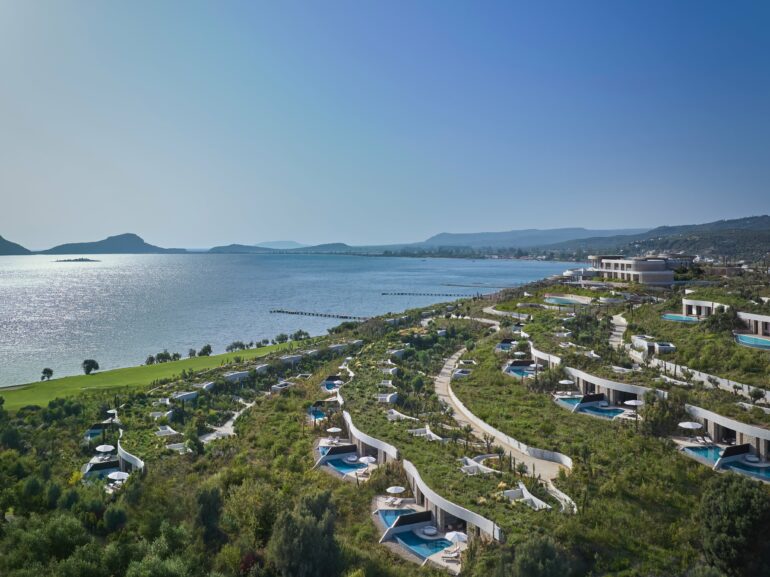
Perched above Navarino Bay, the Mandarin Oriental Costa Navarino offers a unique take on luxury hospitality. Designed by Alexandros N. Tombazis & Associates Architects in collaboration with K-Studio, the resort prioritizes integration with the landscape over ostentatious architectural gestures. Here, the landscape is not merely a backdrop: it becomes the very foundation of the project. This is a rare approach in an industry where visual impact often takes precedence over seamless integration.
Nestled on the southwestern coast of the Peloponnese, this region—rich in Mediterranean history and still largely untouched—dictated the design guidelines for the resort. Each space was designed to engage with the topography rather than impose itself upon it. Far from being ascetic, this formal restraint reflects a rare architectural rigor, endowing the site with an innate and timeless elegance.
A Topography Enhanced by Design
The site’s spatial organization draws inspiration from the mandria, traditional stone enclosures that perfectly adapt to the Messinian terrain and climate. The buildings are scattered in intimate hamlets, flowing along the curves of the hill. This organic approach significantly reduces the visual impact and breaks with the sense of mass so common in the region’s large resorts.
The development features 99 suites, including 48 private villas with pools, while the main building houses 39 guest rooms and all communal spaces: reception, lounges, terraces, spa, restaurant, and bar. The architecture strikes a subtle balance between social spaces and private sanctuaries. The site is not merely occupied; it is carved out, given breathing room, and carefully proportioned.
The semi-underground accommodations extend this philosophy of unobtrusiveness. The project preserves the spectacular views of the bay while softening the exposure of the facades. Green roofs, sheltered terraces, and skillfully framed openings extend the interior outward with remarkable fluidity, erasing any abrupt boundaries.
Timeless Materials
Inside, the color and material palette embodies minimalist sophistication. Local stone, terrazzo, organic textures, and warm tones create a tactile atmosphere, free from any ornamental excess. The architects have infused the space with a subdued elegance where the built environment almost fades into the background to celebrate both use and contemplation. This approach marks a complete break from the monumental style often favored by traditional seaside hotels.
The design of the circulation spaces fully embodies this commitment to simplicity. Outdoor walkways minimize the need for air-conditioned corridors, while shaded areas naturally regulate temperatures. Here we see the vernacular wisdom of the Greek coastline, where the quest for shelter and the quest for light are in balance. The complex’s modernity does not deny the climate; it enhances it.
Invisible and Sustainable Engineering
The ecological dimension goes beyond a mere technical addition: it shapes the very essence of the estate. Green roofs, thermal mass optimization, cross-ventilation, the use of local materials, water-efficient landscaping, and strict lighting management all shape the experience. The organization into hamlets also proves strategic, allowing the activity in certain wings to be adjusted according to the season.

This flexibility addresses both economic and ecological imperatives, drastically reducing the overall energy footprint. In a sector often drawn to the spectacular, this technical and environmental intelligence stands out as a true aesthetic choice.
The legacy of the Athens-based firm Alexandros N. Tombazis & Associates—a pioneer of bioclimatic design in Greece since the 1960s—is palpable here. The collaboration with K-Studio, known for its contextual approach, reflects a shared philosophy: to design on a grand scale with humility, without ever succumbing to visual austerity.
A New Language of Hospitality
The Mandarin Oriental Costa Navarino does not seek to overturn conventions with a great deal of fanfare. On the contrary, it offers a measured response to the excesses of contemporary luxury. The complex demonstrates that a world-class resort can cultivate radical authenticity, eschewing standardization and ostentatious artifice. The strength of this project lies precisely in this creative tension: the art of combining deep local roots with global standards of excellence.
In the Mediterranean region, where architecture often oscillates between antique pastiche and excessive ambition, this project takes an alternative path. It prioritizes integration over domination. While the design does not seek to dazzle at first glance, it is precisely this deliberate discretion that underpins its credibility and absolute prestige.