
To liberate color from its two-dimensional state and imbue it with a physical, tangible, and habitable reality. This approach represents a spatial transgression that Gerhard Richter, a leading figure in contemporary abstraction, is set to bring to life on the shores of the Persian Gulf. On September 10, the governing body Qatar Museums officially announced the construction of a permanent structure designed by the German artist in collaboration with the New York-based firm Selldorf Architects. Scheduled to open on November 20, 2026, the building will be located within MIA Park, sharing its skyline with the geometric lines of the Museum of Islamic Art. Far from being merely a showcase for paintings, this project will mark a radical shift: that of a pictorial language which, rejecting the confines of the frame, transforms to become architecture itself.
The origins of this transformation lie in a specific geographical and temporal shift. The beginnings of Richter’s reflection date back to 2013, when the painter discovered Doha’s urban environment and cultural fabric during a visit. Direct contact with the topography of the Qatari capital—torn between architectural brilliance and heritage—acted as a catalyst. The idea was no longer to impose a work onto a wall, but to create an autonomous volume capable of interacting with the city’s light and perspectives. Thirteen years after that initial survey, the transition from pure painting to an integrated spatiality finds its culmination under the understated title *Doha Pavilion: Gerhard Richter*.
Algorithmic Fragmentation as a Facade
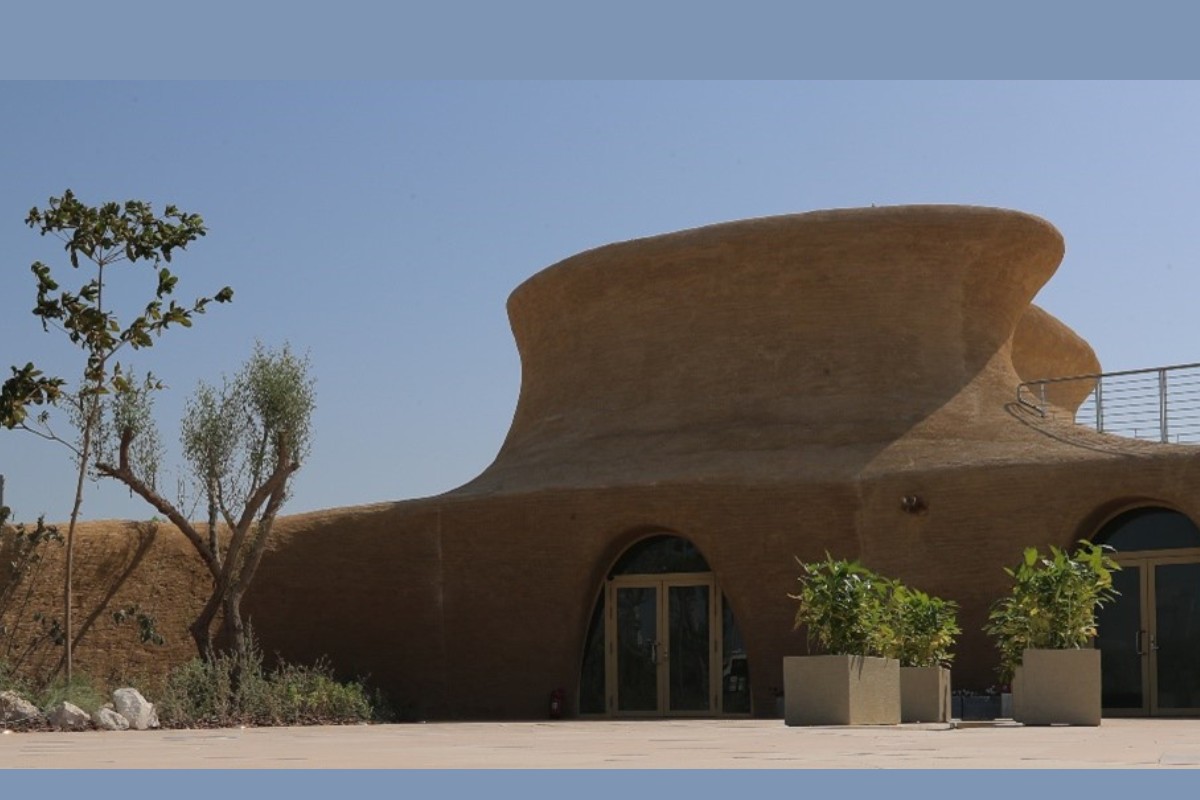
The choice of a hexagonal base for this structure is by no means incidental. The pavilion’s exterior envelope was designed to interact with its immediate surroundings, while building upon the aesthetic explorations the painter began at the start of the previous decade. Specialized publications such as Designboom and e-architect have highlighted the direct connection between the building’s facade and the motifs explored by the artist in his 2011 book *Patterns*. To understand the exterior of this pavilion, one must go back to an original source: *Abstract Painting (724-4)*, a canvas created in 1990.
This seminal work was subjected to a relentless digital dissection. Through a computer-assisted fragmentation process, the painted image was split, cut up, and then multiplied symmetrically. The artist’s free-flowing brushwork was thus subdued by the rigor of algorithmic calculation. Applied on the monumental scale of a facade, this principle of strict repetition creates a unsettling echo. Contemporary European abstraction intersects, almost by accident or through aesthetic synchronicity, with the mathematical complexity of the traditional geometries found in Islamic art. The pavilion establishes a silent yet visually dense dialogue with the historical collections housed just a few dozen meters away.
An Optical Mechanism in a Closed System
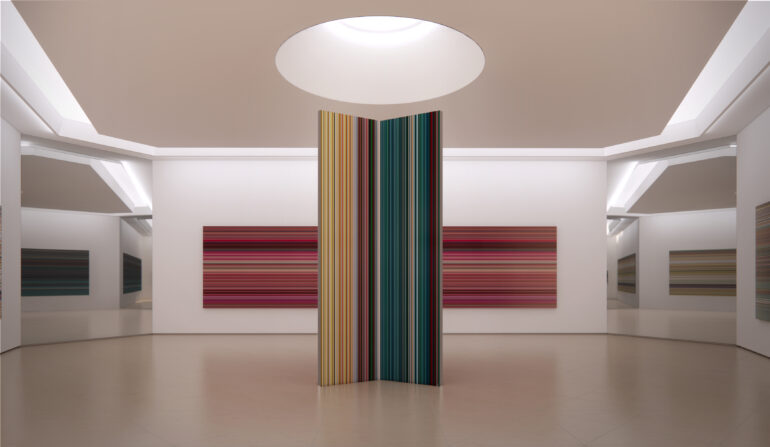
Crossing the threshold will draw the visitor into a meticulously calibrated visual mechanism. The interior space has been calibrated to extend the dizzying flatness of the “Strip Paintings”—those horizontal bands of color that constitute an essential part of the artist’s recent abstract vocabulary. The main walls will feature three monumental paintings from this series. But the experience will revolve around a physical pivot point: the integration of a Strip Tower. This element will divide the central space, adding a sculptural and autonomous verticality within the hexagon.
To counter any sense of enclosure and manipulate the perception of volume, the design will rely on two massive mirrors stretching from floor to ceiling, positioned on the side walls. The purpose of these reflective surfaces is twofold: to dissolve the physical boundaries of the room and to create the illusion of infinite visual expansion. The colored bands will echo one another, virtually intersecting and saturating the field of vision. Here, Richter remains entirely consistent with his historical method, tirelessly seeking to blur perception. The architecture becomes an optical illusion that dissolves the boundary separating the image, the display surface, and the habitable space. The viewer does not come here to scrutinize paintings; instead, they find themselves physically absorbed by the work itself, far removed from any purely decorative pleasure.
The Pace of a New Cultural Diplomacy
The schedule chosen to unveil this pavilion is part of an institutional calendar calculated down to the day. November 20, 2026, will not be an isolated date, but rather the opening act of a much broader sequence. The very next day, November 21, Doha will inaugurate the very first edition of Rubaiya Qatar, an international event dedicated to the visual arts. Designed to take place every four years, this program will run through April 30, 2027.
This synchronicity reveals the emirate’s desire to build its visibility on the global art scene around key events capable of capturing the attention of international curatorial networks. Qatar Museums is making its move by structuring this new quadrennial around a three-pronged approach that combines ambitious public commissions, a cycle of temporary exhibitions, and a series of projects requiring direct public participation. The goal is to saturate the urban space with artistic initiatives, transforming the entire city into a platform for experimentation.
Preparations for this redevelopment are already well underway. The local press, such as the Qatar Tribune, has recently documented the emergence of contemporary art in the green spaces surrounding the museums. A participatory installation, commissioned from artist Rirkrit Tiravanija, was set up in the heart of MIA Park. This outdoor installation served as a prelude to the announcement of the quadrennial, confirming the local cultural authorities’ commitment to reimagining the public sphere.
A lasting presence in the face of the transience of events
The commission awarded to Gerhard Richter goes beyond mere publicity. It is part of an institutional and architectural network that the Qatari capital has been methodically expanding for several years. The pavilion’s immediate surroundings bear witness to this. In addition to the monumental structure of the Museum of Islamic Art, the site engages with the AL RIWAQ space, a major cultural venue that recently underwent a renovation noted by critical platforms such as Artsy and ArtReview. In this urban landscape, where spectacle often takes precedence over introspection, the German painter’s project stands out for its highly understated aesthetic, prioritizing rigor and formal simplicity.
The true significance of this architectural gesture will not be measured by the media coverage generated during the month of its inauguration. What matters is the building’s endurance over time and its ability to shape the city’s collective imagination in the long term. Qatar is demonstrating here its commitment to moving away from ephemeral cultural consumerism to build a lasting cultural heritage, capable of embedding the history of contemporary art directly into the landscape. By embedding his bands of color within the enduring architecture of a public park, Gerhard Richter marks a definitive shift in his painterly practice, leaving behind the climate-controlled confines of traditional museums to subject his abstraction to the shifting light of the Gulf.