
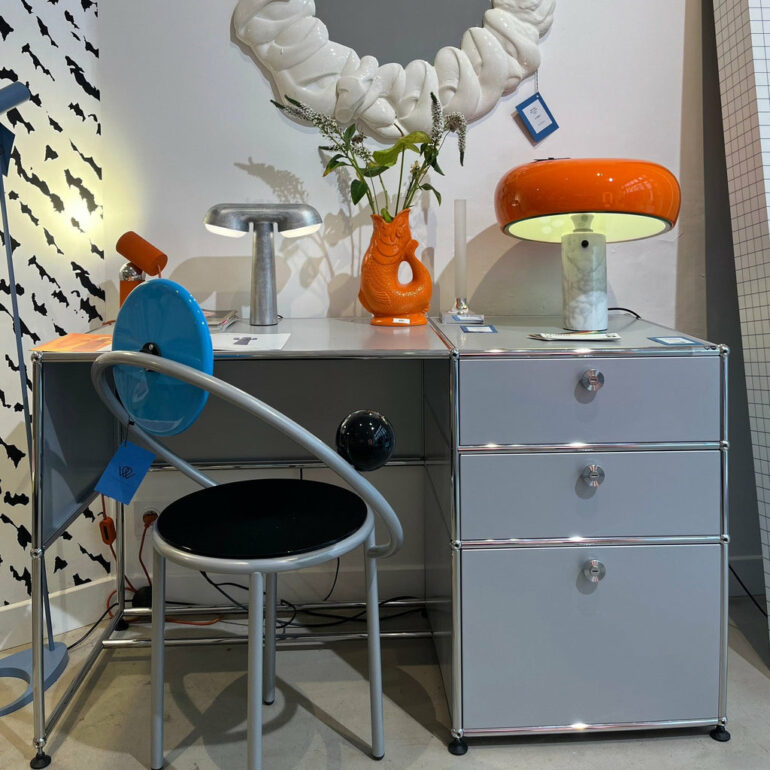
A herringbone-patterned floor, 19th-century moldings, a marble fireplace. Amid this bourgeois Parisian setting, a cold, geometric, implacable block of metal. The doors open with a sharp click—a heavy, mechanical sound that betrays the weight of the steel. Whether used as a bookshelf in a collector’s apartment, a counter in a fashion boutique, or a record cabinet at a music producer’s home, the Swiss modular system designed more than half a century ago commands a unique presence. It never attempts to blend in or merge with the surroundings. Its strength lies precisely in its industrial rigidity, in that chrome-plated skeleton that divides the space with mathematical precision.
The paradox is complete. Furniture conceived exclusively for factory offices—designed in a rush to meet a practical need—has ultimately established itself as the status symbol of contemporary living. To understand this trajectory, one must leave behind the cozy interiors and trace the origins of a strictly architectural approach, where the very notion of decoration had no place.
Architecture Scaled Down to the Human Level
In the early 1960s, the town of Münsingen, in the canton of Bern, was home to a factory producing window fittings and hinges. The family-owned company USM (standing for Ulrich Schärer Münsingen) was then run by the founder’s grandson, Paul Schärer. Schärer was an engineer by training, fascinated by emerging industrial aesthetics and functional architecture. Wishing to modernize his facilities, he commissioned Fritz Haller, a Swiss architect affiliated with the Solothurn School, known for its constructivist approach.
Haller did not simply design a building. In 1961, he conceived a modular construction system based on steel frames, capable of expanding or contracting as production needs evolved. The factory became a vast, open, flexible, and rational space. But once the walls were up and the machines installed, an unexpected problem arose: no office furniture available on the market fit this new spatial philosophy. The wooden furniture of the time—heavy and static—clashed with the structural lightness of the new pavilion.
Rather than seeking a compromise, Schärer and Haller decided to apply the factory principle to the interior design. They scaled things down. Beams became tubes; facades were transformed into steel sheets. Furniture was no longer conceived as a series of finished objects (a table, a cabinet, a shelf), but as a vocabulary of basic elements capable of generating infinite configurations. In 1963, the first prototype was created. It was intended for the exclusive use of the staff in Münsingen.
A brass sphere as the keystone
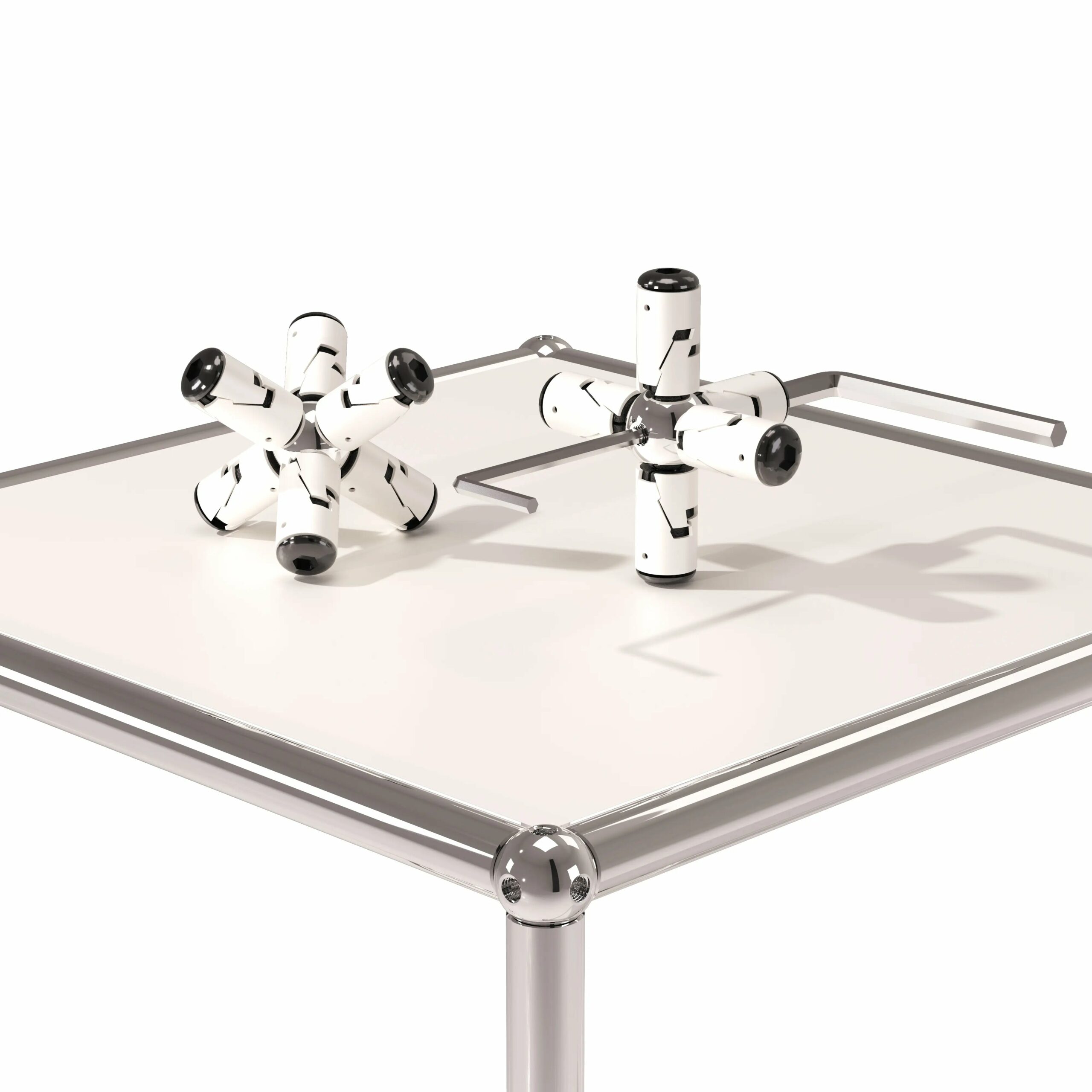
The ingenuity of a modular system is judged by its connection points. It is here that the true technical innovation of Fritz Haller and Paul Schärer lies—one that would be patented in 1965. To connect the chrome-plated steel tubes without welding, they devised a machined brass sphere with six threaded holes. This multidirectional connection point allows the frame to extend in all directions: upward, outward, and downward.
This sphere, just a few centimeters in diameter, is the cornerstone of the entire structure. It requires an extraordinary level of precision during machining. A one-millimeter misalignment in the thread, and the entire structural tension collapses. The fastening is done from the inside of the tube, making the screws completely invisible. From the outside, the eye perceives only a perfect, smooth, and shiny joint that catches the light and highlights the furniture’s geometric pattern. The supporting framework thus becomes its own ornament.
Once the frame is assembled, it is clad with powder-coated steel panels, inserted under pressure. The metal is folded at the edges to ensure maximum rigidity. Drop-down doors, full-extension drawers, or glass panels are added as needed. The concept is akin to a construction set for adults, governed by the physics of materials and the rationality of Swiss engineering.
The Rejection of Obsolescence
While most designs from the 1960s bear the hallmarks of their era—organic forms, molded plastics, psychedelic colors—the system designed in Münsingen has stood the test of time without undergoing any structural changes. The reason for this enduring quality lies in its complete lack of any initial stylistic intent. The furniture was not designed to please, but to function.

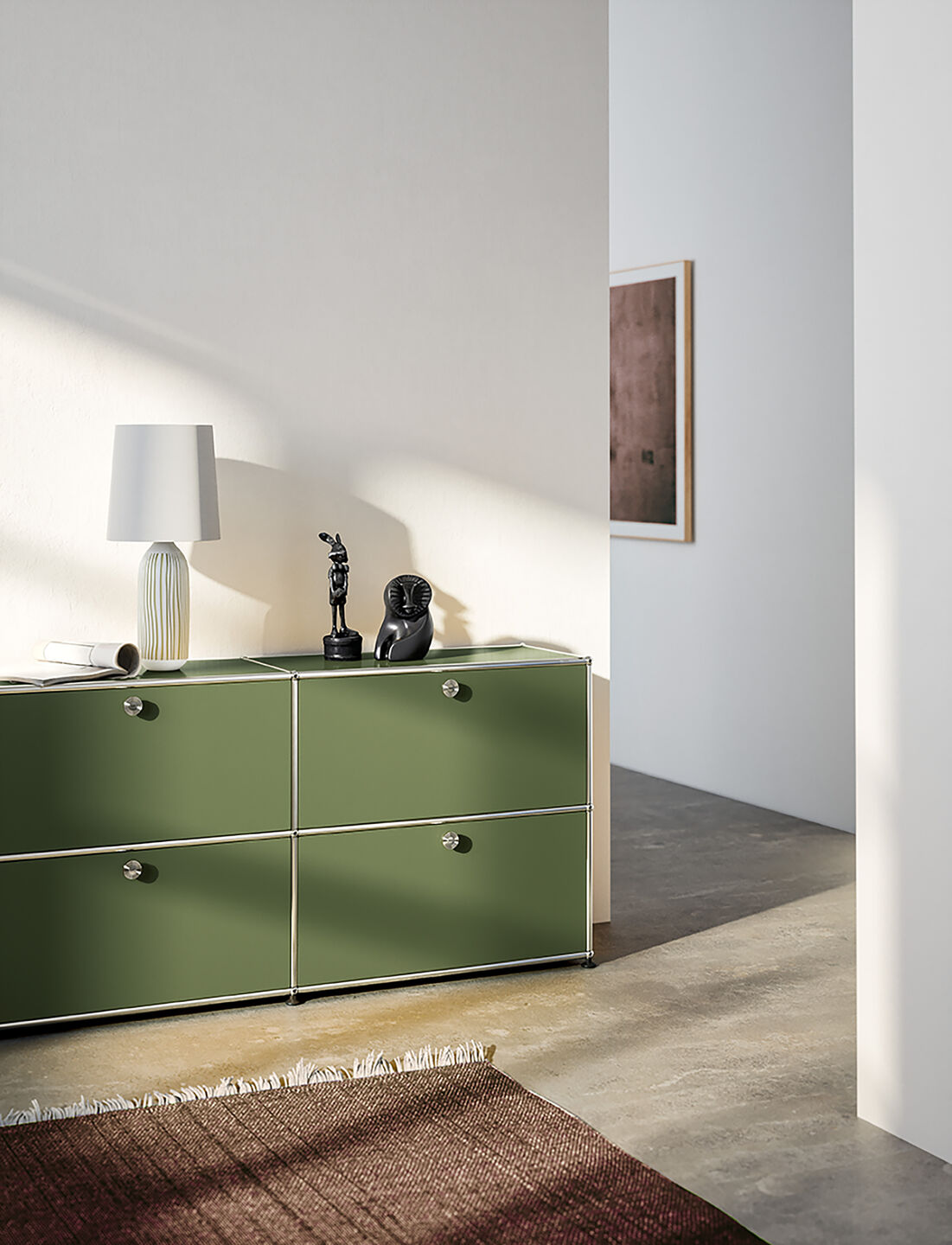
This absolute pragmatism has, almost by accident, produced a radical response to planned obsolescence. A user can disassemble a sideboard purchased in 1978 and transform it into a nightstand by incorporating parts bought in 2024. The thread pitch of the brass sphere has not varied by even a fraction of a millimeter. The color palette itself reflects this consistency. Fourteen shades, ranging from pure white to graphite black, including golden yellow, ruby red, and apple green. These bold colors, applied via powder coating, do not fade over time. They contribute to the visual structure of the piece, acting as geometric blocks of color reminiscent of Mondrian’s canvases or the De Stijl movement.
At a time when the furniture industry is making increasing declarations of intent regarding sustainability—often under pressure from contemporary standards—this system puts into practice an “ecology of the object” based on complete reparability. A scratched door can be replaced, a bent tube can be swapped out, and the configuration evolves as you move from place to place. The object refuses to die.
From Open-Plan Offices to Museum Collections
The shift from the professional sphere to the domestic space has occurred gradually, over the course of decades. Initially perceived as high-end office furniture, prized by banks, law firms, and architectural firms, the system gradually made its way into the living room. Professionals began installing it in their homes, drawn to its ability to structure space with authority. Interior design magazines of the 1990s did the rest, highlighting the striking contrast between the coolness of colored metal and the warmth of classic interiors.
Its definitive institutional recognition came in 2001. The Museum of Modern Art in New York added the system to its permanent collection of architecture and design. This formal recognition marked its transition from a simple storage solution to a milestone in the history of industrial design.
Today, assembly still requires the assistance of specialized technicians, equipped with a specific Allen wrench designed to reach the center of the sphere. The process demands both strength and precision. The metal creaks slightly before falling into place; the screw locks into position. The structure becomes rigid and heavy, ready to bear the weight of books, files, or everyday objects, completely indifferent to passing trends.