
Make Texture a preferred source on Google to support us
Add Texture to GoogleYou can cover a runway in gold and almost always keep the bags out of the frame. This paradox sheds light on Anthony Vaccarello’s approach at Saint Laurent: creating desire around a silhouette, rather than turning the runway show into a showcase for accessories. The Spring/Summer 2027 women’s collection takes this logic to the point of luminous saturation. It brings together the hallmarks of the house and the obsessions of its creative director, after ten years of work. Rumors of his departure already give it the air of a swan song. But by searching everywhere for clues of a farewell, we risk missing what the clothes are saying: a certain way of staying true to a vision.
Gold as a Tool for Interpretation
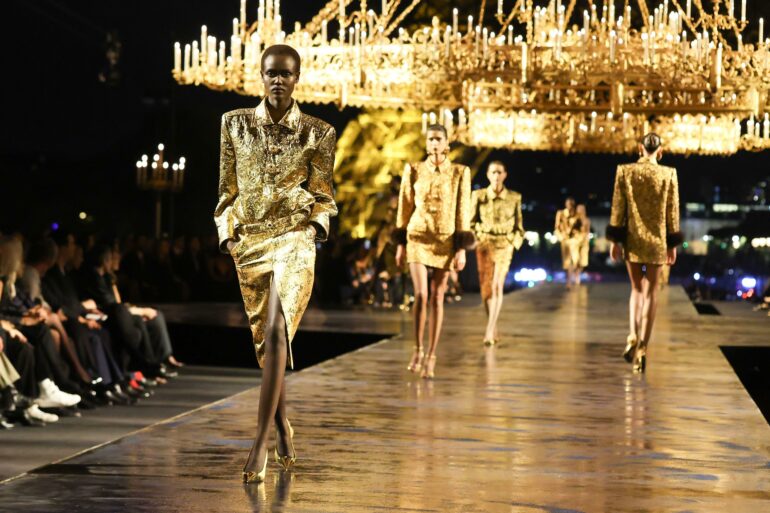
The choice might seem easy. At Saint Laurent, gold immediately evokes luxury and spectacle. Vaccarello, however, turns it into a rather precise tool: a common color allows him to bring together garments from different eras, to examine what connects them without erasing their individual characteristics. Saharan jackets, trench coats, blouses, and wrap skirts drawn from Yves Saint Laurent’s vocabulary thus meet the silhouettes that his successor has established over the seasons.
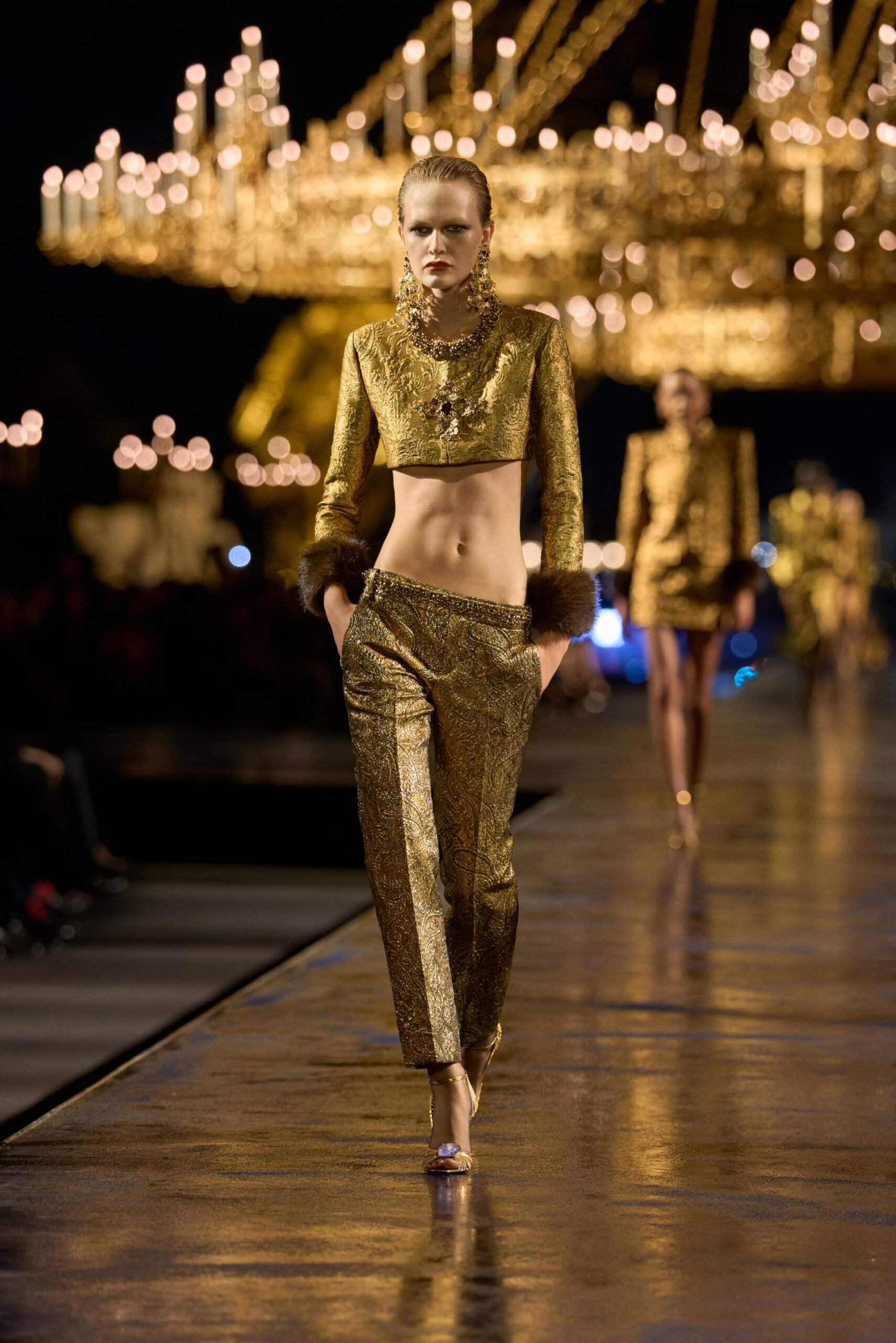
Coats with pronounced shoulders, generous jackets, and short, sharp suits framed by wide strips of fur belong to this second category. Brought together under the same radiant glow, they do not seek to distinguish between legacy and personal contribution. Rather, they demonstrate just how deeply the two have become intertwined. This is perhaps the most compelling point of this collection: after a decade, the question is no longer simply what Vaccarello borrows from the founder, but what, in our perception of Saint Laurent, now passes through him.
Yet this gold must not be uniform. Deep or pale, matte or burnished, it varies depending on the fabric. Lame does not have the same presence as organza; guipure and brocade introduce further textures. Latex covered in gold leaf further shifts the relationship between surface and material. The house itself describes an almost obsessive use of the material. And rightly so: here, repetition focuses less on the cut than on the possibilities of brilliance, extending all the way down to the feet.
Ten Years to Create a Familiar Silhouette
This work is best appreciated over time. Vaccarello has often revisited Yves’s silhouettes—in which he recognized himself—without seeking to make each season unrecognizable compared to the previous one. In his case, repetition does not necessarily mean a lack of ideas. It also means persisting until a proportion, an attitude, or a way of wearing a garment becomes instantly recognizable without explanation.
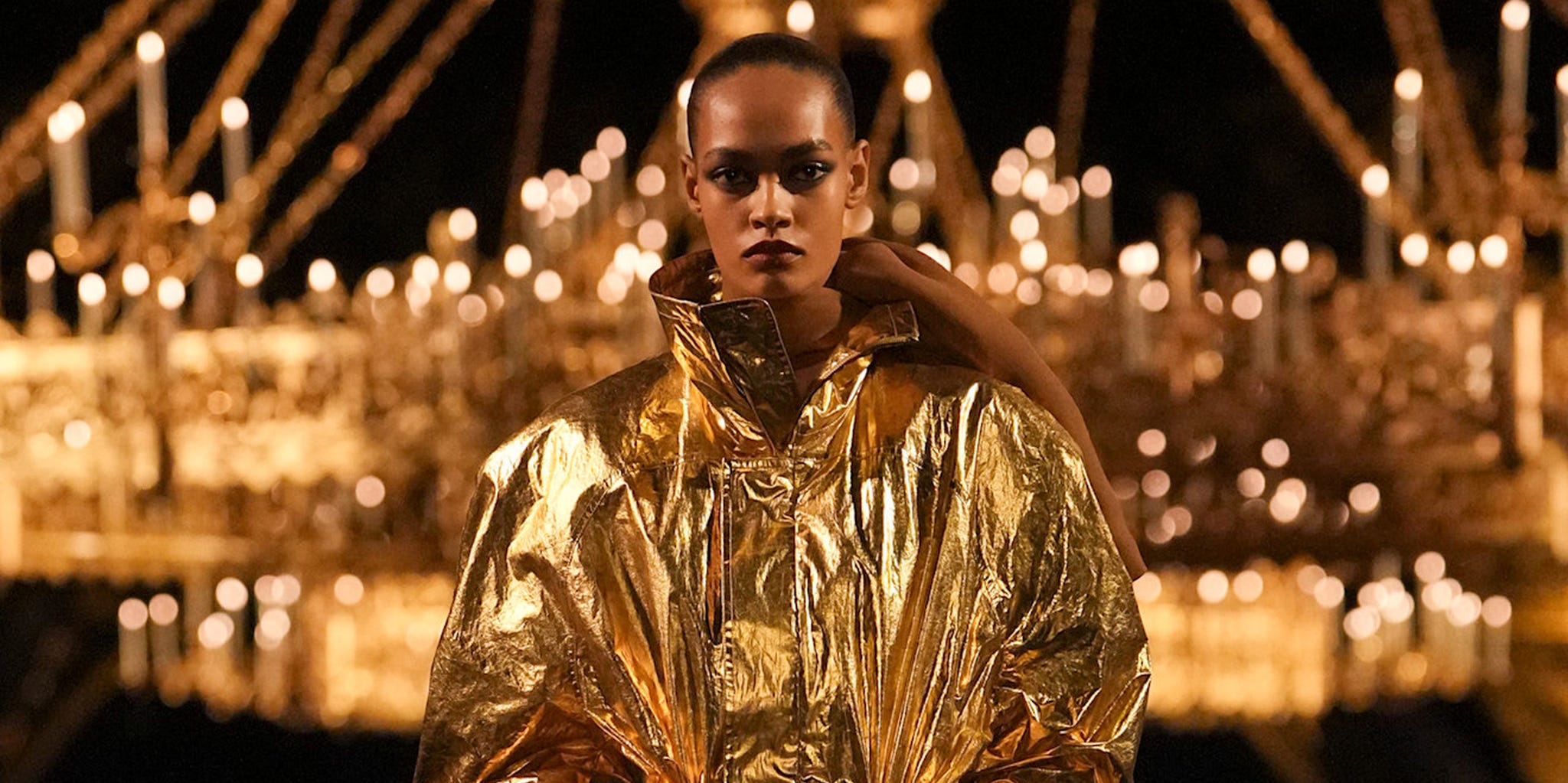
The scarcity of bags on the models’ arms is part of this discipline. It allows the clothing to capture the eye and prevents each appearance from being reduced to an immediately identifiable object. This approach doesn’t preclude commerce; it simply reorganizes the art of seduction. Before desiring a piece, one desires to step into the image it creates. The consistency built up season after season gives this image its power.
Duration matters just as much as intention. Ten years as creative director have allowed Vaccarello to refine his aesthetic, with the confidence required for work that did not always rely on immediate obviousness. His long collaboration with Francesca Bellettini, former head of Saint Laurent and now at the helm of Gucci, has accompanied this journey. The brand’s regained standing cannot, therefore, be viewed solely as a succession of successful fashion shows: it also stems from the continuity between a creative vision and those who gave it the time to take root.
Desire extends beyond the wardrobe
One sign allows us to gauge this influence without citing figures: people who don’t buy the clothes are still adopting its style codes. Over-the-knee leather boots and ties tucked into shirts have spread beyond the clientele who can afford Saint Laurent. The silhouette thus becomes an accessible reference point, one that can be interpreted in other ways.
Vaccarello has thus reached an adult clientele while still capturing the attention of younger audiences. This dual audience deserves better than the conventional dichotomy between loyalty to heritage and winning over a new generation. Here, recognizing a style does not prevent its appropriation. The collection is distinctive enough to be recognized, desirable enough to be imitated. This is also what makes the idea of his departure difficult to imagine: replacing a designer would mean shifting an image that has become familiar.
A finale laden with subtext
Nevertheless, the speculation has some basis. Facing the Eiffel Tower, an excessively long runway and three large gilded chandeliers lend the fashion show a particular solemnity. When gold gives way to black in the final looks, this shift in tone is enough to fuel various interpretations. Clothing remains clothing; yet in such a context, every contrast takes on the significance of a statement.

Anthony Vaccarello’s bow sparked even more commentary. Instead of a brief appearance, the designer took a long walk down the runway. The models applauded him, a gesture reminiscent of Yves Saint Laurent’s final fashion show. His visible emotion, the song performed by Charlotte Gainsbourg, and the keys entrusted to his five-year-old son reinforce the impression of a personal ceremony. Some interpret these keys as those to the house. This interpretation remains a supposition, not an established fact.
The notes from the fashion show also maintain the ambiguity. In them, Vaccarello associates the beauty of light with the impossibility of holding onto it and suggests that what disappears can leave behind more radiance than what remains. The connection to the end of a term is easy to make. However, this does not constitute confirmation. At the time these reports were published, Kering had not issued any press release or commented on a possible departure.
The personal dimension, without confession
The soundtrack offers another layer of interpretation. The opening track, “Io Vengo,” sung by Piero De Benedictis—known as Piero—evokes humble origins, a neighborhood, and a narrow street. For Vaccarello, born in Brussels to parents who emigrated from Sicily, the choice may resonate as a return to his family history. It would, however, be an overinterpretation to see it as an explicit autobiographical statement.
This restraint makes the connection all the more intriguing. A song can introduce a sense of intimacy without revealing a secret; a collection can take stock without signaling a break. Gold itself belongs to both stories—that of the designer and that of the fashion house: Yves Saint Laurent loved it and, when it illuminated a woman, associated it with the sun. Vaccarello therefore has no need to invent a symbol outside the wardrobe to give this fashion show a personal resonance.
The succession remains uncertain
Succeeding Hedi Slimane was already a delicate task at a fashion house whose name carries far more weight than just a fashion business. The prospect of the post-Vaccarello era now poses a similar challenge. The name of Chemena Kamali, currently the creative director at Chloé, is circulating in the industry. Nothing in the available information suggests this rumor will lead to an appointment.
The next decisive sign, therefore, will be neither a song nor a gesture on the runway. It will be an official statement. Until then, the image of a child holding the keys remains open to interpretation—not proof of a vacant position.