
Make Texture a preferred source on Google to support us
Add Texture to GoogleThe period of shock and disbelief seems to have given way to an era of pragmatism. After months of heated debate over the alleged plundering of artistic data by generative artificial intelligence models, a new perspective is emerging within specialized legal circles. Far from the predicted creative apocalypse, the focus is now on tolerance—or at least on a reasoned acceptance of this technology as an inevitable component of the cultural ecosystem. This shift, observed by the leadership of the Institute of Art and Law, suggests that visual artists may, against all odds, have stronger defenses than their colleagues in other disciplines.
The Unsolvable Equation of Copyright
The first obstacle to a massive legal challenge lies in the very nature of the evidence. For an artist, proving in court that a protected work was used to train an AI model is akin to a complex quest. If the final product—the output—bears no obvious resemblance to the original work, the legal classification of infringement becomes uncertain. The debate remains open: Does training models—this “harvesting” of data on an industrial scale—constitute illegal copying in the strict sense of copyright law? To date, the answer remains unclear.
Added to this practical complexity is a major territorial asymmetry. The majority of training processes take place on U.S. or Chinese soil. For a creator residing in the United Kingdom or the European Union, pursuing legal action on the other side of the world presents a colossal procedural and financial challenge. This geographic fragmentation of jurisdictions creates de facto protection for technology companies, leaving artists in a position of forced inaction.

The Resilience of the Physical Experience
However, not all creators are equally exposed to the winds of automation. A clear distinction exists between commission-based professions and those centered on exhibition. Photographers, writers, composers of commercial music, and graphic designers face a threat of direct replacement. In these sectors, AI is capable of generating scripts, pop melodies, or logos in a matter of seconds, eliminating routine commissions and undermining the self-employed workers who have traditionally managed these production workflows.
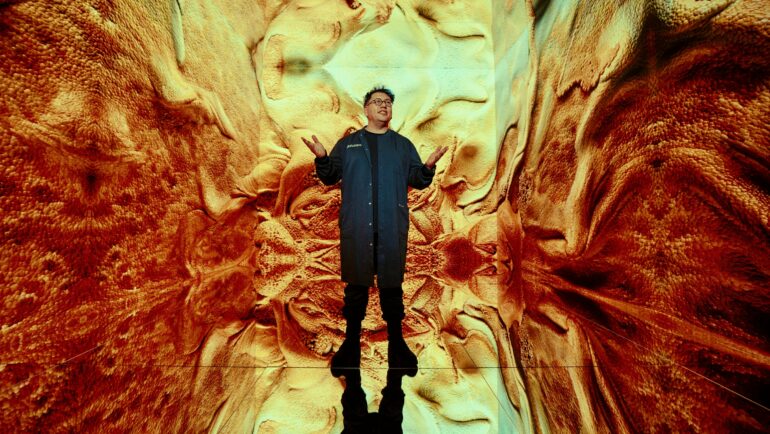
In contrast, visual artists and gallery artists retain a form of immunity tied to the materiality of their practice. Figures such as Anselm Kiefer or Kara Walker, whose work relies on monumental installations and a physical occupation of museum space, cannot be replaced by an algorithm. The spatial and tactile experience of a work of art—its interaction with the venue and the viewer—remains the exclusive domain of humans. AI can generate an image, but it cannot yet construct an installation that exudes the physical and historical presence unique to the fine arts.
The Lesson of History: From Photography to AI
To understand this transition, we must look back to the 1860s. The rise of photography was then perceived as an existential threat to painting. Yet this technological shift did not lead to the disappearance of painters; rather, it freed them from the obligation of realism. By forcing painting to reinvent itself, photography served as the catalyst for major modern movements, from Impressionism to Cubism and Pointillism. History seems to be repeating itself: AI could well be the new mirror compelling the visual arts to deepen their ability to convey meaning and offer fresh perspectives on the world.
Art retains its intrinsic value in its capacity for human interpretation. Beyond the tool—whether it’s a paintbrush, a camera, or an algorithm—it is the artist’s vision that remains at the heart of its value. The market has, in fact, already embraced this in a spectacular way: as early as 2018, the AI-generated painting *Portrait of Edmond de Belamy*, created by the Obvious collective, sold for $432,000 at auction, signaling collectors’ interest in these new forms of creation from the very beginning.
The Rise of a Contract-Based Economy
The path forward no longer seems to lie in systematic confrontation, but rather in contractual agreements. We are witnessing the emergence of licensing agreements negotiated between major publishing groups, rights management agencies, and artificial intelligence giants. These agreements allow models to be trained on identified datasets in exchange for compensation for authors and rights holders.
This approach, while pragmatic, raises questions about the fair redistribution of revenue. While some experts and authors now agree to include their works in these collective licenses, the royalties generated are still described as “modest,” and no standardized public fee schedule has been established to date. Nevertheless, for much of the industry, this contractual negotiation appears to be the only realistic strategy for ensuring a sustainable financial flow in the face of the ubiquity of technology platforms. Tolerance here is not a surrender, but a necessary adaptation to a new infrastructure of creation.