
Make Texture a preferred source on Google to support us
Add Texture to GoogleOn the Moray Coast, not far from Inverness, the banks of the Findhorn River sometimes wash up the remnants of a disaster, transformed into materials for creation. It is here, in northern Scotland, that American artist Lucy Dodd chose to settle with her family and set up her studio, leaving behind the landscapes of Upstate New York for a land of moors and mist. During her explorations along the shore, she collected fragments of charred peat—smoothed by the waves and currents—organic residues from the United Kingdom’s first official “mega-fire,” which occurred at Dava Moor in June 2025. These coal nuggets, naturally washed and sterilized by seawater, have become the beating heart of a new series of works presented in London at the Sprüth Magers Gallery.
The Metamorphosis of Peat
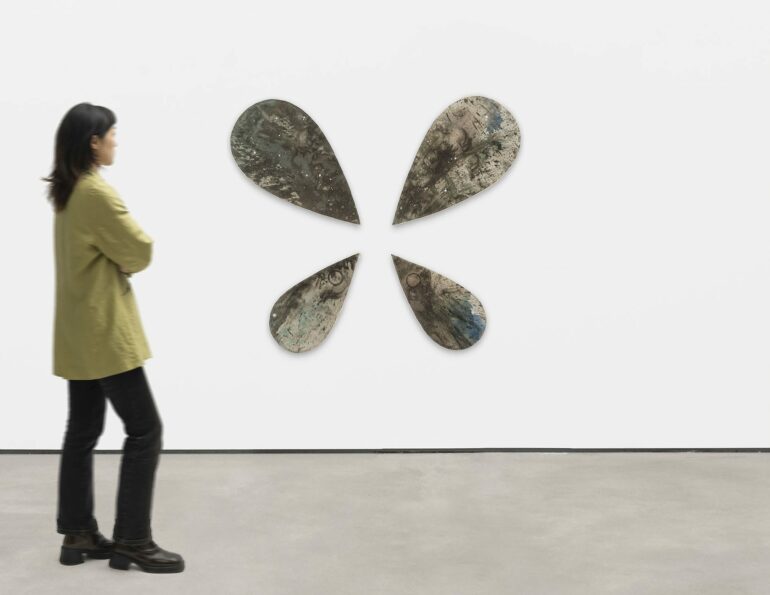
The work of Lucy Dodd, born in New York in 1981, is part of a tradition of lyrical abstraction in which process takes precedence over form. For her exhibition titled *The Good, the True, and the Beautiful*, she presents her darkest body of work to date. The burnt peat from Dava Moor, once collected, undergoes a rigorous artisanal transformation: soaked and then ground, it is converted into a pigment of profound darkness. This raw material is not chosen solely for its color, but for its historical and geological significance. By using the residue of a devastating fire, the artist explores the emergence of light within darkness, transforming destruction into a fertile pictorial foundation.
Dodd’s alchemy does not stop at peat. She rejects the use of tap water treated with chlorine or fluoride, preferring instead water drawn directly from the Findhorn River to bind her compositions. This choice is accompanied by a list of ingredients that reads like a complex botanical and mineral inventory. Her mixtures include plants of the Artemisia genus (mugwort and wormwood), horsetail, as well as onion skins and algae such as blue and green spirulina. For Dodd, the inclusion of these elements—as well as bearded lichen or macerations of flowers such as iris, poppy, daisy, purple foxglove, clover, and forget-me-not—is part of a ritualistic intention. She seeks to infuse her painting with an organic, almost shamanic dimension, although the energetic properties she attributes to these mixtures are part of her personal approach and not based on any proven material reality.
A cosmogony of materials
The palette of this series also incorporates denser components, creating textures that trap light as much as they diffuse it. Copper ink, hematite, iron oxide, terracotta, and cochineal blend with peat to give structure to the canvas. Even more surprising, the artist incorporates pulverized meteorite dust into her binder, introducing an extraterrestrial dimension into her earthly abstractions. This dialogue between heaven and earth—between the residue of a Scottish fire and stardust—defines the structure of these works, on view from September 18 to October 24, 2026, in the Mayfair neighborhood.
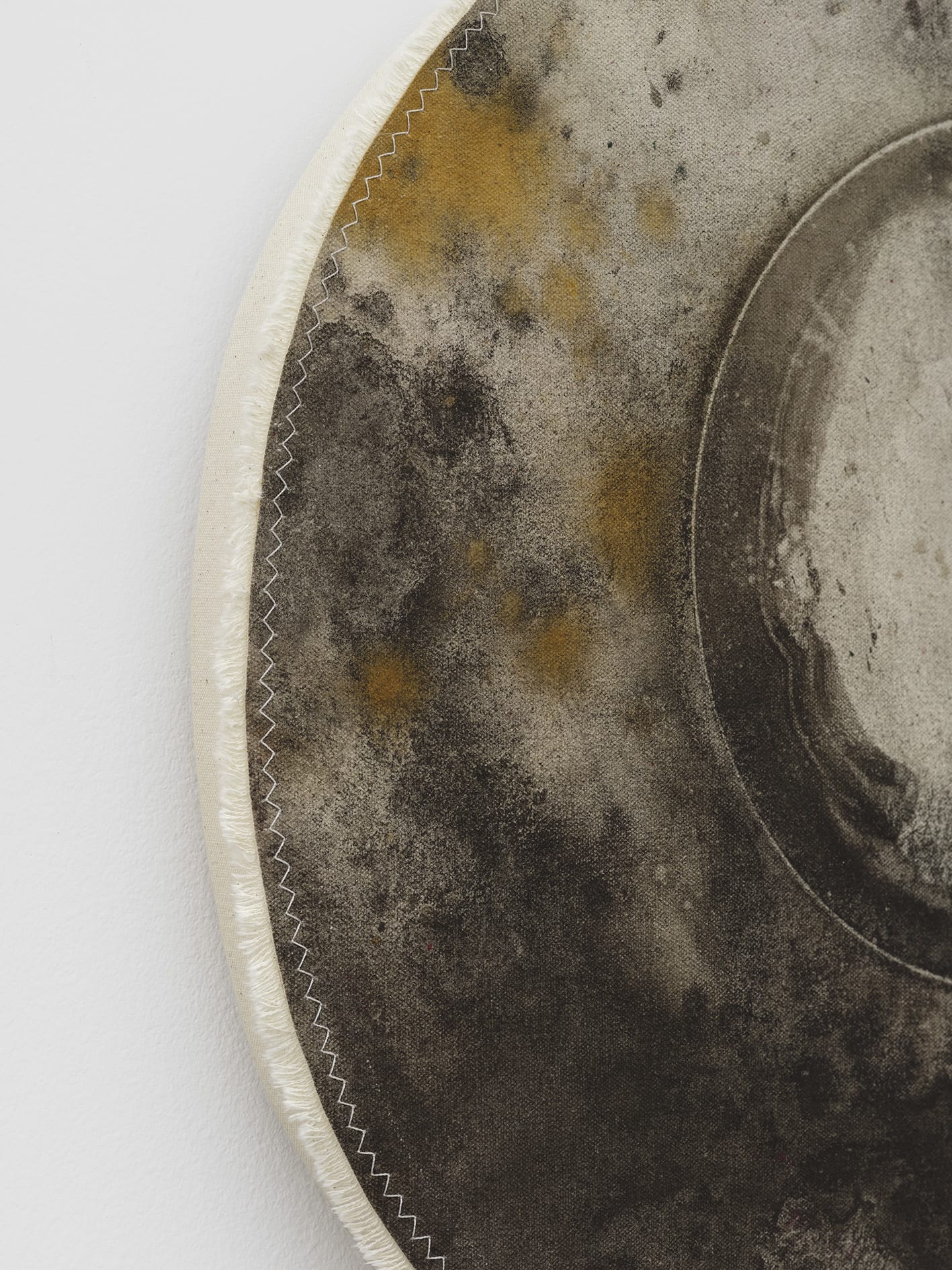
On a technical level, Dodd introduces new formats. While the rectangular canvases—with proportions reminiscent of digital screens—seem to critique the artificial light of our interfaces through their material darkness, the emergence of circular formats marks a turning point. These discs evoke, in turn, the moon, a hunter’s target, an eye, or a breast. The artist also leaves direct traces of his creative process: here the imprint of a child’s foot, there an abandoned paintbrush, frozen in the wet impasto of the canvas, bearing witness to a studio life that does not separate art from domestic existence.

From Mythology to Modern Icon
At the heart of this exhibition lies the figure of Artemis, the lunar goddess of the hunt and protector of women in transition. This archetype resonates with a contemporary figure: Diana Spencer, the Princess of Wales. The name “Diana” serves here as a bridge between the personal—the name of the artist’s grandmother—and the collective. For Lucy Dodd, the Princess of Wales embodies a modern version of the Artemis archetype—a woman hounded for her claim to independence.
This theme is physically manifested in one of the exhibition’s key pieces. A canvas has been cut and stretched to take the shape of a diving board. This geometric silhouette directly references the famous 1997 photograph showing Lady Diana sitting alone at the end of a yacht’s diving board—an image of solitude and melancholy that haunts the collective imagination. By reinterpreting this scene through the lens of his peat and meteorite pigments, Dodd anchors the historical figure within a cyclical and mythological temporality.
Market Value and Outlook
Lucy Dodd’s market performance reflects sustained, albeit selective, interest. At Sprüth Magers Gallery, prices for the works in this exhibition are provided only upon request—a standard practice in the primary market at this level. However, secondary market data offers some points of reference. Her public auction record stands at $37,500 (approximately 34,200 euros), a high reached in October 2026.
Over the twelve months leading up to October 2026, the average auction price was around $2,777, reflecting a disparity between small-format works and major pieces. In April 2026, works on paper were estimated at between 3,000 and 4,000 euros at a Piasa auction, while early works on canvas were valued earlier in the year at between $5,000 and $8,000. These figures, though modest compared to the record prices achieved by some of her contemporaries, underscore a sense of stability for an artist whose approach remains resolutely experimental and far removed from standard commercial norms. The exhibition at 7A Grafton Street in London thus marks an important milestone in the recognition of this work on the materiality of shadow.