
Make Texture a preferred source on Google to support us
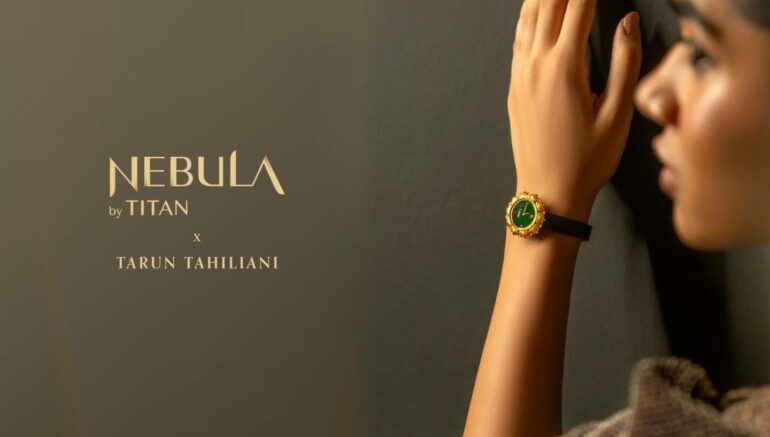
Add Texture to GoogleClothing tolerates the roughness of movement; draping thrives on it. The watch, however, categorically rejects it. Transposing the exuberance and fluidity of Indian couture into the millimeter-precise constraints of watchmaking: this is the technical and aesthetic challenge that Tarun Tahiliani set out to meet. Far from simply affixing his name to a dial, the designer had to relearn the laws of physics and gravity. This transition from fabric to solid gold recently came to life in New Delhi during the presentation of his Bespoke Couture 2026 fashion show. Breaking with the usual distance of the runway, the event offered a decidedly tactile exploration of materials and techniques. Amid this journey designed as a garden brimming with fresh flowers, the audience discovered the result of a unique collaboration with Nebula by Titan.
The Constraints of the Wrist and the Price of Gold
Tarun Tahiliani’s foray into this high-precision sector was not the result of a premeditated ambition in watchmaking, but rather a logical next step. After designing a jewelry line for Tanishq, the fashion designer was approached by Revathi Kant, Chief Design Officer at Titan. The proposal seemed simple on the surface: to design a few timepieces to seal their collaboration. For the designer, accepting the challenge meant grappling with strict ergonomic rules. Unlike a fine jewelry bracelet, which moves, slides, and adapts to the body’s movements, a watch requires perfect stability. Its primary function—telling time—demands a secure fit on the wrist.
Added to this structural constraint was a major economic variable: the dramatic surge in the price of gold throughout the project’s development. The development of these 18-karat gold pieces required constant adjustments between the designer’s vision and the technical expertise of the Titan teams, highlighting the complexity of balancing the desired sculptural volume with the financial feasibility of production—even on a limited scale.
Micro-architecture and Centuries-Old Craftsmanship
Named Phool Chadar, the collection eschews simplistic folklore to focus on applying centuries-old Indian techniques to contemporary forms. A closer look at the four models developed—Kalli, Mandala, Kyaari, and Gulistan—reveals an extreme miniaturization of Tahiliani’s visual vocabulary. The gold is given a distinctive antique finish, contrasting with the mirror-like polishes of classic European watchmaking. The collection features the intricate integration of Polki—those uncut, rough diamonds characteristic of Mughal goldsmithing—as well as jaali latticework motifs and Chandak ornamental details.
Two masterpieces particularly exemplify this ultra-luxury positioning, both produced in a limited edition of just 40 pieces. The Gulistan model, priced at 24 lakh Rs, takes the form of a rose garden crafted in 18-karat gold. Its handcrafted, oscillating bracelet supports a case whose bezel combines fine granulation with Chandak workmanship. The dial, carved from champagne-colored mother-of-pearl, is illuminated by 56 brilliant-cut diamonds. The watch is powered by the T9073 quartz caliber, a slim movement developed in-house by Nebula by Titan. The case back, designed as a display case, also features the jaali motif so dear to the fashion designer.

The Kyaari watch, priced at 19.50 lakh Rs, explores a different geometric aesthetic. It draws inspiration from the sculptural and substantial silhouette of the kada, a traditional Indian rigid bracelet. The metalwork is dominated by the rava technique, combined with Polki diamonds and a dial set with 52 brilliant-cut diamonds. For men, the designer did not seek mechanical complications but rather the purity of the materials. The TT Signature Men’s Leather Edition features the jaali motif on a large 40-mm mother-of-pearl dial, secured by an alligator leather strap lined with Zermatt leather—a material well known among trunk makers and saddlers for its resistance to moisture.
A New Relationship with the Luxury Item
Beyond being a stylistic exercise, this collaboration highlights a profound shift in the Indian luxury market. Historically, the purchase of timepieces of this caliber has been strongly tied to wedding ceremonies, where the jewelry serves primarily as a symbol of social status. Kalpana Rangamani, head of sales and marketing for premium and luxury watches at Titan, sees a shift here. According to her, the watch industry often suffers from the “other’s gaze” syndrome. Customers buy a brand for the status it projects.
With Phool Chadar, the approach is intimate and sensory. These are pieces whose value is appreciated through touch, by running one’s fingers over the engravings and the metalwork. The brand’s positioning therefore does not target exclusively brides-to-be, but rather a female clientele capable of purchasing a watch for her own pleasure, as an expression of financial independence and self-esteem. Nebula’s selection of Tarun Tahiliani is part of this commitment to blending the glamour of haute couture with the legacy of cutting-edge craftsmanship, without limiting itself solely to the bridal market.
Until now, the wrists of India’s wealthiest clients have been largely dominated by major French houses—Cartier and Van Cleef & Arpels leading the way—the undisputed masters of jewelry watches. But the dynamics of domestic consumption are shifting. Local buyers are investing heavily in their own aesthetic heritage—provided it is crafted to international quality standards. Tarun Tahiliani anticipates a proliferation of such partnerships between Indian designers and watchmakers in the coming years, seeing this limited collection as the first sign of a groundswell set to redefine the contours of luxury watchmaking on the subcontinent.