
Make Texture a preferred source on Google to support us
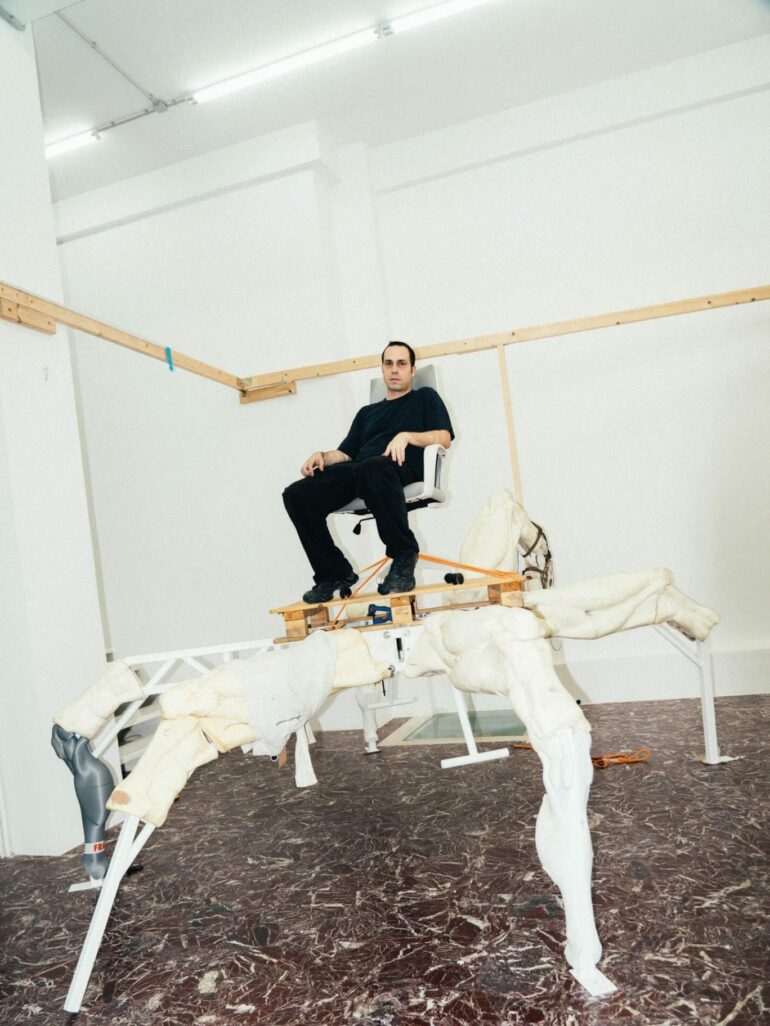
Add Texture to GoogleIn the heart of Regent’s Park, the 2026 edition of the Frieze London art fair ventures into a realm where raw materiality challenges the immaterial promises of the digital world. At location P1 in the Focus section, a monumental structure catches the eye: a giant arachnid creature takes center stage at The Breeder gallery’s booth. Winner of the eleventh Frieze Artist Award, Greek artist Theo Triantafyllidis presents *Feral Metaverse (Spider)*, a work that blends interactive sculpture with a multiplayer video game. Far from being a mere contemplative installation, this six-limbed arachnid—a deliberate departure from natural anatomy—invites visitors to climb it and immerse themselves in a unique collective experience.
A Textile and Technological Sculpture
The work functions as a physical interface between the tangible world of the art fair and a persistent virtual universe. The structure of this “spider” is clad in repurposed materials: deconstructed sneakers and medical-grade stockings cover its limbs, creating an organic and strangely familiar aesthetic. Bathed in orange lighting that casts a twilight-like atmosphere over the space, the sculpture becomes a new kind of urban fixture. The public is invited to sit on it, perch on it, or try to balance themselves on it, transforming the act of looking into a collective physical performance.
This installation was designed specifically for the October 2026 edition of Frieze London. To bring this large-scale project to life, Theo Triantafyllidis collaborated with Forma, a nonprofit arts organization that has supported the prize for the eighth consecutive year. The project also marks a technological turning point with the involvement of Google Arts & Culture, a first-time partner for this eleventh edition, whose artificial intelligence tools served as the foundation for creating the work’s virtual environments and characters.
Artificial Intelligence in the Service of the Wild
The theme of the 2026 call for projects called for an exploration of cutting-edge technologies, and more specifically, artificial intelligence as a creative collaborator. Theo Triantafyllidis embraced this challenge to generate a gallery of fantastical creatures—a “bizarre cast of feral creatures”—that populate the video game integrated into the sculpture. Using Google’s technologies, the artist was able to design landscapes and avatars whose aesthetic defies the polished standards of the traditional video game industry.
In this installation, AI is not used to automate production, but to explore forms of digital vulnerability. Players, physically positioned on the sculpture, guide these avatars through a world where survival depends on one another. Unlike most competitive multiplayer games, Feral Metaverse (Spider) requires mutual aid as the sole mechanism for progression. To overcome obstacles or escape the threat of a giant virtual spider, participants must coordinate their movements to form temporary collective entities: human towers, wheels, or “group hugs.” This shared clumsiness becomes the driving force behind real social interaction, mediated by the screen.

Rethinking Digital Commons
Through this installation, Theo Triantafyllidis poses a political question about the future of virtual spaces. The title itself, *Feral Metaverse*, serves as a critique of dominant commercial metaverse models, often perceived as privatized extensions of public space. Here, the artist offers a reflection on the “digital commons,” seeking to foster dynamics of mutual care and solidarity rather than performance or transaction.
The artist’s background explains this structural approach to space. After earning a degree in architecture from the National Technical University of Athens before pursuing a Master’s in Design Media Arts at UCLA, Triantafyllidis retains from his early training a keen sense of volume and the movement of bodies. Based in Athens, he has developed a practice centered on live simulations and performances that explore the permeability between our physical existences and our virtual identities. Here, the sculpture does not serve as a backdrop; it is the tool that synchronizes the weight of the bodies at the fair booth with the movements of the avatars on screen.
An immersive experience in Regent’s Park
On view from October 14 to 18, 2026, in the Focus section of Frieze London, the work unfolds within a brief yet intense timeframe. It transforms Booth P1 into a social laboratory where visitors cease to be mere observers and become cogs in a collective entity. The absence of any immediate commercial aspect in the presentation of this special commission underscores the prize’s ambition: to provide a platform for radical proposals that use technology to reconnect individuals rather than isolate them behind conventional interfaces.
The installation succeeds in making the intangible tangible, using the rough texture of deconstructed sneakers and the tension of physical balance to embody the complex challenges of artificial intelligence and online collaboration. As they leave the structure after their gaming session, participants take with them an experience of vulnerability, far removed from the promises of perfection often associated with the technologies of tomorrow.