
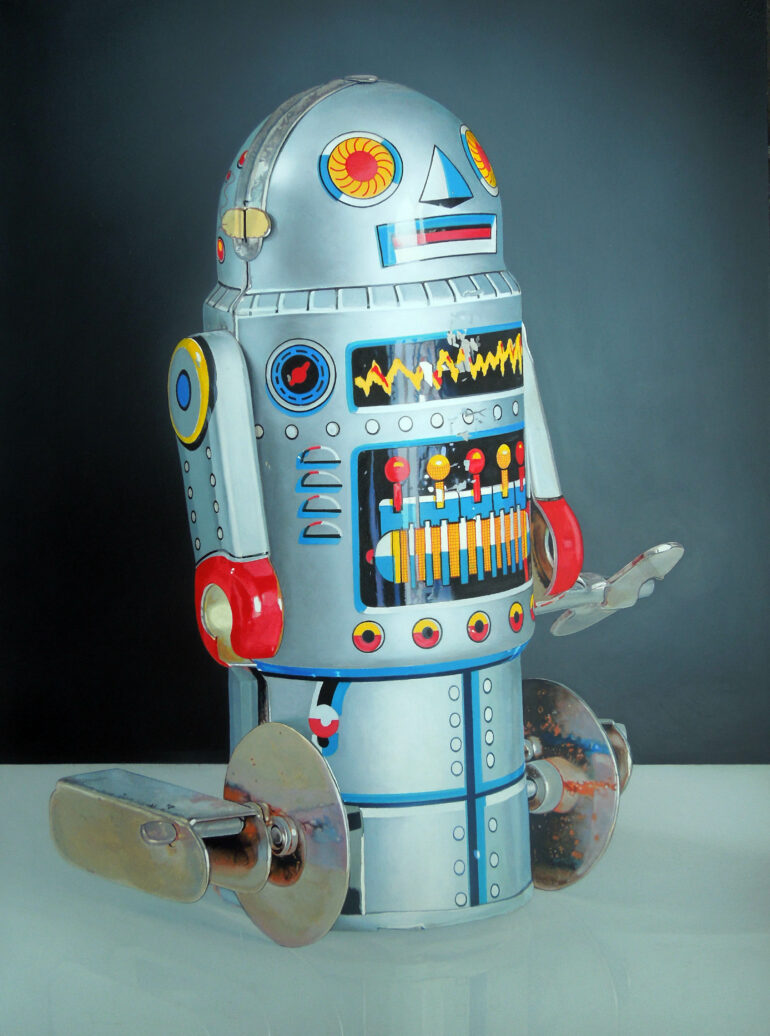
In Christopher Green’s studio, time does not pass according to the standards of digital immediacy. Born in 1965 in Pewsey, Wiltshire, this British painter has long lent his brush to the demands of high-end commercial illustration. From the covers of the Rumpole series for Penguin Books to campaigns for Saatchi & Saatchi, as well as collaborations with the Walt Disney Corporation and Sainsbury’s, Green has mastered the art of the effective, narrative image. Yet his current practice, represented by the Plus One Gallery in London, stands in stark contrast to that frenzy. By turning his back on commissions to devote himself to oil and acrylic, he has chosen to capture the ephemeral: a 580-gram lobster, a few cherry blossoms, or the distorted reflection of a chrome teapot.
The precision of symmetrical composition
Christopher Green’s approach cannot be reduced to a mere technical feat of reproduction. His paintings take objects—often invisible precisely because they are so familiar—and elevate them to subjects of contemplation. Whether they are eggs, strawberries, or glassware, the artist favors centered or strictly symmetrical compositions. This aesthetic choice is no accident; it compels the viewer to pause, to focus their gaze in a way that transforms the mundane object into an almost sculptural presence.
This focus on symmetry serves as a foundation for a complex exploration of textures. Green strives to capture the sheen of chrome, the fragile transparency of glass, or the delicate fuzziness of a flower stem. By isolating these elements against understated backgrounds, he reveals their intrinsic beauty, which is often obscured by their utilitarian function. This quest to “reveal the extraordinary” is expressed with particular acuity in his still lifes of animals and plants, where every detail seems imbued with a new intensity.
A reality transcended by the lens and the brush
Christopher Green’s creative process has its roots in photography, but he quickly moves beyond it. For each work, he takes numerous photographs from various angles and under different lighting conditions. This step allows him to “see around corners” and understand how light behaves on wet or reflective surfaces. Nevertheless, the artist rejects a slavish reproduction of a single photograph. The images are merely reference points, raw data that he reorganizes to construct an idealized reality.
His preferred mediums—oil and acrylic—are applied to rigid surfaces such as wood panels, composite boards, or aluminum. These smooth surfaces allow him to achieve the extreme level of precision necessary to capture fleeting lighting conditions. The final work does not seek to imitate a photograph, but rather to elevate the human perception of the moment, creating an image that is sharper, denser, and more vibrant than what the naked eye or a camera lens could capture on its own.
From Popular Culture to the Royal Society
Christopher Green’s career is marked by prestigious collaborations that attest to the versatility of his talent. Before focusing on his personal research, he designed textile patterns for fashion houses such as Paul Smith and Barbour. His portrait of Rowan Atkinson, designed for a London West End poster, was actually acquired by the actor himself. Even more impressive, the Royal Society in London commissioned a triptych from him, which is now on display at its headquarters on The Mall, alongside a work by Salvador Dalí.
This institutional recognition is complemented by a prominent presence in the collections of major British retailers such as Harrods and Fortnum & Mason. Far from being a niche artist, Green is part of a tradition of British painting that combines classical craftsmanship with contemporary aesthetics, without ever falling into abstraction disconnected from reality.
The Market and Recent Exhibitions
For collectors, access to Green’s works is primarily through the Plus One Gallery. Between 2025 and 2026, the artist’s prices have stabilized in a range of £10,000 to £15,000 (approximately €11,800 to €17,700, based on indicative exchange rates). Recent works such as *580g Lobster* (2026) and *3 Spring Blossoms* (2026), both created on panel in large formats exceeding one meter in width, exemplify this price range.
The artist has been particularly active recently. Following a major solo exhibition titled *Beautifully Simple*, held from January 15 to February 17, 2026, her works were featured in the gallery’s 2026 Summer Show. Works such as 7.5oz of Strawberries #2 and Egg Reflections #2 continue to demonstrate his ability to reinvent the still-life genre by playing on technical titles (weight, quantity) that contrast with the visual poetry of the final result.
It is crucial not to confuse Christopher Green with his namesakes, notably the abstract artist Christopher P. Green based in Cornwall, or the metal sculptor. The Green of the Plus One Gallery remains the artist of millimeter-precise detail, the one who transforms a simple strawberry or a teapot into an object of aesthetic devotion.