
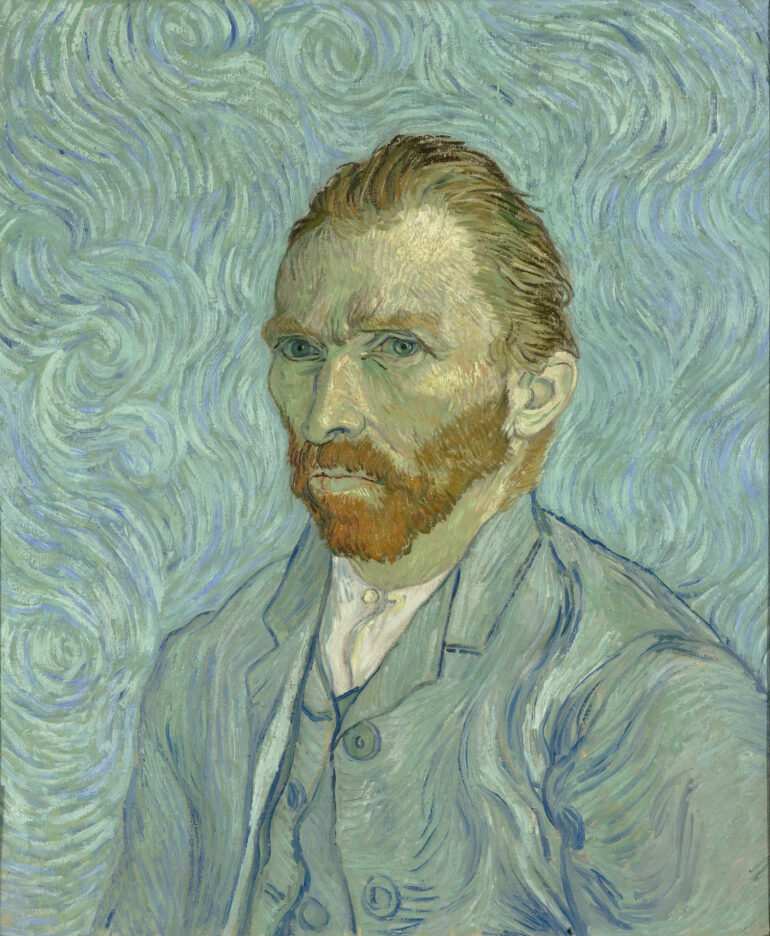
With a bandaged ear, a fixed gaze, and a pipe between his lips. The image is one of the most remarkable in the history of art, capturing the precise moment when Vincent van Gogh, following his nervous breakdown on December 23, 1888, was attempting to regain his footing through painting. This portrait, officially titled Self-Portrait with Bandaged Ear and Pipe, is about to emerge from the privacy of private collections for an exceptional exhibition at the Louis Vuitton Foundation. This loan, granted by the family of Greek shipowner Stavros Niarchos, is part of a major exhibition dedicated to Gustave Fayet, a pioneering collector whose vision shaped the reception of the Dutch painter’s work.
A Return to the Parisian Art Scene
The work is no stranger to art historians, but it is rarely seen in public. Held by Philip Niarchos, Stavros Niarchos’s eldest son, it remains the sole property of the family. This presentation at the Louis Vuitton Foundation is by no means an acquisition or a donation, but a temporary and highly symbolic loan. The painting occupies a central place in Van Gogh’s body of work from Arles: it was painted in January 1889, in the weeks following Van Gogh’s release from the hospital on January 7. It is the testimony of a man who, despite his mutilation, sought in his work a form of convalescence and stability.
In the catalogs raisonnés, this painting is identified as F529 by Jacob Baart de la Faille and JH1658 by Jan Hulsker. It is clearly distinct from another famous version, the *Self-Portrait with Bandaged Ear* (referenced as F527), which is part of the permanent collection of the Courtauld Gallery in London. While both works share the same theme of the bandaged ear, the one in the Niarchos Collection is distinguished by the presence of the pipe, adding a sense of everyday life and apparent calm to the harshness of the bandage that obscures the artist’s face.
The Legacy of a Legendary Collection
The history of this painting is also the story of an art market in the midst of profound change. Stavros Niarchos, a major figure in the global shipping industry in the 20th century, acquired it in the early 1970s. At the time, the transaction amount was estimated at between $2,000,000 and $3,000,000 USD, a range of approximately 1.8 to 2.7 million euros based on historical exchange rates. This purchase already placed the work among the most valuable pieces of its time, before Van Gogh’s prices reached the heights we see today on the public market.
The decision to exhibit this portrait in a retrospective dedicated to Gustave Fayet is no coincidence. Fayet was one of Van Gogh’s earliest advocates, amassing works at a time when the painter’s genius was recognized only by a small circle of connoisseurs. By bringing these works together in Paris, the Louis Vuitton Foundation highlights the connection between pure artistic creation and those who, through their discernment and financial boldness, enabled these masterpieces to survive the century out of the public eye, until this kind of direct encounter with the public.
The presence of the *Self-Portrait with Bandaged Ear and Pipe* in Paris thus represents a moment suspended in time. It allows visitors to confront the physical reality of Van Gogh’s trauma, documented by the painter himself with clinical precision and a vibrant palette—hallmarks of his time in Provence. The exhibition thus offers a rare opportunity to observe up close the brushwork of January 1889—that of an artist standing tall, picking up his brushes once more to confront his own reflection.