
The Face of America: A Visual Architecture
There are figures who, even before uttering a word or singing a note, establish themselves as complete narrative structures. Dolly Parton belonged to that rare category of public figures who understood that image is not merely a reflection, but a tool for massive construction. Over the course of a career spanning several decades, she transformed her appearance into a realm of exploration for the most demanding creators of her time. It was not merely a matter of fame, but a profound reflection on the art of self-presentation—a continuous performance that ultimately captured the keenest eyes in the contemporary art world.
From the country music scene in Nashville to the galleries of Manhattan, the woman who passed away, leaving behind an indelible aesthetic legacy, served as a catalyst for the collective imagination. Her ability to embody both total artifice and a form of raw truth constituted an irresistible paradox. For artists, she was not merely a collaborator or a subject; she was raw material, a reflective surface where the usual distinctions between good and bad taste, between the sacred and the profane, came crashing down.
The Multiplication of the Subject Through the Warhol Prism
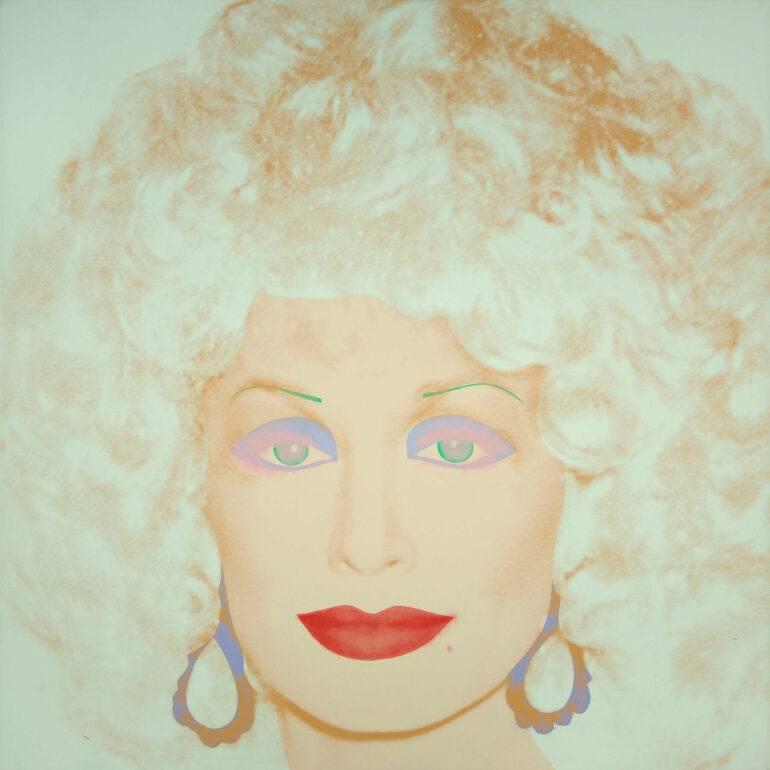
Andy Warhol’s interest in this extraordinary figure was by no means a coincidence. The master of Pop Art, obsessed with technical reproducibility and color saturation, found in her the living embodiment of his own theories. Through the lens of his camera and the silkscreen prints of the Factory, Parton attained the status of a secular saint of cultural consumption. Warhol seized upon what others considered superficiality and turned it into a demonstration of power. Under his direction, her pink lips, the shine of her peroxide-bleached hair, and the omnipresence of her makeup became flat swaths of color that transformed the singer into an object of modern devotion.
In the New York artist’s work, Parton joins the pantheon of faces that no longer need a name to be recognized. This encounter between two worlds—that of the intellectual underground and that of Southern popular culture—helped redefine the boundaries of inspiration. Warhol did not seek to capture the soul of his subject, but to celebrate the perfection of her mask. By isolating the star’s features, he revealed how a completely fabricated identity could attain a form of universal truth. The work created around her image at the Andy Warhol Museum still allows us today to gauge the depth of this mutual fascination.
This collaboration marked a turning point. It proved that Parton possessed a visual intelligence capable of rivaling that of the greatest art theorists. By allowing herself to be transformed into a two-dimensional icon, she achieved artistic immortality. Every accentuated line, every saturated shadow added by Warhol underscored the strength of a woman who had decided to become her own masterpiece. We were no longer looking at a musician, but at a symbol of American culture—as robust and exportable as a logo—while retaining a mysterious humanity that defied mass production.
Annie Leibovitz’s Unveiling of the Myth
While Warhol focused on surface and repetition, Annie Leibovitz approached the subject from a radically different angle, emphasizing monumentality and contextual storytelling. Through the photographer’s lens, Parton ceased to be a mere paper icon and became a sculptural, almost earthy figure. Leibovitz captured the tension between the public figure’s immense stature and the technical precision of the career woman. Her portraits did more than simply document an appearance; they told an epic story—one of constant ascent and absolute mastery over her environment.
Leibovitz’s work often involved placing Parton in settings that highlighted her uniqueness. Whether surrounded by luxury or placed in an unexpectedly minimalist setting, the strength of her character shone through the lens. The photographer explored the texture of this life spent in the spotlight, revealing the determination behind the smile and the structure behind the costume. One could see the discipline of a professional who had weathered the ages without ever losing control of her personal narrative. It was here that inspiration for artists took on a more organic, almost biological form.

Leibovitz’s approach made it possible to document this “long career”—as chronicled by critics—with rare insight. By refusing to succumb to the easy path of caricature, she offered a vision of Parton that respected her complexity. The images from these sessions are not mere promotional photos, but studies of power, femininity, and perseverance. They show how an artist can become the architect of her own legend, using every detail of her body and clothing as elements of a language addressed to posterity.
A Legacy with Many Faces
Dolly Parton’s influence on the art world was not limited to these two giants. Throughout her career, she has served as a guiding light for a multitude of creators seeking to understand the mechanisms of fame and resilience. Her passing leaves a void, but above all, a body of work and attitudes from which future generations will inevitably draw inspiration. She demonstrated that one could be both a mass-market product and an inspiration to the avant-garde—a dichotomy that few individuals have managed to maintain with such grace and longevity.
Contemporary artists saw her as a pioneer of self-creation. At a time when identity has become a central issue in the visual arts, Parton stood out as a trailblazer, claiming to have created her persona from her own childhood dreams. This sincerity within artifice paved the way for many visual artists who today explore notions of gender, social origin, and performance. She was not merely a passive model, but an active force who imposed her own codes on those who sought to understand her.
Her journey is one of successful metamorphosis, a transition from rural reality to artistic abstraction. By remaining faithful to an aesthetic that she herself described as costly to make appear so simple, she challenged the norms of the art world, which is often prone to austere minimalism. Parton established excess, ornamentation, and brilliance as serious aesthetic values. This boldness forced institutions and critics to reevaluate their judgments, gradually integrating her world into a broader reflection on 20th-century visual culture.
The influence she exerted on photographers, painters, and sculptors lay in her ability to never be where one expected her to be, while remaining perfectly recognizable. This is the hallmark of great muses: offering enough material to stimulate the imagination while retaining an inaccessible air of mystery. By exploring her life and work, artists have sought to unravel this mystery, helping to elevate Dolly Parton to the status of a cultural icon whose influence will continue to extend far beyond her time on earth.