
The Quiet Disappearance of a Frank Lloyd Wright Building in Los Angeles
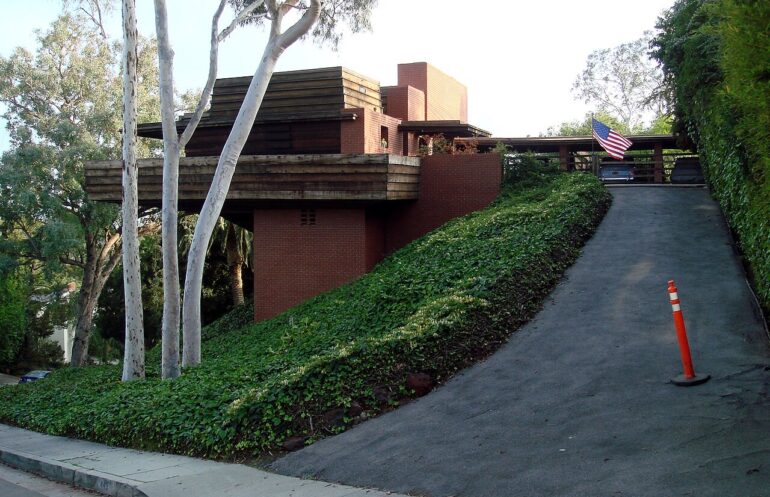
The Los Angeles sky, with its often deceptive brightness, overlooks an architectural reality darker than it appears. In the nooks and crannies of this city that is constantly reinventing itself, a unique structure is sinking into a form of oblivion that dare not speak its name. The Sturges House, the sole remnant of a specific ideal within the Californian metropolis, is now under attack by an insidious urban disease: demolition by neglect. It is not the clatter of excavators that threatens this heritage site, but the oppressive silence of neglected maintenance, transforming a Frank Lloyd Wright masterpiece into a relic on its deathbed.
Watching this building deteriorate is like witnessing a slow-motion shipwreck. The state of disrepair into which it is sinking is not merely a matter of peeling paint or neglected gardens. It is the very integrity of a vision that is crumbling. The concept of “demolition by neglect” precisely describes this process, in which indifference becomes a weapon of mass destruction, allowing time and the elements to accomplish what the authorities would not dare to order openly. In a city that prides itself on its connection to art and design, seeing the city’s only Usonian-style residence fall into disrepair raises pointed questions about the value we truly place on our built heritage.
The Uniqueness of an Ideal in Peril
The significance of the Sturges House lies not solely in the prestigious signature of its designer. It stems from its very nature as a Usonian home, a typology that Frank Lloyd Wright developed to embody a certain vision of American life—one that is both democratic and organic. The fact that Los Angeles has only one such example makes its current state of disrepair all the more tragic. It is a unique piece in the region’s architectural puzzle, a link that, once broken, will leave a void impossible to fill. The fact that this very home is the one falling into ruin strikes a chord with those who see Frank Lloyd Wright as the father of a lived modernity.
The reported state of disrepair is not limited to the aesthetics of a romantic ruin. It signals a profound disconnect between the prestige of a name and the material reality of its preservation. In Los Angeles, a city of image and appearances, the Sturges House serves as a stark reminder that architecture is a living entity that requires constant care. Its current state of neglect casts a shadow over the city’s ability to protect what makes it unique. The passage of time, when left unchecked by human intervention, becomes an agent of historical erasure. We are no longer speaking here of patina, but of programmed disappearance.
The Mechanism of Passive Destruction
The concept of demolition by neglect is an administrative and cultural paradox. It allows a structure to be erased without ever issuing a demolition permit. In the case of this Frank Lloyd Wright residence, the reality is undeniable: the house is dying from neglect. Every day that passes without intervention reinforces the inevitability of a permanent loss. This mode of disappearance is undoubtedly the cruelest for our heritage, as it deprives the public of a debate on preservation, replacing the exchange of ideas with the fait accompli of dilapidation.
Decay is gaining ground, and with it, the entire Usonian philosophy is being overshadowed. These houses, designed to be in harmony with their surroundings, lose their meaning once the structure can no longer fulfill its role as a refuge. The contrast is striking between the project’s original ambition and the current state of a building that seems abandoned to its fate. This is not merely a private property falling into disrepair; it is a fragment of Los Angeles’ cultural history evaporating before our eyes, a victim of a lack of commitment to preservation.
An Emergency Behind the Facades
The fate of the Sturges House has become a symbol of how certain 20th-century icons are treated. Faced with the risk of demolition by neglect, the urgency is no longer merely aesthetic—it is structural. The name Frank Lloyd Wright draws crowds to museums, but it does not seem enough to stabilize the foundations of a house ravaged by time. The current situation forces us to look beyond the myth and confront the physical reality of a building that can no longer wait for a burst of dignity.
The descent into dereliction of this unique residence underscores the hypocrisy of a system that celebrates the geniuses of the past while allowing their most fragile works to wither away. In Los Angeles, where real estate often dictates the terms, neglect can be interpreted as a strategy or as weariness. Whatever the case, the result remains the same: irreplaceable architecture is slowly sliding toward a point of no return. The Sturges House waits, within its crumbling walls, for a decision on whether its existence is still worth the sacrifice of attention.
The issue now extends beyond the realm of expert circles or design enthusiasts. It is a signal about the state of our urban civilization. If even the faintest trace of an architectural ideal like Wright’s Usonian model fails to inspire the effort needed for its survival in a city like Los Angeles, it is because our relationship to permanence has radically changed. Decay is thus no longer an accident, but the logical consequence of a culture of transience that ultimately devours its own monuments.