
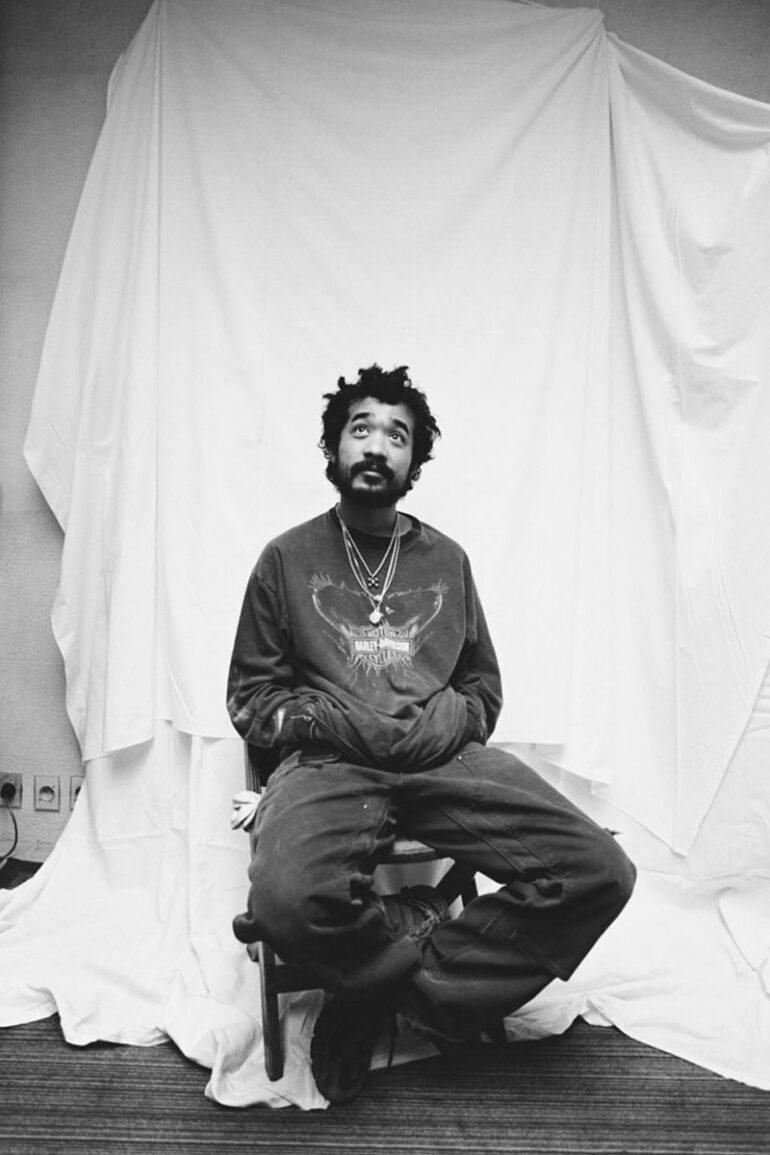
The news spread with the brutal discretion of an internal earthquake, coursing through the arteries of Manhattan before bringing the global artistic microcosm to a standstill: Lucien Smith is no more. At thirty-seven—an age that, in the chronology of artistic creation, often marks the transition from impetuous experimentation to serene maturity—the artist passed away, leaving behind the trail of a meteoric career. This is not merely the disappearance of a name from a gallery poster, but the loss of a point of reference, of one of those figures who, by their very presence and intuition, managed to embody the spirit of a neighborhood, an era, and a certain idea of artistic freedom. New York—and more specifically its beating heart, “Downtown,” where reputations are made and unmade in the shadows of lofts and the harsh light of opening receptions—has lost one of its most distinctive faces.
The Liberation of Gesture and Tool
Lucien Smith’s work will undoubtedly be remembered for his rare ability to challenge the dogmas of the discipline of painting. Very early on, his approach stood out for a clear determination not to be confined within the narrow limits of the traditional framework. For him, painting was not a matter of submission to the tool, but an exploration of the medium. The source aptly notes that his practice pushed painting far beyond the capabilities of the brush. This statement immediately evokes a break with academic tradition—a quest in which inventiveness takes precedence over learned technique. In his hands, paint was no longer a fluid carefully applied to a surface, but a territory for experimentation where other means, other instruments, and other energies came to collide with the canvas.
This inventiveness, cited as the cornerstone of his work, suggests an insatiable curiosity. By breaking free from the brush, the artist opened a breach through which new languages poured in. This is where the strength of his legacy lies: in having proven that painting, far from being a moribund art form or one frozen in its past, still possesses infinite elasticity. “Stretching painting,” this expansion of the practice, is not merely a technical device but a philosophical stance. The aim was to restore to the creative gesture a spontaneity that the traditional tool can sometimes stifle. Each work thus became a testament to a struggle or a dance with the canvas, where the unexpected and invention replaced the premeditation of the brushstroke.
An Indisputable Figure of Downtown New York
Beyond his paintings, it was the man himself who occupied a prominent place in the cultural ecosystem. Being described as a central figure in the art world of lower Manhattan is not an honorary title acquired through commercial success alone; it is a sign of deep integration into the social and intellectual fabric of a demanding community. Lucien Smith emerged from this New York scene with a vigor that immediately attracted attention, not only through his artistic output but also through his ability to capture the spirit of the times. Downtown New York is not just a geographical area; it is a state of mind, a blend of urban grit, casual glamour, and aesthetic radicalism. He was one of its pillars, one of those beacons whose absence today leaves a palpable void.
The emergence of his talent in this specific context also tells the story of a city that, despite transformations and gentrification, continues to produce talents capable of shaking up established hierarchies. As he stepped out of this scene to make his mark on the international stage, the artist never denied his roots. He carried within him that energy unique to New York—that urgency to create that defies convention. His presence in the streets, studios, and social hubs of this iconic neighborhood made him both a witness to and a major player in the creative vitality of his generation. His death at the age of thirty-seven froze this image of an artist on the rise, forever linked to the effervescence of his early years.

The brevity of a destiny and the permanence of invention
Thirty-seven years old. The number resonates with a particular sadness. It is the age of fulfilled promises that hint at even greater heights. By dying so young, Lucien Smith unwittingly joins the ranks of those artists whose work will always be viewed through the lens of a premature end. Yet what we will remember is not the final chapter, but the momentum that characterized his active years. The inventiveness he breathed into painting does not die with him. It remains as an invitation to future generations never to view a tool—even one as ancient as the paintbrush—as an insurmountable limit.
The art world, often quick to move on to the next novelty, pauses here. The loss of a painter who knew how to stretch the boundaries of his medium compels us to reflect on what it means to “be a painter” today. It is not so much the mastery of a craft that defines the artist, but rather his ability to invent new relationships with the world and with materials. Lucien Smith understood this and applied it with a boldness that commanded the respect of his peers and observers alike. As he leaves the Downtown art scene, he leaves behind a field of possibilities still largely unexplored, an indelible mark on the canvas of a century still searching for its masters.
His career, though brief, was enough to leave a lasting impression through its relevance. He will be remembered as the artist who was unafraid to confront the void, preferring constant invention to comforting repetition. As the curtain falls on this life cut short too soon, the work of this regular on the Lower East Side continues to resonate, reminding us that true painting always lies just beyond what we think we know.