
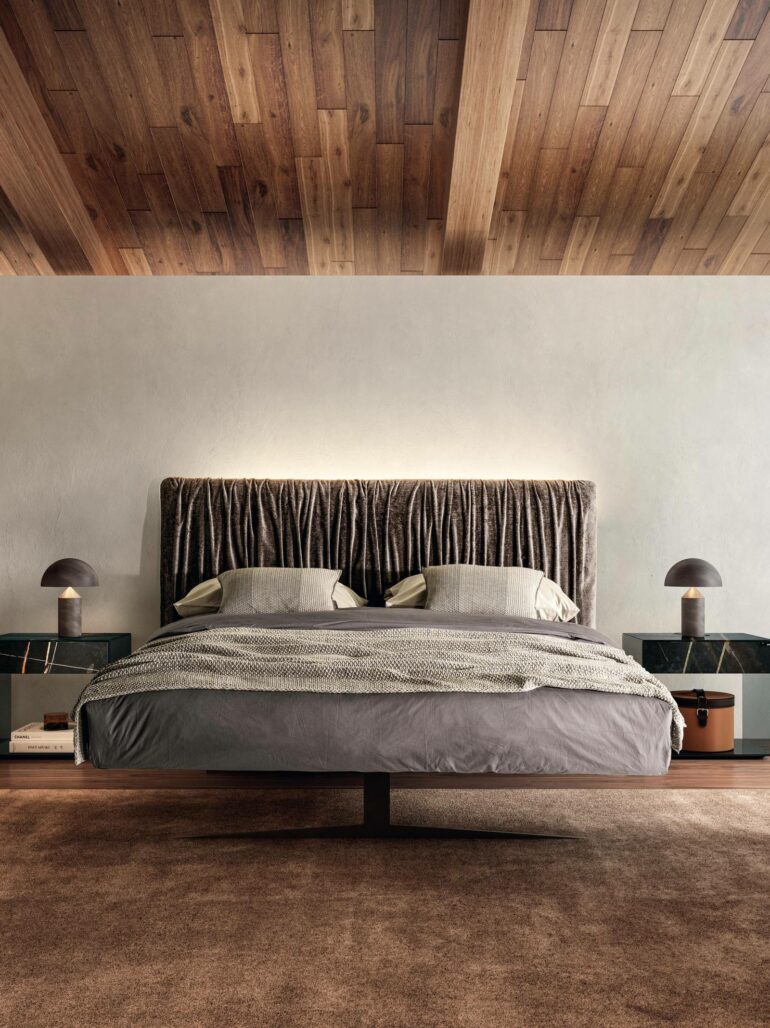
The retina is overwhelmed. Between the austerity of Scandinavian minimalism—which eventually faded into a uniform beige—and the visual assault of chaotic maximalism, a new aesthetic tension is emerging. It takes no side. On one hand, a chrome-hued nostalgia for a future that never came to be; on the other, a sensual retreat toward an almost womb-like sense of protection. The clash is brutal yet fascinating: Space Age aesthetics and the romantic silhouette of the canopy simultaneously enter the contemporary discourse, transforming our interiors and wardrobes into laboratories of contrasts.
The Revenge of Orbit and Polymer
The return of lines inspired by the space race is not merely a catalog reissue. It is the reactivation of an imagination in which the curve was political. We’re seeing the reappearance of structures that seem to have been cast from a single block—objects that reject right angles as if they had to withstand atmospheric pressure. Brushed steel, aluminum, and translucent plastics are no longer perceived as cold or industrial materials, but as vehicles for a rediscovered fluidity.
This Space Age influence manifests itself in an obsession with the sphere and the ellipse. In furniture, this translates into seats that envelop the body without ever constraining it, evoking the utopian cockpits of the 1960s. Light, too, is changing in nature. It becomes indirect and diffuse, emanating from invisible sources or opaque globes that seem to float weightlessly. This is not a decoration that is simply placed; it is an environment that is created—an attempt to transform the home into an orbital station of comfort and discreet technology.
The Architecture of the Refuge: The Reinvented Canopy
In stark contrast to this reach for the stars, we see a fascination with the silhouette of the canopy. But forget the dusty, heavy structures of provincial castles. The “canopy silhouette” emerging today is all about structure and transparency. It responds to a visceral need to define intimacy in spaces that are increasingly open and exposed. The modern canopy uses minimalist frames—often made of black metal or light wood—to support sheer curtains that act as filters rather than barriers.
This trend marks the return of a form of romanticism that makes no apologies. It treats the bed—or even the workspace—as a sanctuary. By visually isolating an area, one creates a room within a room. This architectural silhouette brings a verticality that has been sorely lacking in contemporary interiors, which are often too horizontal. It’s an invitation to slow down, to read, to voluntarily withdraw from the digital clamor. The drapery becomes a punctuation mark, a moment of softness that breaks up the rigidity of modern materials.
The Fruitful Clash of Opposites
What makes this cultural moment unique is the coexistence of these two worlds. One might think that a fiberglass armchair inspired by Apollo capsules would clash with the lightness of a canopy structure. The opposite is true. The contrast between the gleaming hardness of the Space Age and the ethereal softness of Romanticism creates a dynamic balance. It’s a response to the complexity of our times: we want the most advanced technology while dreaming of hiding behind linen curtains.
In fashion, this duality is expressed through hybrid volumes. We see technical, almost robotic materials cut into silhouettes reminiscent of hoop skirts or medieval protective armor. It’s a silhouette of “elegant survival.” Clothing becomes armor that doesn’t forget to be poetic. The use of shape-memory fabrics allows for the creation of volumes that evoke both the sail of an ancient ship and the hull of a satellite.

A Psychology of Domestic Space
Why are these two styles “clashing” now? Undoubtedly because they offer two different solutions to the same anxiety. The Space Age offers an escape upward, through progress and bold design. The canopy offers protection through grounding and a reimagined tradition. One looks toward the distant horizon; the other focuses on the immediate, on the square meter that surrounds us. It is a reconciliation between our digital, globalized self and our physical body, which needs textures and clear boundaries.
Materials play a pivotal role in this transition. We’re seeing more and more daring combinations: a high-gloss resin table set on a long-pile looped wool rug, or chrome light fixtures suspended within a canopy bed frame. The sense of touch is reclaiming its place. We’re moving from the cold, smooth surface of a screen to the roughness of a natural fabric or the softness of polished plastic. This sensory contrast is what defines the new luxury: the ability to shift from one state of consciousness to another simply through the decor.
The End of Monolithic Styles
We are moving beyond the era of “total looks.” No one wants to live in a 1968 museum or a romantic-era reenactment. The relevance of these trends lies in their ability to be fragmented. A typical Space Age convex mirror can be enough to breathe new life into a bedroom with classic accents. Similarly, a simple raised bed frame can give structure to an industrial loft with raw concrete walls. What matters is no longer adherence to a particular design school, but the creation of a dialogue between objects.
This hybridization heralds a more personal aesthetic, one less subject to the dictates of algorithms. By drawing from these two contrasting repertoires, we create spaces that tell a richer story. It’s a way of acknowledging our need for futurism as much as our nostalgia for security. Design is no longer content to merely fulfill functions; it becomes an emotional interface between us and the outside world, a buffer zone where the rigidity of steel and the suppleness of fabric ultimately harmonize perfectly.