
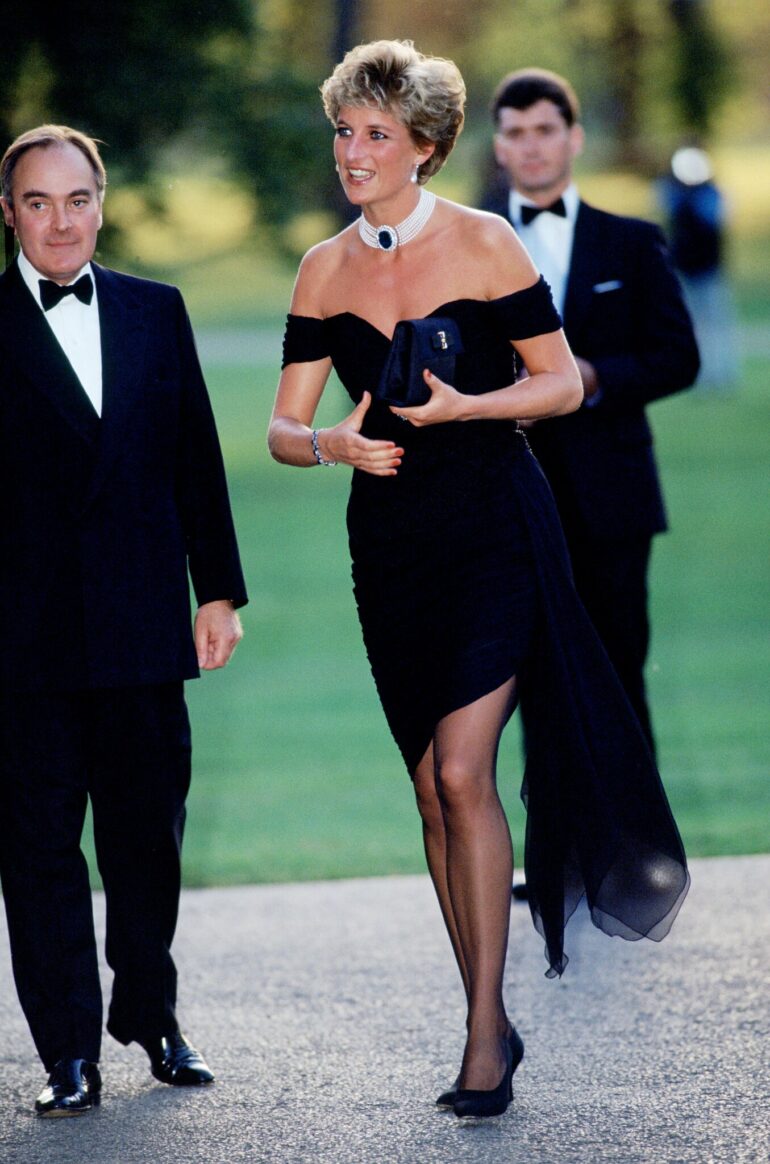
The silence that precedes major upheavals often has a distinct quality. That evening, as the airwaves prepared to broadcast the confession of a royal affair across the country, a response of an entirely different nature was taking shape in the shadows of a royal dressing room. History records the words, but it never forgets the images. While Prince Charles spoke his truth, publicly admitting to having had an affair, the woman he had married chose not to utter a single word. She preferred to let a design by Christina Stambolian speak for her. It was no longer merely a matter of protocol or propriety, but an act of pure presence—a way of reclaiming a narrative that, until then, had seemed to slip from her grasp.
The Confession and the Shockwave
An admission of adultery, when made by the future monarch, transcends the realm of privacy to become a societal event. This public confession acted like an explosion, shattering the veneer of an institution once believed to be immutable. Yet the impact of this verbal earthquake found an unexpected counterpoint in a meticulously timed visual appearance. By choosing to appear precisely at the moment her husband acknowledged his wrongdoing, the princess shifted the focus of attention. The message was no longer solely in the words, but in the demeanor. The contrast was striking: on one hand, words confessing a failure; on the other, a figure exuding renewed confidence.
This simultaneity was no coincidence. It marked the end of an era of enforced discretion. Prince Charles’s admission, far from isolating his wife in the role of a victim, served as a catalyst for a radical transformation. By breaking free from the customary codes of royal reserve, she turned an evening that should have been one of humiliation into a moment of personal triumph. Words are silver, but that evening, her poise was gold.
The Christina Stambolian Choice
The name Christina Stambolian remains inextricably linked to that specific night. By choosing this dress, the princess was not merely selecting an outfit, but embracing a new stylistic language. The garment, through its cut and boldness, broke with the standards expected of a representative of the Crown. It was a creation that demanded to be seen, one that commanded the gaze of others rather than seeking it out. The decision to wear this particular outfit—which had remained in her personal archives for several years—underscores a desire to break with the past.
Christina Stambolian’s aesthetic provided the necessary foundation for this sartorial rebellion. Far from the heavy fabrics and sometimes overly staid cuts dictated by her rank, this dress offered a freer, more vibrant structure. It moved with her, underscored her determination, and, above all, portrayed a woman in full control of her own image. Here, the garment became a suit of silk armor—both a shield and a declaration of war against indifference. In the language of fashion, every seam and every pleat was a direct response to the prince’s public admission.

A Transformation Through Image
Beyond the sartorial anecdote, this episode illustrates an absolute mastery of nonverbal communication. In an era when social media did not exist, the princess managed to create a global media impact with a single appearance. The message was clear: she was no longer bound by the obligations of silence imposed by a failing marriage. Paradoxically, Prince Charles’s confession had restored her freedom of movement. That evening marked the transition from a traditional royal figure to an autonomous icon, capable of dictating her own rules in the public sphere.
The power of this strategy lay in its immediacy. While analyses of the prince’s interview were in full swing, the image of the Stambolian dress was already saturating the collective imagination. It short-circuited the moral debate to impose an undeniable aesthetic reality. People were no longer looking at a scorned wife, but at a woman who, by the grace of a black fabric, erased the shadow of infidelity. The symbolic power of this outfit was such that it managed to make the prince’s confession seem almost secondary—mere background noise against the radiance of a presence regained.
The Legacy of a Singular Night
What this clash between words and appearance teaches us is that fashion can be the most effective political tool. On the night Prince Charles chose verbal transparency, his wife chose visual transcendence. It was not merely an evening gown, but a manifesto of resilience. The story of this dress continues to fascinate because it embodies the exact moment when power shifted from the one who speaks to the one who is looked at.
Today, the association between Christina Stambolian’s design and the admission of the royal affair remains one of the most memorable chapters in contemporary culture. It reminds us that, in the face of complex emotions and the intensity of public revelations, elegance remains a form of resistance. That evening, amid the silence of the gardens and the commotion in the newsrooms, a dress proved it could carry more weight than any televised confession. It remains the silent yet eloquent witness to a breakup consummated before the entire world.