
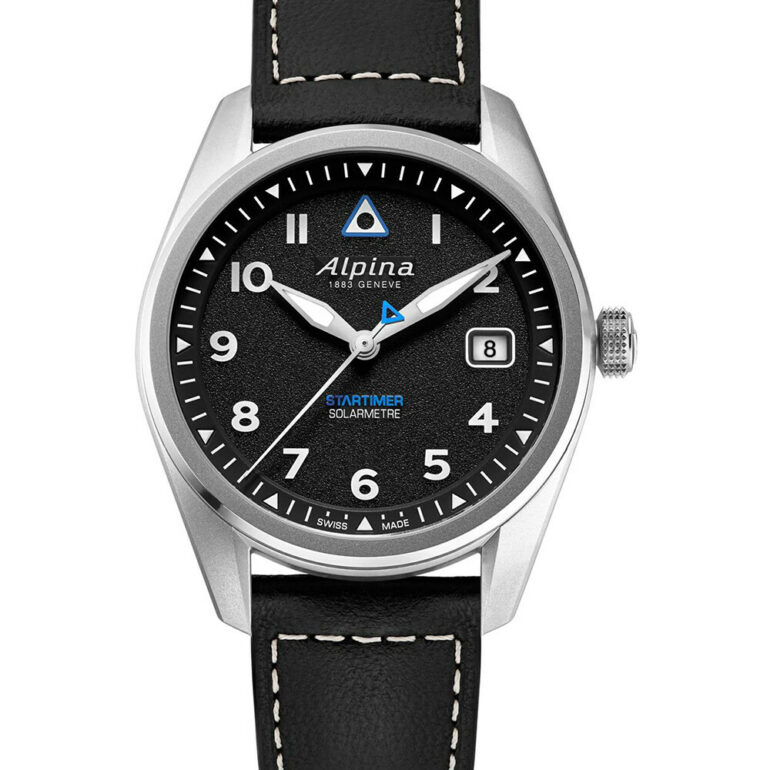
Sometimes it takes just a few words to shift the focus of a collection. Alpina announces the arrival of the AL-140 solar-powered quartz movement in the Startimer Pilot with Solarmetre series. The announcement is brief, but it signals a clear evolution: the collection, inspired by aeronautical design, now features a light-powered electronic movement, with a name that directly references this energy source.
A movement that redefines the collection
The name AL-140 is the technical highlight of this announcement. Alpina is not introducing a new standalone line here, nor is it making a declared shift in aesthetic direction: the brand is introducing a movement into an already established collection, the Startimer Pilot Solarmetre. This is a less spectacular move than a launch from scratch, but often more revealing. A collection is also built through these internal shifts, when its design language remains recognizable while its functionality evolves.
The choice of solar quartz combines two terms whose union has immediate significance. “Quartz” refers to electronic timekeeping; the adjective “solar” specifies the power source used. Alpina thus positions the AL-140 movement within a concept of energy continuity linked to light. The term “Solarmetre,” already present in the series name, finds an explicit technical translation with this introduction.
This alignment between the collection’s name and the movement avoids the disconnect that sometimes arises between a case and what it houses. Here, the information conveyed places the caliber front and center. It is not simply a matter of adding a reference to the Startimer Pilot family: it is the AL-140 movement that constitutes the new development and gives precise meaning to the announced evolution.
Solar: A Choice of Language as Much as Technology
In watchmaking, the words used to describe a technology matter just as much as the technology itself. “Solar quartz” does not merely describe a category of movement; the term carries a promise of a direct connection to the immediate environment. Light becomes the central element of the narrative. In the available press release, Alpina does not detail the specifications of the AL-140—its dimensions, power reserve, or functions. But its principle is stated plainly: it is a quartz movement powered by solar energy.
This restraint in providing information serves a purpose. It allows the movement to take center stage without being buried under a technical spec sheet. AL-140: the caliber’s name. Solar quartz: its operating mechanism. Startimer Pilot Solarmetre: the collection that houses it. These three elements are enough to convey the shift Alpina has made.
The suffix “meter” in Solarmetre deserves closer attention. It links the idea of measurement with that of the sun, without the announcement providing any further explanation. This is precisely what makes the name effective: it establishes a connection between the watch’s function, the movement, and its power source. The collection’s language isn’t merely superimposed on the product; it accompanies a concrete decision regarding the caliber.
Startimer Pilot, an Established Framework
Alpina has chosen the Startimer Pilot as the home for the AL-140. The word “Pilot” immediately directs the reader’s attention toward a world of navigation and instruments, while “Startimer” situates the series within a more direct, functional sense of time. The announcement provides no details about the case, no description of the dial, and no indication of dimensions. It does not seek to turn the object into a mere sum of visual cues. Its focus lies elsewhere: in the union of the Startimer Pilot series and the solar-powered movement.
This restraint also helps avoid the false impression of novelty. The message does not claim to reinvent the collection as a whole. Rather, it states that the Startimer Pilot Solarmetre series is now equipped with the AL-140 movement. The nuance is important. It situates the evolution within an existing design language and reminds us that a watch is not limited to what is visible on the wrist. Its movement also determines how it fits into everyday life.
The decision to incorporate this movement into a series named Solarmetre therefore seems consistent in its very formulation. The collection evokes the sun; the movement is solar-powered. This continuity—almost literal—gives the project a rare clarity. Nothing unnecessarily complicates the concept. Alpina links a caliber, a power source, and a collection name.
A Deliberately Concise Announcement
The concise format of this presentation calls for careful reading rather than speculation. No figures are provided. No dates are specified. No details regarding the variations of the Startimer Pilot Solarmetre accompany the introduction of the AL-140. It would therefore be risky to attribute performance characteristics, materials, or uses to the movement that have not been announced.
What is certain can be summed up in a few words, but those few words are fundamental: Alpina is introducing a solar-powered quartz movement, designated AL-140, in the Startimer Pilot with Solarmetre series. For a watchmaker, the movement is rarely just a catalog detail. It reflects a way of thinking about the object, its energy, and the coherence of the collection in which it is featured.
It now remains to be seen how Alpina will incorporate this new addition into the Startimer Pilot Solarmetre line. For now, the message is clear: light becomes the power source associated with the Solarmetre name, and the AL-140 is its technical embodiment.